
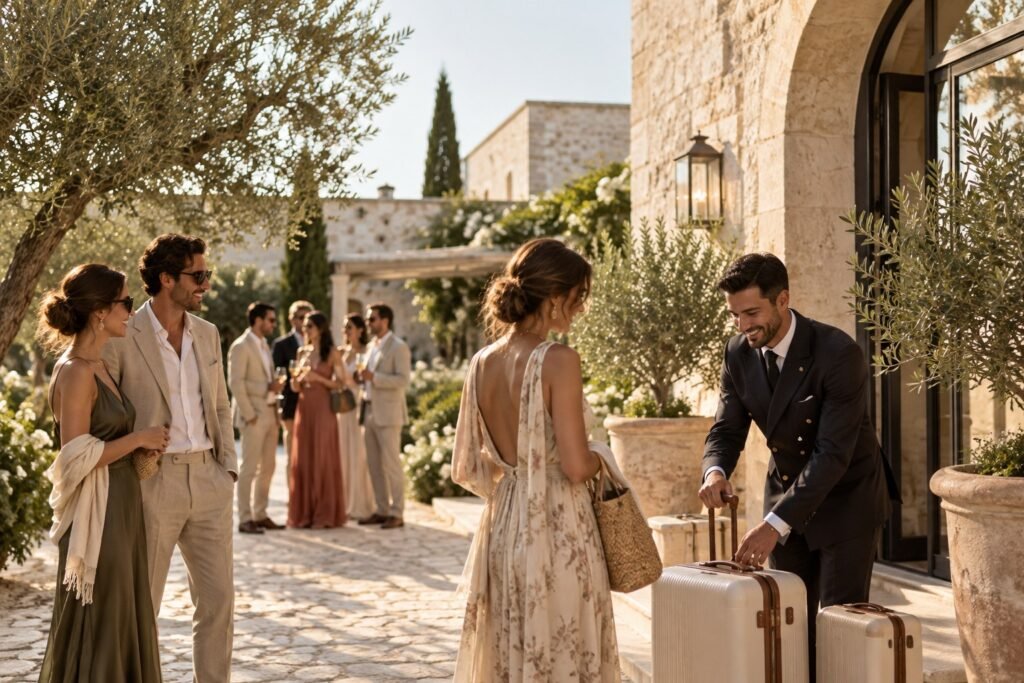
A destination wedding has a way of revealing hospitality in extraordinary detail.
For a few days, a hotel is no longer simply the place where guests sleep. It becomes part of the celebration. It is where people arrive after a long flight, meet relatives they have not seen for years, ask where dinner is, book a massage, look for a late transfer, change plans because of the weather, order lunch before getting dressed for the ceremony and gather again the morning after the wedding.
After years of planning destination weddings in Puglia, we have learned that guests rarely separate these moments into neat categories. To them, it is all one experience.
And very often, the smallest parts of that experience are what people remember.

The wedding day is only one part of the stay
When couples first begin planning a wedding abroad, attention naturally goes to the ceremony, dinner, flowers, music and venue. Guests experience something wider.
Their journey may begin at Bari or Brindisi airport. Then comes the transfer, hotel arrival, check-in, the first drink, perhaps a welcome dinner, a free morning, the wedding itself and often a brunch or another gathering before everyone leaves.
We have written separately about managing travel and accommodation for destination wedding guests, because those practical decisions matter enormously. But once everyone arrives, a different layer of hospitality begins.
A guest may want to know whether there is time for a spa treatment before the welcome dinner. Someone else needs a restaurant for six people that evening. Another couple wants to arrange a driver to Alberobello. A family asks about babysitting. Someone has forgotten the departure time for tomorrow’s shuttle.
None of these requests is particularly dramatic.
But put a hundred guests into the same destination for three days and those small questions quickly become part of the rhythm of the entire wedding weekend.
Guests do not think in hotel departments
This is something we notice constantly.
A guest does not usually think: “This question belongs to concierge rather than reception,” or “I should speak to food and beverage rather than the wedding planner.”
They simply know what they want.
They might ask the first person they see. They may send a WhatsApp message, call reception, speak to the planner, ask the driver or mention something casually while having breakfast.
From the guest’s point of view, that is completely reasonable. From behind the scenes, however, one apparently simple request can pass through several people before somebody actually owns it.
This is where good hospitality becomes less about adding more services and more about creating clarity.
The guest should not need to understand the organisational chart of the hotel in order to enjoy the hotel.
A beautiful hotel can still create friction
When we evaluate wedding venues in Puglia, beauty is only the beginning.
A spectacular property can photograph perfectly and still make a wedding weekend unnecessarily difficult if guests are constantly trying to understand where to go, whom to ask or how to arrange something simple.
Conversely, a hotel that anticipates those moments can make the entire celebration feel effortless.
This is why we pay attention to practical details that rarely appear in photographs: how guests move through the property, how quickly information can be found, how the reception team communicates with other departments, what happens when plans change and whether somebody can take responsibility for a request without sending the guest on a small administrative journey.
Luxury, in this context, is not about having more.
It is often about removing friction.

The best service often feels almost invisible
Some of the strongest hotel teams we work with are exceptionally good at making complexity disappear.
Guests do not see the messages exchanged before a transfer changes. They do not see the conversation about a dietary requirement or the person who checks that a table is still available after the schedule moves by thirty minutes.
They simply receive an answer.
That is one of the reasons human hospitality remains so important. There are situations that require judgement, sensitivity and knowledge of the people involved. A nervous parent, a VIP guest, a last-minute change to an important dinner or an unexpected family request should not feel as though it is being processed by a machine.
At the same time, a hotel team should not have to spend its entire day answering the same practical questions or reconstructing requests scattered across different conversations.
The interesting question is not how to remove people from hospitality.
It is how to give good people more space to do the parts of hospitality that actually require them.
What destination weddings reveal about guest intent
Wedding weekends make another pattern very visible: guests frequently express a desire before they know exactly what they want to buy.
“We would love to do something tomorrow morning.”
“Is there somewhere special for dinner tonight?”
“Can we see the coast before we leave?”
“Could we book something relaxing after the wedding?”
These are not yet bookings. They are intentions.
Handled well, they might become a spa treatment, a restaurant reservation, a private transfer, a boat trip, a local experience or another hotel service. Handled poorly, the guest opens Google, asks somebody else or simply gives up.
This is a fascinating part of hospitality because the demand already exists. The guest is effectively saying, “I would like to spend part of my time — and probably part of my budget — doing something.”
The opportunity is not necessarily to sell harder. It is to understand better.
Where our work with LAETIORA connects
This observation goes well beyond weddings, and it is also where our hospitality experience connects naturally with LAETIORA.
LAETIORA approaches the problem from the hotel side: how to recognise guest intent, turn a conversation into a structured request and keep the hotel team in control of what is ultimately confirmed.
What interests us about that idea is not technology for its own sake.
It is the very familiar situation behind it.
A guest has asked for something. The hotel would like to help. Somewhere between the question and the answer, information can become fragmented, responsibility can become unclear and a perfectly real opportunity can disappear.
Destination weddings simply make that problem easier to see because so many guests are moving through the same property at the same time, each with slightly different plans.
What we look for in a hotel partner
For a destination wedding, we naturally care about rooms, event spaces, food, location and aesthetics. But the way a hotel handles its guests matters just as much.
- Clear ownership. When a guest asks for something, somebody knows what should happen next.
- Good communication between teams. Reception, concierge, food and beverage, spa, transport and the wedding team should not operate as completely separate worlds.
- Local knowledge. Guests have travelled because they want to experience the destination, not simply the inside of the hotel.
- Human judgement. Special situations should be recognised as special situations.
- Useful information at the right moment. Guests should not need to search through long PDFs or old message threads for a simple answer.
- The ability to adapt. Weddings move. Weather changes. Dinner runs late. Flights are delayed. Good hospitality absorbs those changes without transferring the stress to the guest.
These details rarely make the first venue mood board, but they have an enormous influence on how a wedding weekend feels once everybody is actually there.
The memories are made between the big moments
Of course guests will remember the ceremony.
They will remember the music, dinner, flowers, speeches and the moment everybody finally reached the dance floor.
But they may also remember the receptionist who found them a car at the last minute. The recommendation for a small restaurant they would never have discovered alone. The massage they managed to book on a free morning. The breakfast table where everyone slowly reconstructed the night before.
This is one of the things we love about destination weddings.
The celebration is not contained within a timetable. It spills into the hotel, the town, the restaurants, the journeys between places and the conversations guests have when nothing official is happening.
The best hospitality understands that.
It gives people enough structure to feel looked after and enough freedom to feel that they have discovered the destination for themselves.
And when it works, guests rarely talk about the systems behind it.
They simply say that everything felt easy.
Planning a destination wedding in Puglia?
The hotel, guest logistics and wider wedding weekend should be considered as one experience, not as separate pieces. Tell Princess Apulia what you are planning and we can help you understand which settings are best suited to the way you want your guests to experience Puglia.