
The morning after a welcome party in Puglia is when polite intentions usually meet reality. One partner is still answering voice notes, the planner has a list of gifts that arrived before the guests did, and someone has already asked what happens if the honeymoon starts before the cards are written. That is the moment when wedding etiquette thank-you cards stop being a nice idea and become a system, because a destination wedding creates more people to thank, more moving parts to track, and less room for lazy, generic follow-up.
For couples who split their celebration across a weekend, or across airports and countries, the old hometown model does not work. There are welcome dinners, farewell lunches, travel favors, hosted relatives, and gifts that arrive early, late, or by courier while the couple is still unpacking suitcases. If the thank-you process is not built deliberately, it turns into the sort of task that damages relationships, not because anyone is cruel, but because silence reads as indifference.
Princess Apulia has a useful guide for couples planning intimate celebrations abroad, and the same operational thinking applies here, especially when the guest list is already stretched by travel and logistics, as in small intimate weddings abroad. The right response is not more sentiment. It is a clean, defensible framework that tells the couple who gets a note, when it goes out, and what it should say.
The Thank-You Card Reality After a Destination Wedding
The problem with destination wedding etiquette is that people still talk about it as if the wedding happened in one room on one day. In Puglia, that is rarely true. Guests arrive over several days, gifts come in by post and courier, and the people who matter most are not always the ones who dropped an envelope into the gift box.
That changes the job. A couple is not just thanking gift-givers. They are acknowledging the people who crossed borders, hosted dinners, arranged transfers, brought family members, or helped the weekend run without friction. A handwritten note is still the cleanest way to do that, because it feels deliberate rather than transactional.
Practical rule: if a guest spent money, time, or effort to be part of the wedding weekend, a thank-you card is not optional.
The stakes are higher at a destination wedding because travel itself is an act of commitment. A late or lazy note can feel like the couple treated that effort as background noise. That is the mistake that frustrates planners most, especially when a celebration involves multiple events and different layers of hosting.
For couples who are also trying to keep invitation timing and stationery decisions tidy, destination wedding invitation tips are worth reading alongside the thank-you plan. The point is simple. The thank-you system should begin before the trip is over, not after memory and momentum have already faded.
Understanding the Modern Thank-You Timeline
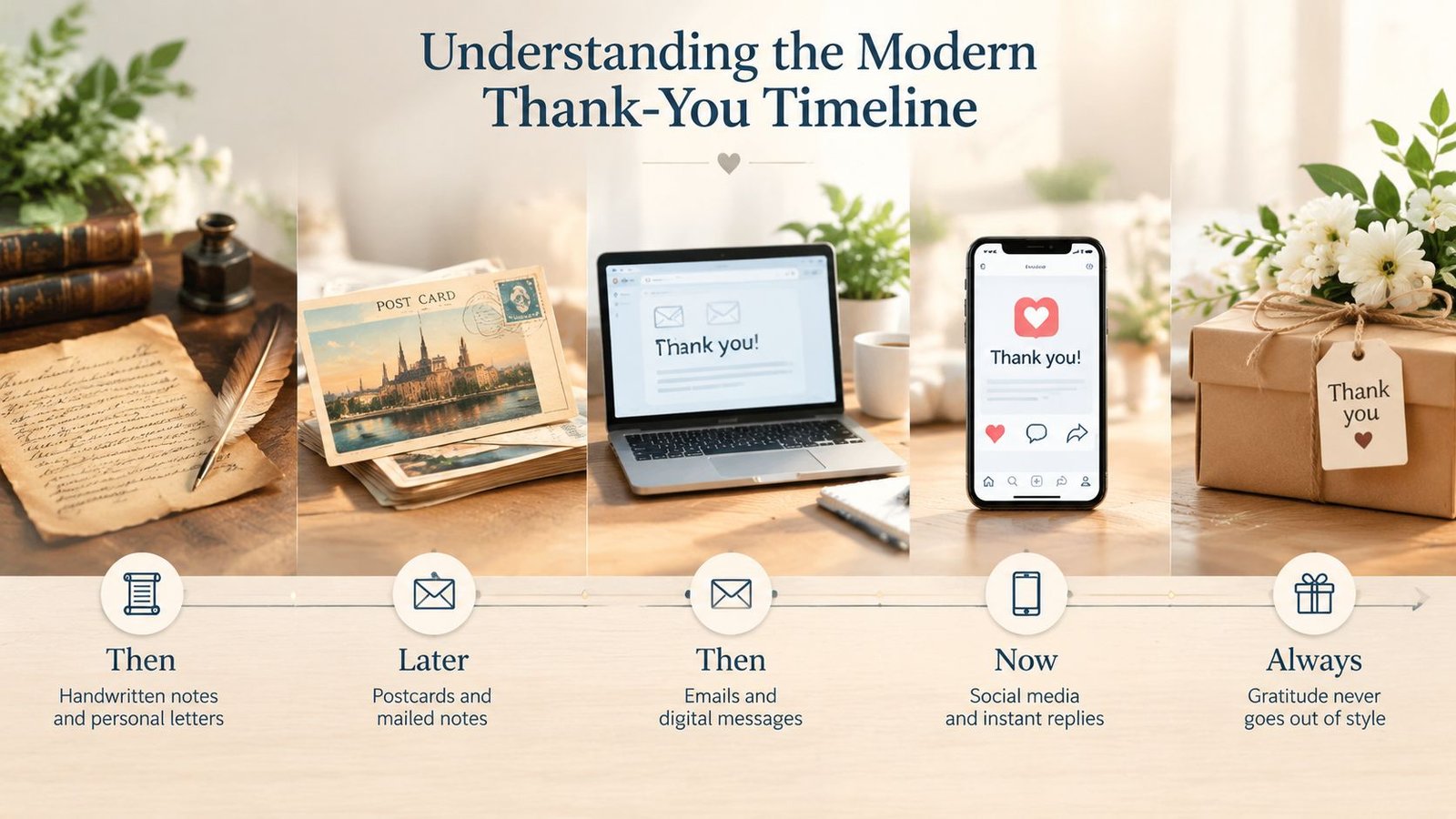
The cleanest way to manage timing is to stop thinking in one vague post-wedding window. Instead, use the trigger that starts the clock. That is how modern etiquette sources make the timeline workable, because the obligation changes depending on when the gift arrives.
Three clocks, not one
For pre-wedding gifts, the card should go out within about two weeks of arrival, even if the note just says the gift was received and the couple is looking forward to seeing the giver in Puglia. That matches the fast-response standard in contemporary guidance, which treats an early gift as something that deserves quick acknowledgment rather than waiting for the ceremony to pass.
For post-wedding gifts, the relevant clock starts when the gift is received, not when the couple returns from the honeymoon. Emily Post says all wedding thank-you notes should be written within three months of receiving the gift, and The Knot similarly advises couples to get all notes mailed by three months after the wedding. Emily Post also rejects the old “one-year rule” outright, which is worth saying plainly because too many couples still rely on it. Emily Post’s wedding thank-you guidance and The Knot’s timing advice both point to the same standard, just from slightly different angles.
For attendance-related notes, the most disciplined approach is to write them while the trip is still fresh. If the honeymoon is immediate, a brief placeholder message before departure keeps anyone from wondering whether they were forgotten; then the handwritten card follows later.
A rule that actually works
Send the note when the trigger happens, not when the couple finally feels ready.
That one line keeps destination-wedding timing honest. It also helps couples who are juggling travel, unpacking, and a hundred small post-event tasks that have nothing to do with gratitude but can easily swallow the whole month.
Who Actually Deserves a Thank-You Card
The recipient list gets messy fastest after a destination wedding, because people assume the note only goes to whoever handed over a wrapped box. That is too narrow. A proper list is broader, and it should be built before the couple lands back home, not after.
The full recipient map
| Thank-You Card Recipient Categories | Why They Deserve a Note |
|---|---|
| Guests who attended the full weekend | They gave time, travel, and presence, which matter even when no gift was brought. |
| Guests who attended only the welcome dinner or ceremony | Partial attendance still reflects effort, and the note should match that effort. |
| Guests who sent gifts but did not attend | They participated in the marriage celebration from afar and deserve formal acknowledgment. |
| Guests who gave group or cash gifts | Their contribution often involves coordination, which deserves clear, personal thanks. |
| Parents and in-laws who hosted or contributed financially | They helped make the wedding possible, not just pleasant. |
| Wedding party and officiant | They carried emotional and practical weight throughout the weekend. |
| Local Italian hosts who opened venues or homes | Hospitality of that kind is an act of trust and deserves direct recognition. |
| Vendors who went beyond contract | Extra care should be met with a note that names the specific effort. |
| Out-of-town relatives who hosted welcome gatherings | They absorbed logistics before the wedding even began. |
| Guests who traveled internationally | Their presence required more planning than an ordinary reception guest. |
The edge cases matter. A couple should not skip someone because the relationship has cooled. They should not send separate cards to spouses who arrived together unless each gave an individual gift. And when a household or group contributed together, the note should go to the household, not as three duplicate cards with slightly different signatures.
That same discipline applies to the gift list. For couples planning a wedding in Italy, it helps to understand the cultural backdrop as well, and Princess Apulia’s Italian wedding traditions page sits neatly alongside this etiquette question. Tradition and practicality overlap here, because both reward precision.
For couples who also want to think about how gratitude can be extended beyond a card, finding the perfect thank-you gift is a useful phrase to keep in mind for wedding party members, though the card itself should never be replaced by a present.
What Makes a Thank-You Note Sound Genuine
A note sounds sincere when it contains evidence that the couple remembers what happened and who the person is. Generic praise reads like a mail merge. Specificity, by contrast, signals that the couple noticed.
The three parts that work
The first part is the specific reference. Name the exact gift, gesture, or moment. A vintage decanter, a practical transfer from Brindisi airport, or the recipe shared during the welcome dinner all work because they show the note is tied to a real memory.
The second part is the personal connection. One sentence should connect that gesture to the giver’s relationship with the couple or the wedding weekend itself. That is what separates a formal acknowledgment from a polite form letter.
The third part is the forward-looking close. Say how the gift will be used, displayed, or remembered. That prevents the note from ending in a blank courtesy line that says almost nothing.
A strong note can be short and still feel complete. For example, the structure below does the job without drifting into stiffness:
Thank you for the hand-painted serving bowl. It was so thoughtful of you to bring something that felt so right for our welcome dinner in Puglia, especially after all the effort you made to travel. It will be on our table often, and every time we use it we will think of that evening.
That sentence works because each part does a different job. The gift is named, the relationship is acknowledged, and the future use is clear. The note does not need a paragraph of sentiment to feel real.
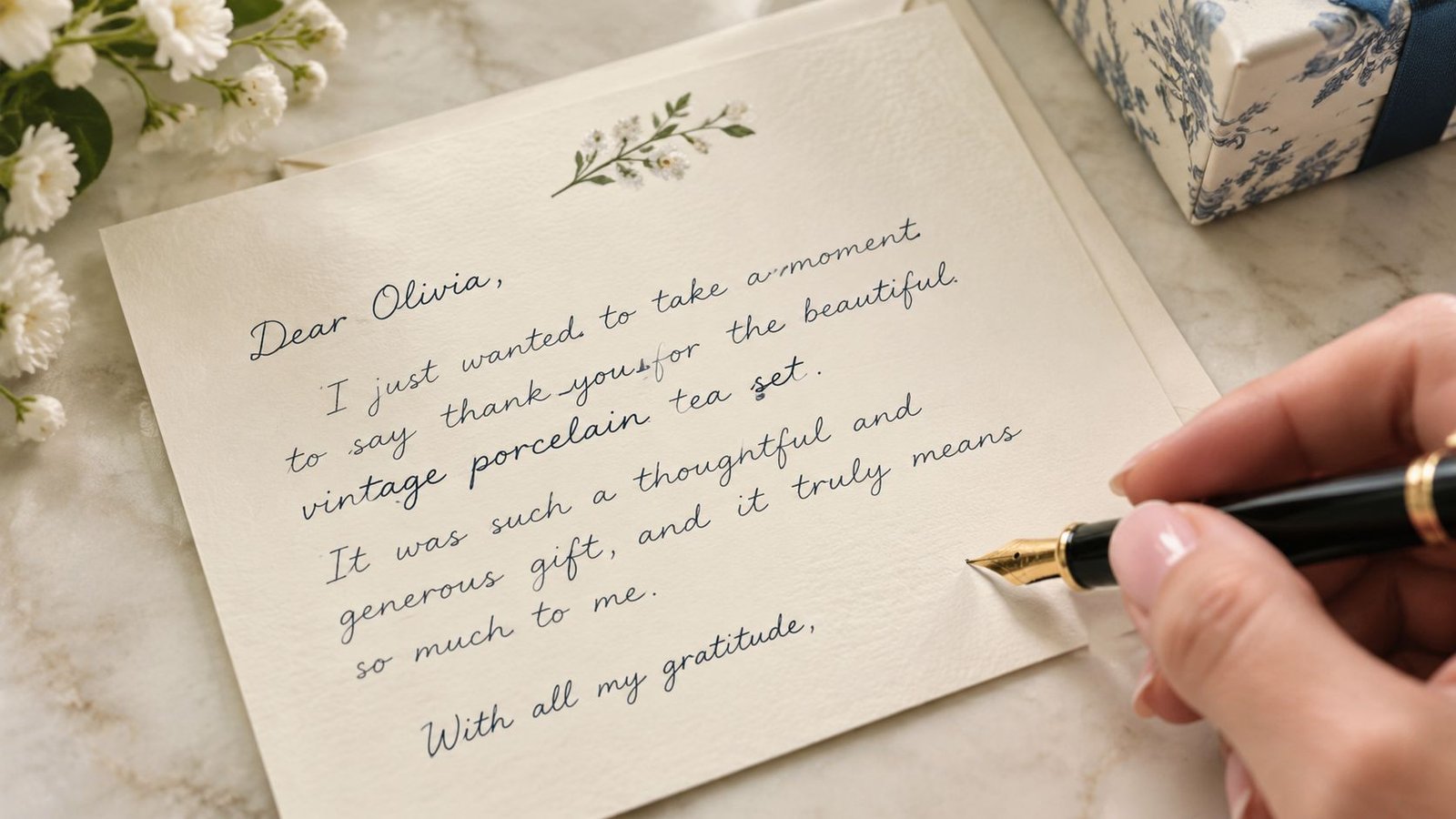
Wording Templates for Every Recipient Type
Wording should be easy to adapt, not reinvented from scratch. The best notes sound like the couple, but they still follow a structure that keeps them specific and polished.
Six templates couples can actually use
Pre-wedding shower or engagement gift:
Thank you for the lovely [gift]. It arrived at exactly the right time, and we were so touched by your thoughtfulness. We loved getting to celebrate with you before the wedding, and we already know [how it will be used]. With love, [Names].
Wedding-day cash gift:
Thank you for your generous wedding gift and for being part of our celebration. Your kindness means a great deal to us, and we’re putting it toward [specific purpose]. We’re grateful for your support and so happy you could celebrate with us. Warmly, [Names].
Physical gift delivered to the couple’s home:
Thank you for the beautiful [gift]. It was such a joy to come home and find something so thoughtful waiting for us. We love how it fits into our home, and we’ll think of you every time we use it. With appreciation, [Names].
Traveling guests who attended without giving a gift:
Thank you for making the trip to celebrate with us. Your presence at [welcome dinner, ceremony, or farewell lunch] meant so much, and we know how much effort it took to be there. We felt lucky to have you with us. All our love, [Names].
Group gift from colleagues or a wedding party:
Thank you all for the generous group gift and the care that went into organizing it. It was so thoughtful of everyone to contribute together, and we’re grateful for the kindness behind it. Please thank [organizer’s name] as well for coordinating everything. Sincerely, [Names].
Vendor or host who contributed services:
Thank you for the time, care, and generosity you brought to our wedding weekend. Your help made a real difference, and we are especially grateful for [specific contribution]. It was a pleasure working with you, and we appreciate everything you did. Best, [Names].
Tone matters. Joint sign-off works for almost every wedding note, especially for gifts and guests who know the couple as a unit. A small Italian flourish can fit naturally if the wedding was in Puglia, but only when it feels organic, not decorative. Brevity also helps. A short note with one precise detail is warmer than a long paragraph full of polite fog.
Destination Wedding Logistics and Group Gifts
The biggest operational mistake is assuming the thank-you process can start once the couple is home and rested. That is how gifts get missed. For a destination wedding, the logistics need to be captured while the weekend is still unfolding.
Build the tracking system before the return flight
A couple should have a way to record gifts as they arrive, even if the home address is empty for weeks. That can be handled by a family member, a planner, or whoever is closest to the delivery stream. A shared spreadsheet is the simplest version, keyed by sender name, gift description, date received, and thank-you status.
Stationery should travel with the couple. Cards, envelopes, and stamps need to be ready before departure, not after the honeymoon, because a quiet half-hour in the middle of the trip is more useful than a heroic catch-up session later. If the couple is writing cards abroad, the return mailing address should already be decided.
Operational truth: if a thank-you cannot be tracked, it will be forgotten.
Group gifts need extra care because the credit belongs to several people, not just the person who organized the envelope. The note should name the organizer and acknowledge the whole household or group once, cleanly, without duplication. If a household split the cost of travel as their gift, the card should reflect that jointly, not as if each person sent a separate present.
For couples who are also handling farewell favors or local gifting details, Princess Apulia’s tag page on Italian party favors sits naturally alongside this kind of logistics thinking. The broader principle is the same. The more organized the tracking, the less likely it is that gratitude slips through the cracks.
Common Thank-You Card Mistakes Couples Still Make
The most common mistake is pretending a generic note counts as personal gratitude. It doesn’t. If every card says the same thing, guests notice, especially after they traveled for a multi-day wedding and made a real effort to be there.
The shortcuts that cause friction
A text message is not a substitute for a proper thank-you card. It can buy time, but it doesn’t complete the social exchange in the way a handwritten note does. That distinction matters more in destination weddings, where guests often contributed more than a present.
A single group card is also a weak solution when multiple people gave distinct gifts. It creates confusion, and it tells each sender that their contribution was absorbed into the crowd. The same mistake shows up when couples wait until they are fully back home to start writing, at which point the trip, the unpacking, and the rest of life have already diluted memory.
Skipping guests who attended but did not give a gift is another quiet error. In a destination setting, their presence often was the gift. The same goes for vendors, hosts, and helpers who made the weekend run properly. Leaving them out is not just sloppy; it ignores the social reality of how a wedding in Italy functions.

Couples in Italy see this pattern repeatedly. The event was beautifully executed, the guests were generous, and the only thing that lands badly afterward is silence. That is why the safest policy is simple, category-specific, and timely. Anything else looks careless.
Your Thank-You Card Execution Checklist
The cleanest way to finish this job is to turn it into a table and keep it visible. Print it, screenshot it, or hand it to the partner who is most likely to follow through.
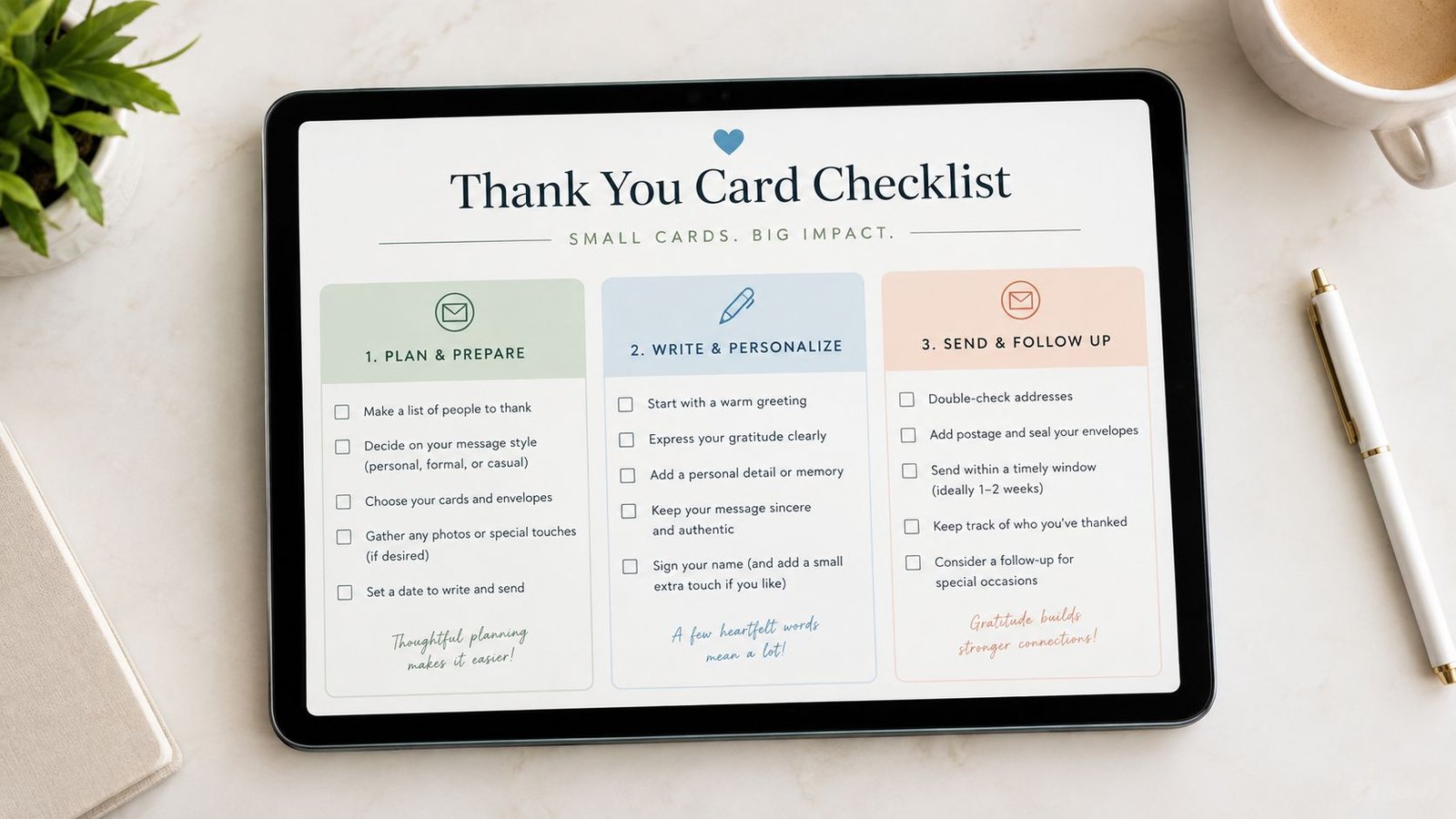
| Task | Trigger Event | Deadline |
|---|---|---|
| Pre-wedding gift note | Gift arrives | Within about two weeks |
| Attendance note for guests at the wedding weekend | Wedding or event attendance | Start within a week, finish promptly |
| Wedding-day gift note | Gift is received after the celebration | Within the three-month etiquette window |
| Travel-thank-you note | Guest attended a destination event | As soon as the guest list is confirmed and cards are ready |
| Vendor or host note | Service or extra help is completed | Send once the final job is done |
| Group gift note | Organizer confirms contributors | After names are verified, one card per household or group |
| Final inventory sweep | Couple returns home | Before the spreadsheet is closed |
The couple should batch stationery sessions instead of trying to finish cards in one late-night burst. One partner should own the spreadsheet, the envelopes, and the mailing list so nothing gets lost after the honeymoon blur. That is the difference between a thoughtful finish and a lingering etiquette mess.
If the wedding weekend is already over and the thank-you pile is sitting on a sideboard, start tonight with the first ten names and the earliest gift dates. Pull out the cards, assign one person to track each recipient category, and send the first wave before the week is out. The couples who do this well are not the ones with the prettiest stationery. They are the ones who treat gratitude like part of the wedding, not an afterthought.