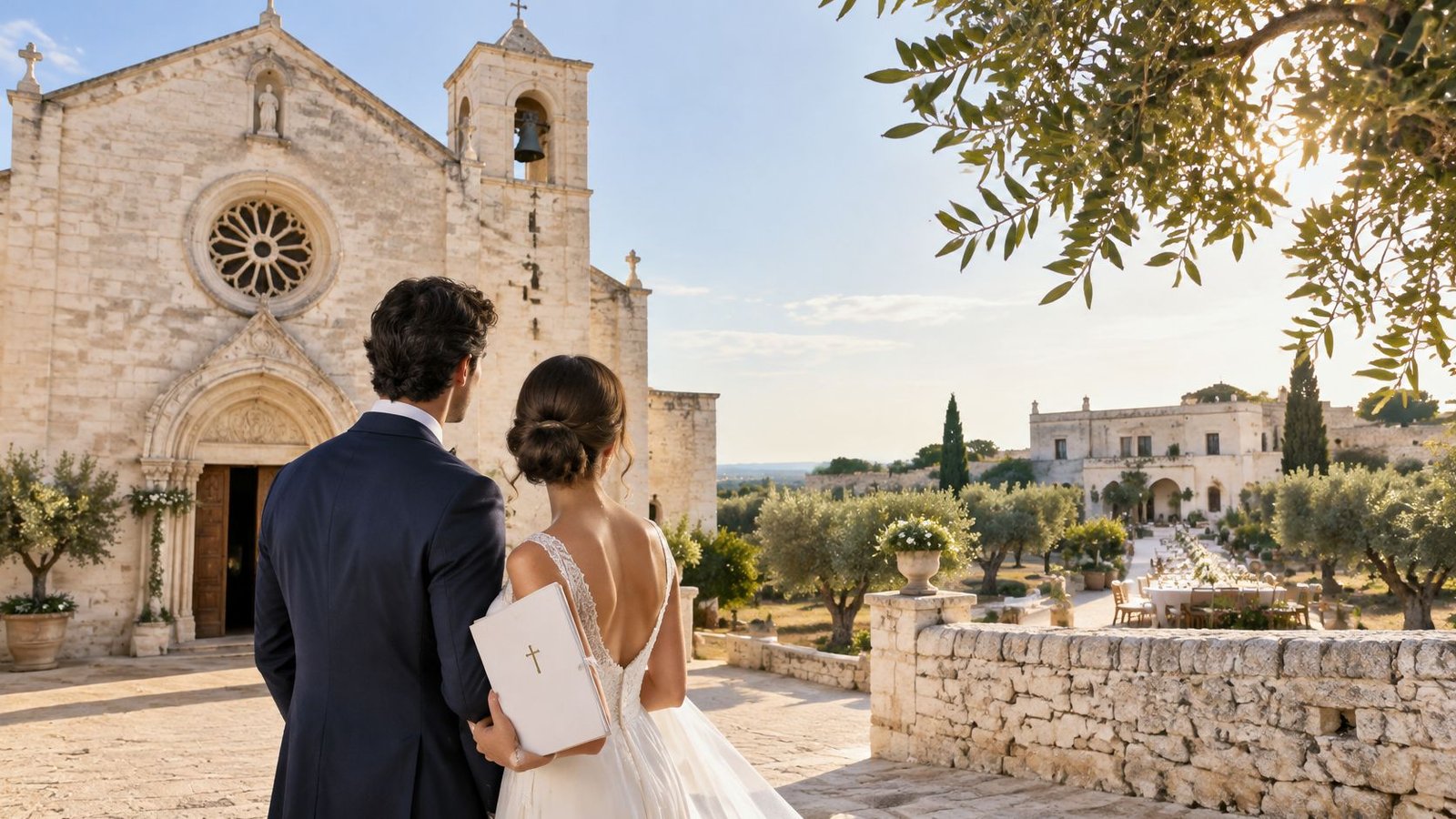
The most popular advice for destination weddings Catholic couples hear in Italy is also the most misleading. Find a beautiful church, secure the masseria, then sort the paperwork. That order reverses how the Church works.
A Catholic marriage isn't confirmed by a venue contract, a photographer's availability, or a priest's informal willingness to travel. It's confirmed through jurisdiction, permission, and preparation, most of which begins in the couple's home parish long before an Italian date should be announced. Couples who book first often discover later that the church they admired can't receive their file, that a permission hasn't been sought, or that the celebration they planned at the reception venue has no sacramental effect.
The safer sequence is less glamorous and far more useful. Home parish first. Written acceptance from the Italian parish second. Venue deposit after that. Everything that follows explains who owns each step, which office writes to whom, and which answers need to exist on paper before money becomes non-refundable.
What Canon Law Requires for Validity
A Catholic destination wedding in Italy is valid when canon law is met, not when a setting looks appropriate for a ceremony. That's the test couples need to apply before they fall for a chapel facade or a cloister garden.
The Vatican's Code of Canon Law states that a marriage involving at least one Catholic is governed by canon law, while civil authorities retain competence over the marriage's civil effects. For validity, the ceremony ordinarily takes place before the local ordinary, parish priest, or a priest or deacon delegated by one of them, and in the presence of two witnesses.
Three Celebrations That Aren't Interchangeable
Confusion starts when three different events are treated as versions of the same thing. They're not.
- Catholic sacramental marriage: A rite celebrated under canon law, before an authorised minister and two witnesses, after preparation and any required permissions.
- Italian civil marriage: A legal marriage under Italian civil law, with its own documents and registration, regardless of religious belief.
- Symbolic celebration: A personal gathering shaped by the couple, with readings or vows, but with no sacramental effect and no civil effect on its own.
A venue team can stage the third option almost anywhere. It cannot turn that gathering into the first option by adding candles, a cross, or a celebrant in clerical dress. Couples who want a Catholic marriage need the sacramental route, planned as such from the start.
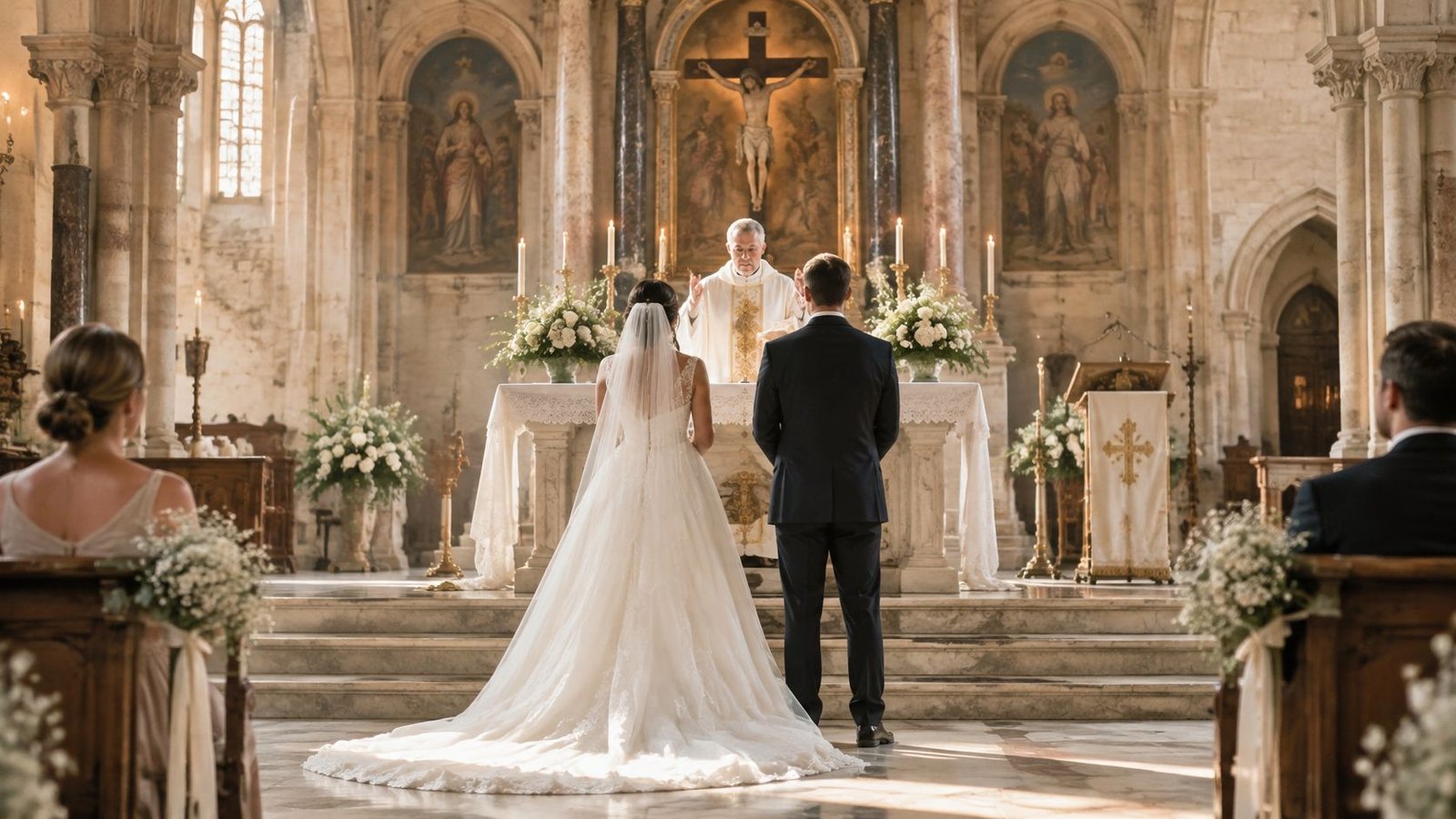
The Territorial Rule and Why Puglia Is Not an Exception
Canon law also works on territory. Marriages are generally celebrated in the parish where one party has a domicile, quasi-domicile, or at least a month-long residence. People who are transient may marry in the parish where they reside. A wedding elsewhere requires permission from the appropriate ordinary or pastor.
That single principle changes destination planning. A historic chapel in Puglia doesn't gain authority to marry visiting couples because it's old, consecrated in appearance, or frequently photographed. Some chapels belong to a parish, some are private, some are no longer used for regular worship, and some can host blessings or prayers without being the place where a parish will celebrate and record a marriage. The building alone answers nothing. The parish with jurisdiction does.
Validity check: Until a parish with jurisdiction, or a properly delegated celebrant, has agreed in writing, a venue hold is only a plan for a party.
Italy can join religious and civil effects in one celebration. When a Roman Catholic priest celebrates the marriage and it's subsequently registered with the Italian civil authorities, couples generally don't need a separate civil ceremony. That arrangement, often called a concordat marriage, still has to be confirmed by the host parish and the local Comune for the specific couple. It shouldn't be assumed from general advice or from another couple's experience in a different town.
Files also vary. The home diocese may require a particular form of preparation, the destination diocese may ask for documents in a particular format, and Italian civil rules add a separate layer. Foreign files are familiar in Italy, since ENIT, the Italian National Tourist Board recorded more than 15,100 weddings involving international couples in Italy in 2024, an 11.4% increase from 2023. Familiarity doesn't mean automatic acceptance. Each file is still reviewed on its own facts, including baptism, freedom to marry, and prior marriages.
The practical conclusion is narrow and strict. Couples shouldn't ask whether a church is available on a Saturday. They should ask whether that parish can and will celebrate their marriage, under which authority, and on the basis of which completed file.
The Parish Sequence Before Any Booking
A Catholic destination wedding runs on correspondence between offices, not on venue availability. Three of them hold different parts of the file: the couple's home parish, the home diocese wherever its involvement is required, and the Italian wedding parish that will host the rite. Each office keeps the portion of the file it owns, writes to a different address, and answers different questions. The order in which they are approached matters as much as the answers themselves.
A diocesan marriage preparation guideline states that marriage preparation should normally occur in the couple's home parish, and that couples should not book a foreign wedding before beginning preparation there. The same guidance has the preparing parish send the wedding parish a letter confirming that preparation has begun and that the couple is free to marry. That ordering matters even more now, as the flow of international couples marrying in Italy keeps growing and receiving parishes handle a rising volume of overseas files each season.
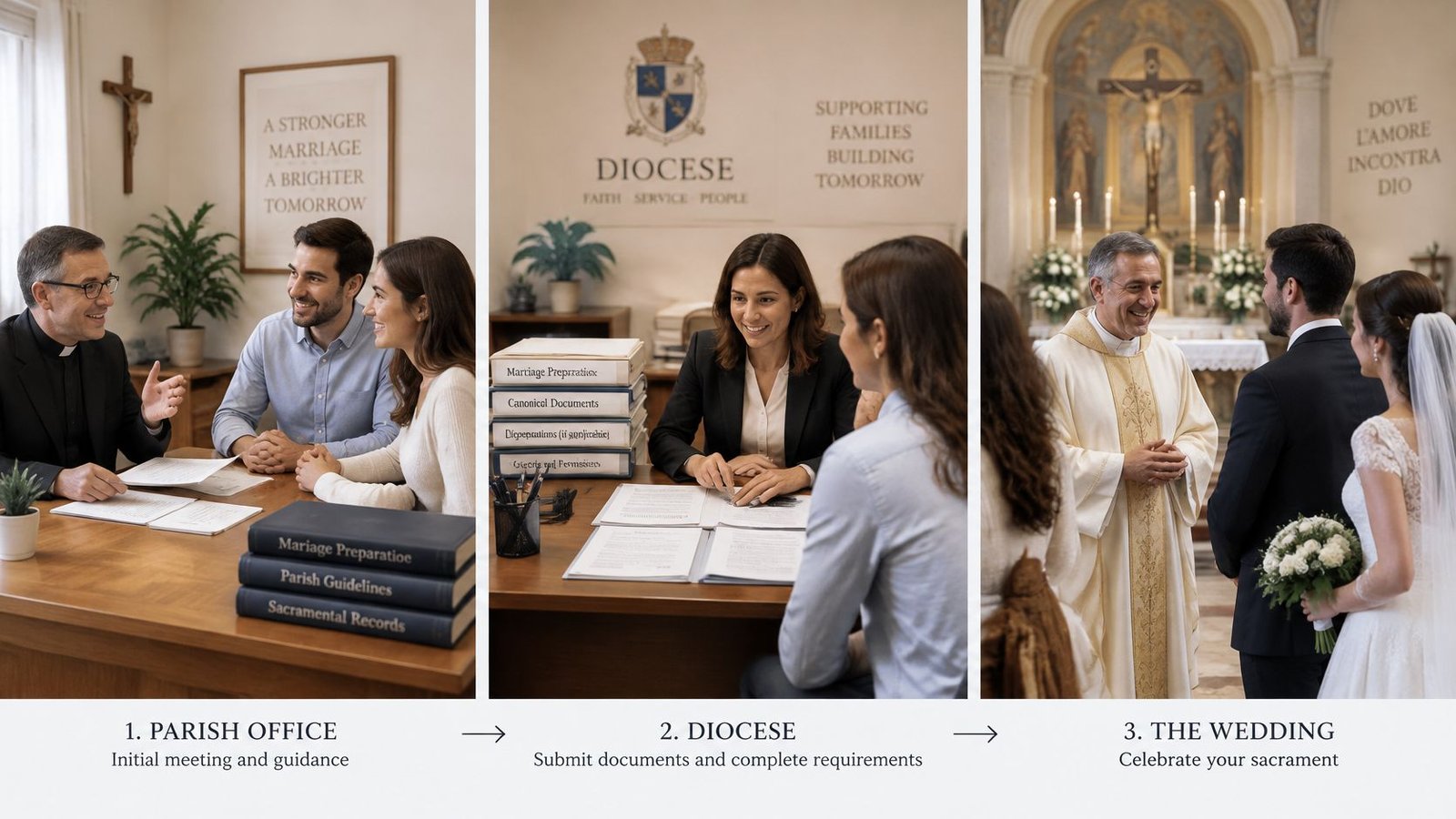
The Six Contacts in Order
- Begin at home: Couples contact their home parish and start marriage preparation before reserving a foreign church or reception date. The usual slip is paying a deposit abroad, then asking the home parish to fit preparation around it.
- Disclose the full picture early: At the first inquiry, couples state each person's baptismal status, any previous marriage, and whether the other party is Catholic, another baptised Christian, or unbaptised. That disclosure lets the parish identify the right permission route before guests hear a date.
- Obtain the preparing parish letter: The home parish confirms in writing that preparation has begun and that the couple is free to marry. The letter travels parish to parish, addressed to the Italian community under consideration, rather than being carried between offices as verbal reassurance.
- Request the receiving parish checklist: The Italian parish provides its written document list, names the celebrant, and confirms whether that celebrant has delegation or will receive it. Couples shouldn't accept a venue manager's summary as a substitute for that answer.
- Reserve the church after acceptance in principle: A date becomes firm only when the receiving parish has seen enough of the file to accept it in principle. Until that acceptance exists, a held date can lapse on either side.
- Build the wider plan on a firm date: Once the file is accepted in principle and the celebrant is named, the date is real enough to organise around. A month by month wedding checklist can then spread the remaining tasks, from guest travel to reception arrangements, across the months that follow.
What Verbal Reassurance Doesn't Cover
Timelines, translations, and the exact evidence for freedom to marry differ by diocese. A priest in one country may work to a different preparation timetable from the parish in Italy, and neither office can complete the other's checks by goodwill alone. Three questions, put to both parishes in writing, close most of that gap.
- Who is delegated: Which named priest or deacon will celebrate, and who grants delegation if he isn't the parish priest?
- Which documents must be recent: How current must certificates be on arrival in Italy, and in what language or format?
- What happens if a paper arrives late: Can the ceremony proceed, must the date move, or would only a blessing or civil step be possible?
The most important destination decision is often made at home, in a parish office, not during a venue visit in Italy.
Run in this order, the sequence leaves each office holding the paper it owns. The home parish has written, the Italian parish has answered, and the celebrant's delegation is named before a single date is promised to guests.
Church Papers and the Italian Civil File
Couples who want a Catholic rite that Italy also recognises usually face two files, not one. The ecclesiastical file satisfies the Church. The civil file satisfies the Italian state. Completing one doesn't complete the other.
The Church Side
Commonly requested church documents include baptismal certificates, confirmation certificates, evidence of premarital preparation, and, depending on the parish or diocese, letters or permissions from the couple's home parish, according to guidance on getting married in Italy. That guidance also stresses that Catholic documentation isn't uniform worldwide and that couples should obtain the host parish's written checklist before booking the ceremony.
Nationality and home diocese affect the details. The U.S. Embassy in Italy guide to getting married in Italy explains that a Catholic wedding celebrated by a Roman Catholic priest and registered with the Italian civil authorities can have civil effect without a separate civil ceremony, and it notes that the Catholic file requires baptismal and confirmation certificates in addition to the standard civil documents. Couples of other nationalities meet their own church and state requirements, so an American checklist shouldn't be copied onto a British, Australian, or Brazilian file.
Recent certificates matter because baptismal records can carry notations about confirmation, marriage, or other sacraments. A certificate issued for marriage purposes, close to the time it's requested, gives the receiving parish current information. An old family copy kept since childhood may not.
The Nulla Osta and Civil Eligibility
On the civil side, foreign couples generally need a Nulla Osta, or certificate of no impediment, issued by the competent authority of their country of origin or by their embassy or consulate in Italy, as UNHCR Italy marriage guidance explains. The document states that no legal obstacle prevents the marriage under the couple's applicable national law, and it may need translation into Italian and legalisation depending on how it's issued.
A useful Nulla Osta normally identifies name and surname, date and place of birth, parents' names, nationality, residence and civil status, according to official guidance on getting married in Italy. If birth details or parentage are missing, an additional birth certificate may be required, translated and legalised.
- Issued abroad: Legalisation is typically handled through the Italian consulate in that country.
- Signed by a consulate in Italy: The consular signature may require legalisation by the competent Prefettura.
- Missing parentage or birth details: A separate birth certificate can become necessary, with its own translation and legalisation.
Document rule: A missing parent's name is a paperwork problem to solve weeks ahead. It isn't something corrected at the altar.
Concordat Registration
When the Catholic ceremony is intended to carry civil effect, couples ask both the host parish and the local Comune the same written question. Will this be a concordat wedding, and which registration steps will the priest perform after the rite?
If the answer is yes, the priest registers the marriage with the civil authorities and a second civil ceremony generally isn't needed. If the answer is no, or if either office is uncertain, couples plan the separate civil step deliberately rather than discovering a gap after the celebration. The host parish checklist, the Comune's document list, and the home parish letter should describe the same event, on the same date, with the same names spelled the same way. Small inconsistencies across three offices cause disproportionate delays.
Ceremony Formats When the Party Is Elsewhere
The courtyard, villa lawn, or hotel garden that frames dinner so well is usually the wrong default for the Catholic rite itself. Catholic validity ordinarily expects a Catholic church and an authorised celebrant, a point reflected in the Archdiocese of San Antonio marriage FAQs, which list celebration in a Catholic church before a Catholic cleric and two witnesses among the usual conditions. That expectation sets the booking order. The parish answer comes first, the venue contract after.
Four models can work, but they don't carry equal sacramental weight.
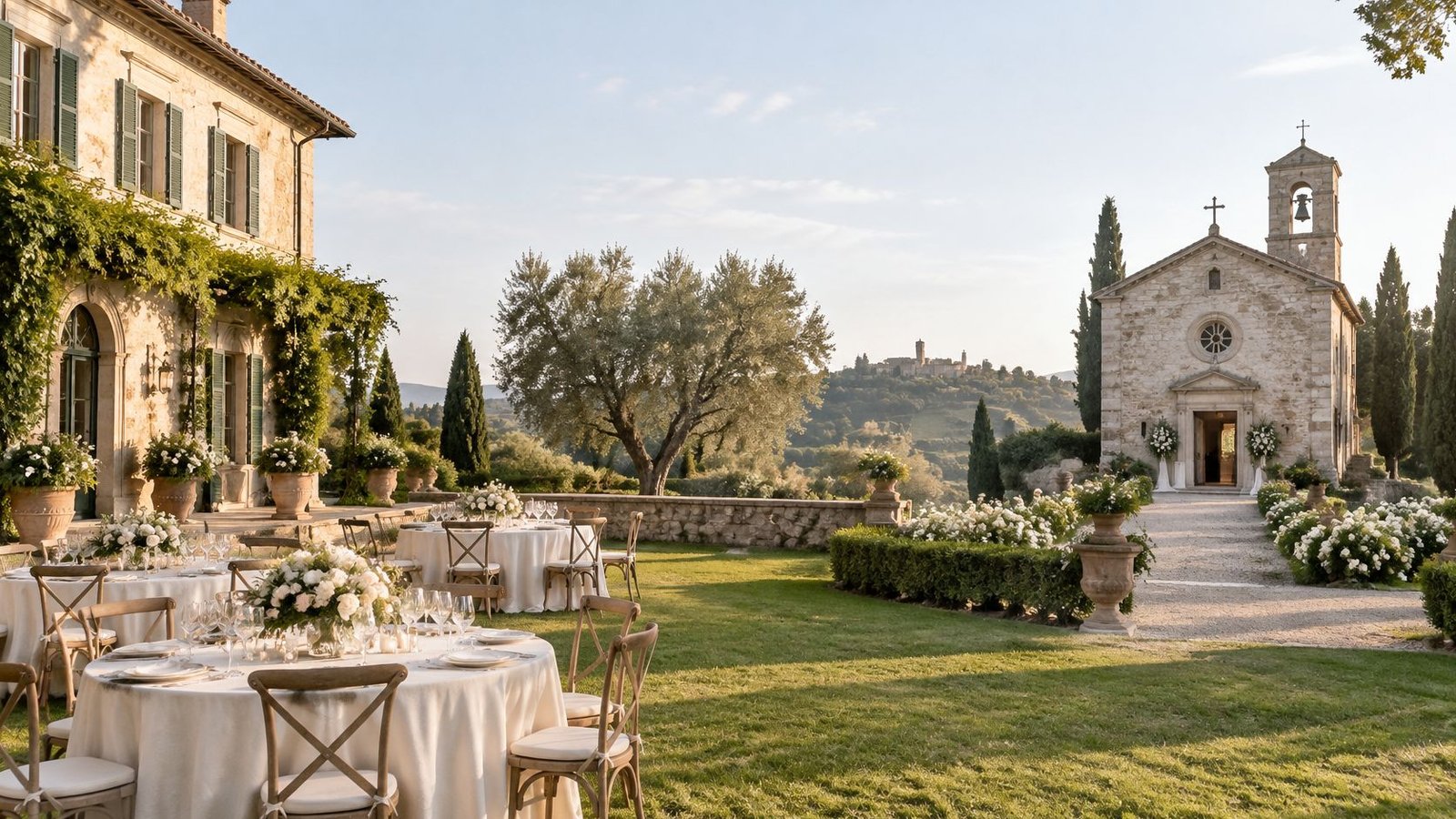
Four Models Compared
| Model | Sacramental effect | Main planning consequence |
|---|---|---|
| Parish church, then reception venue | Catholic marriage when parish requirements are met | Guest transfer between church and meal needs timing and transport |
| Historic Catholic church near the venue | Catholic marriage when that parish permits it and delegation is in place | Shorter transfer, but permission still depends on that parish |
| Celebration outside a church | Possible only where the competent authority grants permission | Cannot be promised by a venue or planner |
| Civil or symbolic gathering at the venue | No Catholic sacramental effect from that gathering itself | A separate Catholic rite must be planned as its own event |
The first model is the most straightforward for couples whose priority is a valid Catholic marriage. Guests attend the liturgy in church, then travel to the masseria or hotel for aperitivo and dinner. The transfer isn't a flaw in the day. It is the honest shape of a day where ceremony and celebration answer to different requirements.
The second model can feel more integrated when a suitable church sits in the same town as the reception. Proximity helps with coaches, older guests, and photography schedules. It doesn't remove parish permission, music rules, or limits on flowers and photography inside the church, so that parish's written agreement still has to exist before the venue deposit goes through.
The third model needs the most caution. A celebration outside a church is possible only where the competent authority permits it for that couple and that place. The permission belongs in the couple's file in writing, requested by name and granted on paper. A venue or planner who describes an outdoor Catholic ceremony is describing a hope until the parish confirms the same thing.
The fourth model suits couples who want a venue gathering for guests and understand its limits. A symbolic ceremony can be personal and well produced, yet it doesn't replace a Catholic rite. Couples weighing the difference can read about what a wedding blessing involves before treating the two as interchangeable.
Whichever model applies, ownership of the paperwork stays the same. The home parish builds the prenuptial file, the Italian host parish confirms the celebration, and any delegation for the celebrant is recorded in writing. Those three answers must exist before money moves.
Questions That Shape the Day
- Transport and access: How long is the coach journey, are church steps manageable for older guests, and where do cars wait?
- Language and celebrant: Will the liturgy be in Italian, English, or both, and is a priest who speaks the couple's language available?
- Music and photography: Which instruments, songs, and camera positions does the parish allow?
- Timing: How much daylight remains for portraits after the liturgy and transfer?
A day can split ceremony and celebration and still keep the sacrament intact. What it cannot do is substitute symbolic flexibility for canon law, however common that flexibility is across the wider Italian market.
Permissions for Mixed Faith Marriages
A mixed-faith file begins in the home parish. Baptismal status determines which office can decide the case and which written answer must reach the Italian parish before the church date is treated as confirmed. When the home parish, the competent authority, and the Italian celebrant sit in different jurisdictions, each office controls a different part of the file. Vague answers at the beginning create delay later.
Two situations must stay distinct.
Baptised Non Catholic Partner
When one party is Catholic and the other is a baptised Christian who isn't in full communion with the Catholic Church, Canon 1124 requires express permission from the competent ecclesiastical authority for the marriage to be celebrated licitly, as set out in Matrimonia Mixta. Licitly means lawfully within Church order.
Permission is a formal act the celebrant cannot grant on the day. The home parish establishes the facts and records the request. The competent ecclesiastical authority grants the permission. The preparing parish's letter to Italy should then identify the permission already granted, giving the Italian parish a written basis for accepting the file.
Unbaptised Partner
When the non-Catholic party is unbaptised, the requirement is stronger. An express dispensation from the impediment of disparity of cult is required for validity. Without that dispensation, a valid Catholic marriage does not take place.
This distinction explains why baptismal status belongs in the first home-parish inquiry, before questions about an Italian venue. A couple that describes both parties as Christian, spiritual, or not practising gives the parish too little to work with. The parish needs to know who was baptised, in which church or community, and what evidence exists. The home parish gathers that information, the competent authority decides the permission or dispensation, and the Italian celebrant receives the written result.
Church preparation adds a further layer. Permission or dispensation presupposes that both parties understand and accept the defining properties and purposes of marriage, while the Catholic party accepts obligations concerning the baptism and Catholic upbringing of children. Couples don't need to turn that into a legal lecture between themselves. They do need to discuss it during preparation, because the parish will ask about it directly.
The practical sequence follows from those responsibilities. Couples disclose baptismal status at the first home-parish meeting and allow the ordinary, or the authority delegated to decide, enough time to review the file before any Italian date is announced. Once the decision is granted, the preparing parish's letter should state whether it is a mixed-faith permission or a disparity-of-cult dispensation. A pending request leaves the Italian parish without a final answer.
Couples aren't being asked to change beliefs to suit a venue timetable. Dioceses can use different forms, interview patterns, and preparation courses. The distinction between permission for liceity and dispensation for validity remains the same.
Split jurisdiction makes delay more likely because a question raised in Italy may need an answer from an office in another country and time zone. The protective paper trail is short: exact baptismal status, the correct deciding authority, the granted act, and a parish letter carrying that answer to Italy. Until those items exist in writing, the Italian date remains provisional.
Confirm the Parish Before You Pay
A venue deposit becomes safe at one specific moment: when the written answers from the Church and the Comune described earlier in this sequence exist on file. Until that moment, the only money that should move is money that can come back.
Couples who cannot wait can still hold a date, but the hold belongs in writing. A venue contract can carry a refund condition tied to parish acceptance, and the clause has to do real work. It names the event that releases the deposit, sets a deadline by which the home parish and the Italian office must confirm, and states what happens to the payment if the answer is no or never arrives. A reservation note that reads "subject to church confirmation," with no date and no refund term, does none of that. It is a hope wearing the costume of a contract.
One ordering rule applies on either path. Invitations and flights announce a church to guests; the parish file is what commits it. The second waits for the first.
Once agreement exists on paper, planning support can coordinate what the Church doesn't manage: the hours between a parish liturgy and a Puglia masseria or hotel weekend, guest transfers, and a celebration shaped around the rite already secured. Princess Apulia provides that kind of logistical wedding planning support in Puglia. The role stays logistical. A planner doesn't obtain canonical permission, and no particular church is promised.
Couples picturing a historic religious setting within a wider Apulian weekend can look at the Abbey of Santa Maria di Cerrate as an Apulian wedding setting for editorial context, while remembering that a beautiful abbey still requires the same parish confirmation as any other church.