

Attendance at a wedding abroad falls to 59% when guests pay their own travel and lodging, against 80% for a best friend's wedding closer to home, while 73% needed at least five months' notice and travel expense was the leading barrier, cited by more than 45%, according to a 2023 survey of more than 3,000 Americans on destination wedding attendance.
Those figures explain why a luxury destination wedding planner is judged by the guest journey as much as by the couple's budget. The role works like travel logistics, production and local advocacy under one plan: getting people into the right rooms, moving them between venues, timing notice around airfare and leave, and spending the couple's money where guests will feel it most.
Italy rewards that discipline and punishes improvisation. In Puglia the map matters: masserie sit inland, castles and seaside venues answer to different municipalities, summer demand narrows supplier choice, and civil paperwork follows national rules with local appointments and documents. International passports, budgets and expectations arrive on different flights. Choosing a planner here means understanding the scope, the regional demands, what to delegate, how to test the provider before signing, who pays for what, and which papers the Italian state requires.
What a Luxury Destination Wedding Planner Covers in Italy
A luxury destination wedding planner runs a multi-day programme across several locations, suppliers and guest profiles, while a wedding-day coordinator manages one day in one place. Written down, the remit covers venue and supplier sourcing, room blocks, airport and local transfers, a welcome dinner, activities between events, the wedding itself, a farewell lunch and onward travel for guests who extend their stay. In Puglia it also stretches to matching a couple with the right type of setting, whether a masseria, a castle or a seaside venue, and to the civil paperwork a municipality asks for when the marriage is legal rather than symbolic.
Couples sometimes assume the venue's in-house coordinator covers all of this. The coordinator answers to the venue, and the planner answers to the couple. The role sits where event production meets hospitality, and the guest journey, including every cost question guests will ask before they book a flight, runs through both.

Reported market figures show how far the remit has expanded. In 2024, more than 15,000 foreign couples married in Italy, an 11.4% increase on 2023 and 64% above 2019, with total turnover placed at about €931.6 million, average spend near €61,500 per foreign couple, wedding travel at roughly 960,000 arrivals and 2.6 million overnight stays, and couples from the United States, the United Kingdom and Germany representing about 29.2%, 25.7% and 10.2% of foreign weddings respectively, according to reporting on Italy's destination wedding market. These are industry-reported figures, attributed to Convention Bureau Italia and Italy for Weddings, and they shift between years and between sources.
For a planner working in Puglia, that customer mix shapes the working week: enquiries and contracts in English, transatlantic arrival patterns clustered around weekends, dietary requests that surface late, and guests who expect every transfer to come with a time attached.
Guests also arrive with different tolerances. Some book the routing the planner recommends; others find a cheaper itinerary with a six-hour layover in a city nobody planned for. For those arrivals, a 24/7 concierge from Approved Jets covers the kind of late-night rebooking a local wedding team can't staff around the clock.
Each line of that remit is a separate contract, a separate supplier and a separate point of failure. The couples who end up relaxed are the ones whose planner treats the whole weekend as one production, with transfers, meals, guest costs and the weather plan priced and assigned before anyone boards a flight.
Services to Expect from a Puglia Planner
Destination wedding planning in Italy is regional, not national. In a 2024 market breakdown, Tuscany accounted for about 21% of destination weddings involving international couples, with Lombardy, Campania, Puglia, Sicily and Lazio among the leading regions, according to reporting on Italy's wedding tourism growth. Couples aren't buying an abstract Italian product. They're choosing a setting, a cuisine and a style of hospitality, and the planner's local knowledge is what turns that choice into a schedule.
Puglia's offer is unusually wide for its size: masserie with courtyards and olive groves, historic town centres, a long coastline, a serious food and wine culture and a hospitality model built for extended stays. A planner's value here is mostly local knowledge applied to production decisions.
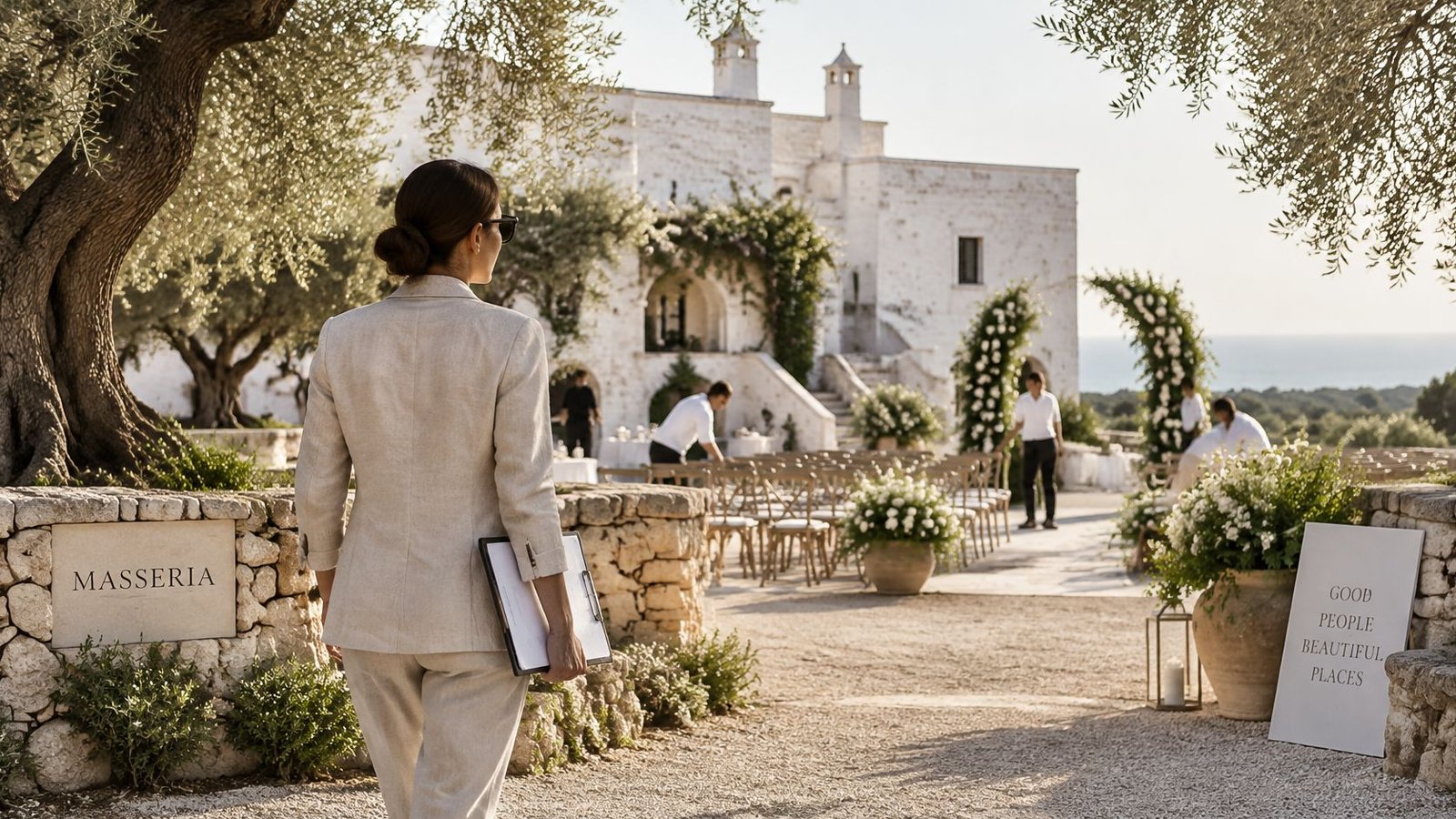
The core service list, Puglia version
- Venue sourcing on capacity and access. Not only the ceremony space: room count, road width for coaches, parking, supplier access times and how the season changes availability.
- Design direction tied to the venue. A masseria's stone and light ask for restraint; a coastal terrace carries stronger colour. Design that ignores the architecture reads as rented.
- Supplier selection and contracts. Including suppliers the couple has already chosen. The useful test isn't reputation but fit: the venue's power supply, access windows, timings and rules.
- Budget oversight. One figure hides everything. Line items by event, with catering minimums and transport separated out.
- Accommodation blocks and transfers. Several hotels at different price points, held under one set of deposit deadlines.
- A production schedule for every event. Load-in, sound check, guest arrival, dinner service, first dance, last transfer.
- A weather and contingency plan for outdoor functions. With a named decision authority and a deadline for calling it.
- Coordination through to the final guest transfer. A wedding weekend is judged on the last morning, not the first dance.
Two Puglia scenarios, two different problems. A seaside ceremony in high season needs shade, water, staffing and a transport staging area that keeps coaches off a narrow coastal road. A masseria reached by country roads needs staged shuttles, a fallback arrival window and a plan for guests who drive themselves after dark.
A written proposal should list each service with the venue and the season named against it. Full planning means little on its own. Venue sourcing, eight supplier contracts, coach transfers for 120 guests from three hotels and a rain plan for a September ceremony at a specific masseria is a scope you can price and compare.
Deciding How Much to Hand Over
Scope comes before provider. Decide which parts of the weekend you'll run yourselves, because the answer changes who you should be talking to.
| Scope level | Hands-on involvement | Best suited to |
|---|---|---|
| Full-service planning | From the earliest decisions to the final guest transfer | Multi-day weddings, remote couples and many suppliers |
| Partial planning | Selected phases such as design or supplier sourcing | Couples with local contacts who need help on specific decisions |
| Day-of coordination | Timetable and suppliers on the wedding day | Couples who have completed planning and need execution support |
| Self-managed with local help | Couple directs everything with on-site support | Small ceremonies in a single town with few guests |
Six questions narrow the choice: how many events the weekend includes, the guest count, how many site visits you can realistically make, whether either of you reads Italian and knows local suppliers, how many contracts need negotiating, and how many hours a week you have between now and the date.
A couple living in New York who can't visit venues or compare suppliers in person needs remote management with scheduled inspection trips. A civil ceremony in one town for thirty guests may need only light support, although the documents still apply and still take time.
Partial scope carries its own risks. Gaps appear between suppliers when nobody owns the sequence from the welcome dinner to the wedding morning. Responsibility for calling a weather change can fall between a designer and a coordinator. Payments sometimes sit between contracts, with each supplier assuming another has covered the deposit.
Ask any provider which services are excluded, in writing, before the first call. Not every firm accepts day-of-only work: Princess Apulia® concentrates on complete planning and full-service destination weddings, and in most cases doesn't take on partial planning or wedding-day coordination alone.
The decision rule is straightforward. The more events, guests and remote decisions a wedding involves, the further the scope should move toward full-service, because coordination between suppliers becomes the work rather than an extra on top of it. Where friends and relatives take over that coordination, the difference between a professionally organized wedding and one run with the help of friends and relatives usually shows up in the gaps nobody was assigned.
Vetting Questions and Written Scope Before You Sign
A vetting call earns its place only when each answer changes a decision. Group your questions by the decision they inform, keep written notes, and treat those answers as the draft of the scope document you will eventually sign.
Experience and process
- Regional depth. How many weddings the team has run in this part of Italy, how many with international guests, and which multi-day programmes they have coordinated from welcome dinner to farewell. A planner who knows the coast but has never sequenced three events across two towns will learn on your weekend.
- Remote workflow. How planning runs when the couple lives abroad, including venue research, supplier comparisons and meetings handled at a distance. Expect a named planning lead, a shared document trail and a stated rhythm of calls rather than messages whenever someone is free.
- Supplier control. Whether you may bring your own suppliers, and how the planner assesses each one against the venue's requirements and the wider plan before any contract is signed.
- Guest logistics. Who arranges accommodation, transfers between venues and travel for guests arriving from abroad, since your guests will judge the weekend by how smoothly they were moved around.
- Timeline. What start date the planner proposes. For larger destination weddings, Princess Apulia® recommends beginning the planning 12 to 18 months in advance, a horizon that also tells you how long the working relationship runs and when deposits fall due.
Money, contracts and contingency
- Contracts. Who signs each one, the payment schedule, what is refundable, and the cancellation terms that apply if numbers drop.
- Contingency. Who calls a weather change for an outdoor ceremony, how quickly a backup can be activated, and who tells guests once the decision is made.
- Paperwork. Which municipality handles the ceremony, whether the planner coordinates the documents, and who confirms current requirements with the consulate.
- Service definition. A full-service agreement should name each area in writing: venue selection, design direction, suppliers, contracts, budget oversight, accommodation and transport planning, production schedules and coordination of every event across the weekend. Anything delivered but unnamed becomes a dispute later.
Three answers should end the conversation. A proposal with no written scope, a fee quoted without stating what it covers, and no named person responsible for contingencies each point to the same problem: responsibility has not been assigned anywhere.
The side-by-side test. Lay two or three written scopes next to each other and check every line against your own list of what the weekend requires. The gaps between two proposals reveal more than either proposal does alone.
Payment patterns deserve the same scrutiny as scope. How to avoid scams in wedding planning sets out the warning signs worth raising early, particularly large deposits requested before any contract exists.
A finished decision leaves three things behind: one signed scope document, a timeline worked backwards from the ceremony date with dated milestones, and a named owner of the contingency plan. If any of the three is missing, the wedding is not yet planned, whatever the proposal looks like.
Costs for the Couple and the Guests
Wedding costs begin with decisions the couple controls: guest count, venue, catering, flowers, music, photography, transport, accommodation and the level of service in each area. A fifty-guest dinner in a masseria and a hundred-and-fifty-guest dinner in the same room are different projects, and a Saturday in June prices differently from a Thursday in September.
Ask for a written estimate by line item rather than a single total. A total hides the catering minimum, the transport staging cost, the staff meal and the extra hour of music. A line-item estimate lets you move money between lines without renegotiating the whole.

The guest side is where most planning advice goes quiet. Destination weddings averaged about $41,312 in 2025, compared with $34,208 for local weddings, and 79% of destination-wedding couples expected guests to give smaller gifts because of the additional travel expense, according to Zola's 2025 wedding cost and guest expectations report.
| Measure | Destination wedding | Local wedding |
|---|---|---|
| Average total cost (2025, reported) | $41,312 | $34,208 |
| Couples expecting guests to give smaller gifts (2025, reported) | 79% of destination-wedding couples | Not reported in the same source |
Guests carry airfare, several nights of accommodation, meals outside the hosted events, excursions, currency conversion and, for some, childcare and accessibility arrangements. None of it appears in the couple's budget, and all of it decides who comes.
Protecting the guest budget without diluting the weekend
- Make events optional. A welcome aperitivo and a farewell lunch can be invitations rather than obligations, with the hosted elements clearly marked.
- Offer accommodation in tiers. Two or three hotels at different price points, each with published rates and a single booking deadline.
- Give transfer alternatives. A shared coach, a scheduled shuttle at fixed times and a clearly priced private car cover most guests without a fleet running half empty.
The counterintuitive part of luxury. A shorter programme of genuinely optional events often feels more generous than a packed itinerary that obliges everyone to attend.
Luxury doesn't require maximising the number of hosted experiences, and a planner who adds to the itinerary without asking about guest budgets isn't necessarily serving the weekend. Ask for a table showing, event by event, what the couple hosts and what guests pay themselves. Sending a plain Italy budget guide for connected travelers with the save-the-date does more for attendance than another planned excursion. For the couple's side of the ledger, a budget wedding checklist keeps the categories visible while the numbers firm up.
Paperwork and Timelines for Marrying in Italy
A foreign couple marrying in Italy follows the rules of the municipality where the ceremony takes place, and those rules depend on nationality and residence. No single checklist applies across the country, which is why the paperwork belongs in the planning schedule rather than in the week before the wedding.
The core document comes first. Under Article 116 of the Italian Civil Code, a foreign citizen must provide a certificate of no impediment to marriage issued by the competent authority of the country of citizenship, as set out in Italian Ministry of Foreign Affairs guidance on marriage. Citizens of countries participating in the 1980 Munich Convention may alternatively provide a certificate of legal capacity to marry. The exact document, the issuing authority and any authentication step vary by nationality, so the requirements need confirming with the ceremony municipality or the consulate rather than assuming.
Publication follows its own clock. Italy's Ministry of Justice guidance on marriages between people of different nationalities states that, where applicable, marriage banns must be posted in the municipalities in which the future spouses reside at least four days before the marriage, and that the notice must remain posted at the city hall for at least eight days.
| Requirement | Timing or rule | Source |
|---|---|---|
| Banns posted in the municipalities where the spouses reside | At least four days before the marriage | Italian Ministry of Justice guidance |
| Notice displayed at the city hall | At least eight days | Italian Ministry of Justice guidance |
| Home-country certificate of no impediment to marriage | Required; issuing authority and format vary by nationality | Article 116 of the Italian Civil Code |
| Translation or authentication of documents | Set by the ceremony municipality or consulate; confirm in writing | Ceremony municipality or consulate |
Work backwards from the ceremony date and mark each deadline against a name:
- Confirm the ceremony municipality and its specific requirements.
- Request the home-country certificate.
- Confirm whether translation or authentication is needed, and by whom.
- Check the publication dates against the ceremony date.
- Fix the ceremony date and venue only once those dates are confirmed.
Ask the planner who owns this workstream and how it's documented. A single named person with a dated tracker prevents the most common failure, which is discovering a missing certificate after the venue and the flights are already committed.
Couples planning a multi-day wedding in Puglia can start the conversation earlier than they expect. Princess Apulia® plans destination weddings in Puglia and other Italian locations for international couples, following each project from the first venue shortlist to the final guest transfer, and the useful first conversation covers the region, the season, the guest count and the events you're imagining rather than a colour palette. Bring the questions from the vetting list, ask for a written scope with exclusions named, and request the hosted and self-paid cost split event by event. That conversation is where a wedding weekend stops being an idea and becomes something a team can deliver.