
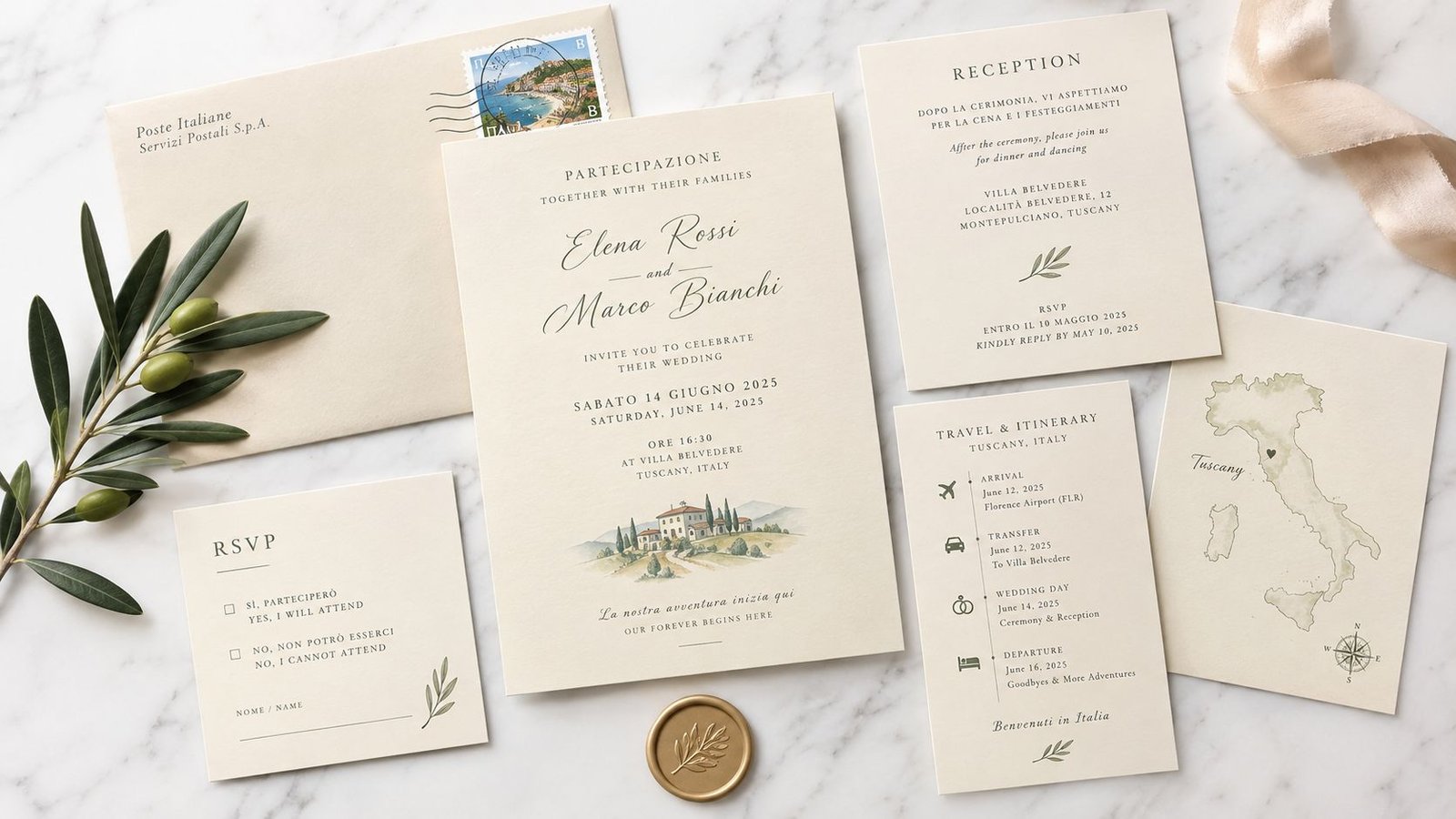
For an Italian destination wedding, formal invitations should be sent eight to ten months before the event, rather than the two to three months often used for local weddings. International guests need that lead time to arrange flights, accommodation, transfers, passports, childcare, and extended leave.
A couple may have already chosen a stone-built masseria in Puglia, a lakeside ceremony in northern Italy, or a historic venue in one of the country's great cities. Then the stationery arrives, and familiar assumptions begin to unravel. Is the invitation announcing the ceremony, the reception, or both? Should guests reply by card, email, or a website? Does a beautiful square envelope travel easily through the postal system?
Italian wedding invitations are not decorative objects alone. They are part of the guest experience, carrying social meaning, ceremony information, travel guidance, and practical reassurance across languages and generations.
Why Italian Wedding Invitations Require Different Thinking
An international couple might begin with a conventional English-language invitation in mind: one card, a reply card, an envelope, and perhaps a details insert. Italian etiquette often starts from a different premise. The marriage announcement and the reception invitation have historically served different audiences, while family expectations, regional customs, and the formality of the ceremony influence the wording and delivery.
That distinction matters particularly in Puglia. An overseas guest may need to coordinate flights, accommodation, transfers, passports, childcare, and several days of leave. A local relative may already understand the town, the ceremony customs, and the significance of a formal announcement. One stationery suite must respect both experiences without becoming visually crowded or culturally confusing. This gap between Italian etiquette and international expectations remains underexplained in general invitation advice, especially for destination celebrations in Puglia, as noted by Scuderie Odescalchi's guide to Italian wedding invitations.
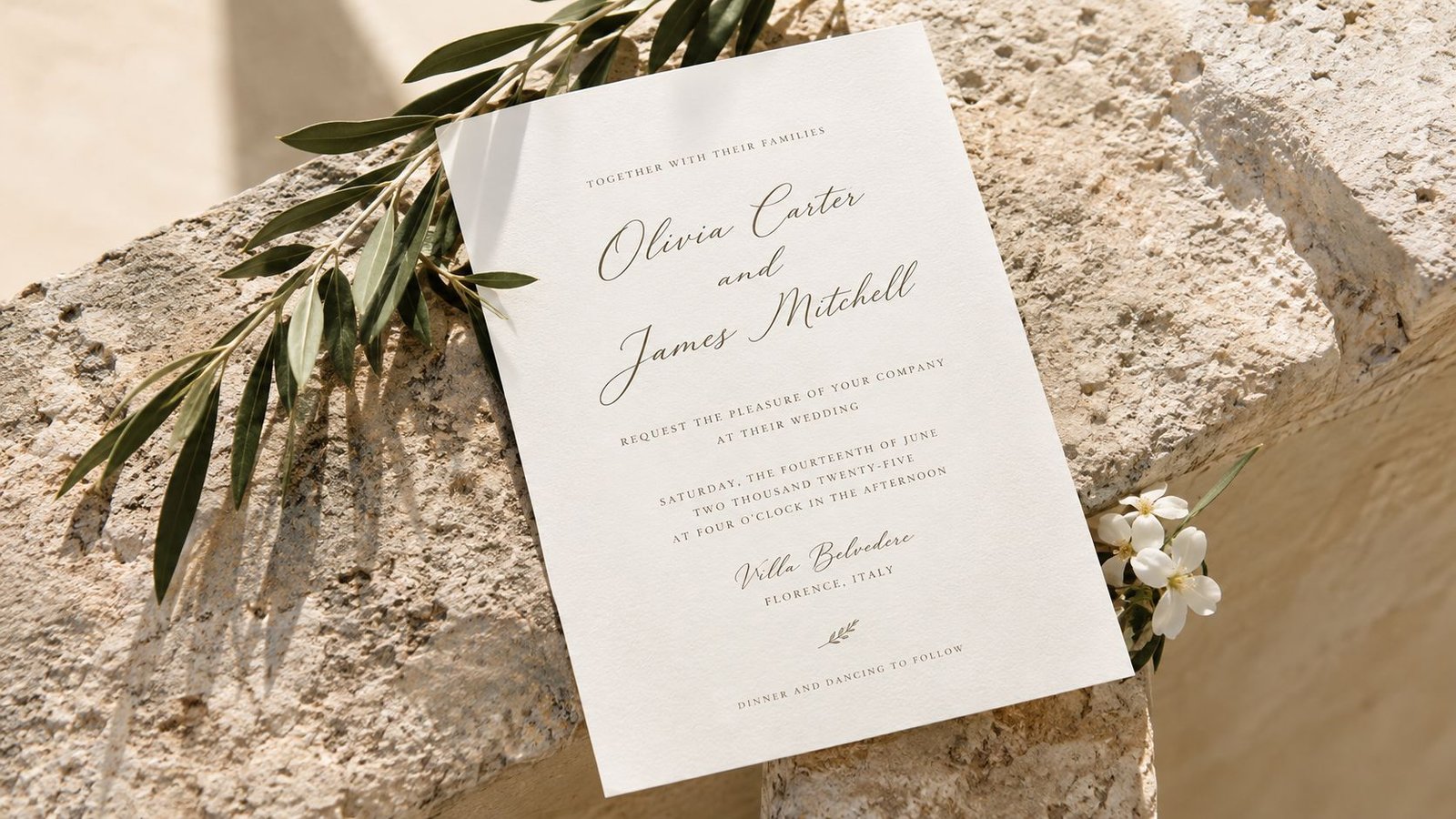
Practical rule: The invitation should answer the guest's emotional question, “Am I included?”, and the logistical questions, “Where, when, and how should I prepare?”
The most useful approach treats stationery as cross-cultural hospitality infrastructure. The formal card establishes the tone and social meaning of the wedding. Supplementary cards or digital pages then carry the information that international guests need, including accommodation guidance, transfer arrangements, weekend events, and a clear response method.
Travel planning may also extend beyond the wedding region. Guests combining the celebration with a wider Italian itinerary can use resources to compare Lake Garda stays and tours, particularly when the wedding forms part of a longer journey through Italy.
Understanding the Italian Two-Part Invitation Tradition
The central Italian term is partecipazione. Historically, it functions as a formal announcement of the marriage rather than as a direct equivalent of the Anglo-American invitation and RSVP card. A separate card may then communicate reception details to the smaller group invited to lunch or dinner.
This format developed from a social structure in which news of the marriage could be shared with a wider circle. Relatives, friends, acquaintances, and professional contacts might receive the announcement, while only some would attend the reception meal. The two documents therefore carried different social purposes, and treating them as interchangeable can create confusion for international couples.
What the traditional suite communicates
A traditional partecipazione has often been associated with high-quality cotton paper, a cream tone, restrained typography, and limited graphic decoration. Brown or blue type can create a quiet formal effect, although contemporary stationery is more varied. The important point isn't the precise colour palette. It's the distinction between a dignified announcement and a fuller invitation containing reception logistics.
A destination wedding can adapt this structure without reproducing it rigidly:
- Formal announcement: The partecipazione can announce the marriage and identify the couple.
- Reception card: A second card can state whether the recipient is invited to the meal and provide the reception address.
- Travel information: International guests can receive accommodation, transfer, and itinerary details in print or through a digital page.
- Response system: A website, email address, or named contact can provide the clarity that the traditional format may not have required.
This preserves the cultural logic while making the suite functional for guests arriving from abroad. Contemporary couples increasingly use bilingual wording, custom layouts, digital inserts, and RSVP websites while retaining the distinction between the announcement and the reception invitation, a tradition described in this overview of Italian partecipazioni.
Couples who want broader cultural context can also consult the guide to Italian wedding traditions. The strongest stationery choices don't imitate Italian formality as surface decoration. They explain inclusion accurately, separate ceremony information from reception information when necessary, and make every guest feel considered.
Writing Bilingual Wording for Italian Ceremonies
Bilingual wording works best when it follows a clear hierarchy rather than placing two dense blocks of translated text on one card. The couple's names, ceremony details, reception information, and response instructions should remain easy to locate in both languages.
A formal structure might present the names first, followed by a family reference if appropriate, then the invitation phrase, date, time, ceremony location, and reception information. English can appear first for an international guest list, with Italian beneath it. An Italian family with a predominantly local guest list may reverse that order. Neither choice is automatically more authentic. Readability and audience should guide the design.
Match the wording to the ceremony
Religious and civil ceremonies shouldn't be described with interchangeable language. A religious ceremony may call for wording that refers to the church service or the couple's request for guests' presence. A civil ceremony may require a more neutral reference to the marriage ceremony at the municipality or selected venue. The final language should be checked by a fluent Italian speaker familiar with the ceremony type, since literal translation can sound formal in the wrong way or omit an important nuance.
A bilingual invitation could use a structure such as:
English
Together with their families,
[Name] and [Name]
invite guests to celebrate their marriage
on [date] at [time]
at [ceremony location].
Reception to follow at [reception location].
Italian
Insieme alle loro famiglie,
[Nome] e [Nome]
invitano a celebrare il loro matrimonio
il [data] alle [ora]
presso [luogo della cerimonia].
A seguire, ricevimento presso [luogo del ricevimento].
The wording should be adapted, not copied mechanically. Italian date and time conventions, forms of address, and the difference between cerimonia and ricevimento deserve careful attention. A translation that sounds elegant in English may feel stiff or unnatural in Italian if the sentence order has been carried across too rigidly.
Give multi-day celebrations their own hierarchy
A welcome dinner, ceremony, reception, and farewell gathering shouldn't compete for space on the main announcement. The formal card can identify the principal celebration, while a details card or digital page can present the weekend in chronological order.
For international guests, the practical page should state:
- ceremony location and start time
- reception location and transport information
- dress guidance, when relevant
- accommodation information
- response method and exact deadline
- optional events and whether they require a separate response
- a contact for questions
A QR code can lead to the bilingual page, but the printed invitation should remain understandable without scanning it. Older relatives and guests with limited internet access may prefer an offline explanation or a named family contact.
Italian Addressing Conventions for Wedding Invitations
Italian addressing has traditionally been more structured than the highly decorative envelope treatments common in English-language stationery. The usual sequence includes the recipient's name, street name and house number, postal code, city, and province abbreviation. That order supports both social clarity and practical delivery.
Traditional invitations may use capital letters without punctuation or special characters. International couples can adapt this convention when readability requires it, especially for names containing accents or for addresses outside Italy. A refined design can remain formal without reproducing every traditional typographic feature.
Build the address in the correct order
For an Italian recipient, the envelope should make the following information easy to identify:
- recipient name or names
- street name and house number
- postal code and city
- province abbreviation, where applicable
The couple should confirm every address with the guest rather than relying on an old contact list. This is particularly important when relatives have moved, when a household includes more than one family unit, or when the invitation needs to clarify whether a partner or children are included.
Address the social question as well
The envelope also communicates who has been invited. A single name, two names, or a family reference can carry different meanings. If the invitation applies to a partner or children, that should be clear either on the envelope, within the invitation wording, or through a direct personal message.
Italian guests have traditionally confirmed attendance by contacting the couple or someone in their close circle rather than using one universal RSVP card. International guests may assume that a reply card or website is required, so the suite should state the preferred response route explicitly. A named email address, website form, or telephone contact removes uncertainty without undermining the formality of the printed invitation.
The result can be traditional in appearance but contemporary in usability. Capital letters, restrained punctuation, and a carefully aligned address can sit comfortably alongside English-language guidance on a separate card. The design should accommodate both local postal conventions and the needs of guests who have never addressed correspondence to Italy.
Timing Your Italian Wedding Invitations Correctly
The correct schedule depends on the guest list, not on a universal rule called “Italian etiquette.” For a destination wedding, the formal invitation should generally leave eight to ten months before the event, because guests may need to arrange flights and accommodation. This recommendation is specifically suited to international travel and is set out in the Italian wedding stationery guide from La Lista.
A shorter local-wedding timetable can also be reasonable. Another Italian invitation guide suggests sending invitations around three months before the wedding, extending to four months for summer dates or particularly busy periods, with replies requested 30 to 40 days before the event. Those figures suit a different planning context, where guests already live nearby and travel arrangements are simpler.
Compare the planning contexts
| Event Type | Send Invitations | RSVP Deadline | Save-the-Dates |
|---|---|---|---|
| Local Italian celebration | Around three months before the wedding, or four months for a summer date or busy period | 30 to 40 days before the event | Useful when the date needs early circulation |
| Italy destination wedding | Eight to ten months before the event | Set backward from the venue's confirmed headcount deadline | Send early enough for international travel planning |
| Multi-day destination celebration | Early formal notice with full travel information | Choose a date that allows follow-up and supplier confirmation | Particularly useful before accommodation and itinerary details are final |
The RSVP date should be a specific calendar date. It needs to leave time to contact non-responders, confirm meal and accommodation information, and give the venue or caterer the final headcount required. The couple should work backward from that operational deadline rather than choosing a date because it looks conventional.
A save-the-date can carry only the essentials: names, location, wedding date, and a note that full details will follow. The formal invitation then becomes the complete travel and hospitality document.
Couples coordinating several suppliers can use a detailed wedding checklist by month to place stationery decisions alongside venue, accommodation, and guest-management tasks. The key principle remains simple: local etiquette may suggest a shorter window, but overseas guests need information while travel choices are still practical.
Postage and Mailing Logistics Through Poste Italiane
A beautiful invitation can become difficult to mail when the finished envelope is too thick, heavy, rigid, or irregular. For correspondence sent through Poste Italiane, the Piccolo Standard category provides a useful design target. Its official limits are 140 to 235 mm in length, 90 to 120 mm in height, and 0.15 to 5 mm in thickness, with a maximum weight of 50 g and a length-to-height ratio of at least 1.4 to 1. These specifications are listed by Poste Italiane.
The measurements apply to the assembled piece, not just to the invitation card. A slim card may fit comfortably on its own, then become non-compliant once a reply insert, layered mount, ribbon, liner, or closure is added.
Design for the complete envelope
The most reliable process is to make one finished prototype before ordering the full suite. The sample should contain every component that guests will receive, including the invitation, reception card, travel insert, response card, envelope liner, and closure.
Pay particular attention to:
- Wax seals: They can create a raised point and affect thickness or machine handling.
- Layered mounts: Several paper pieces may add bulk faster than expected.
- Metallic objects: Decorative elements can make an envelope unsuitable for standard processing.
- Ribbons and ties: Loose or protruding materials may interfere with handling.
- Heavy liners: A liner changes the final weight even when the outer envelope remains unchanged.
Mailing rule: The sample must be weighed and measured after assembly. Paper stock alone doesn't represent the postal item that guests will receive.
A conventional rectangular invitation with a lightweight card, a thin insert, and a standard envelope is more likely to remain within the intended category than a square or rigid design. That doesn't make unusual formats impossible. It means the couple should approve the postal treatment before production and allow time for any revised envelope, postage, or delivery method.
Building a Complete Italian Wedding Invitation Suite
The strongest invitation suite combines the formality of the partecipazione with the practical intelligence of a destination-wedding information system. The printed pieces should feel coherent and tactile. Digital information can carry updates, maps, transport notes, accommodation guidance, and the wider weekend itinerary without forcing every detail onto the formal card.
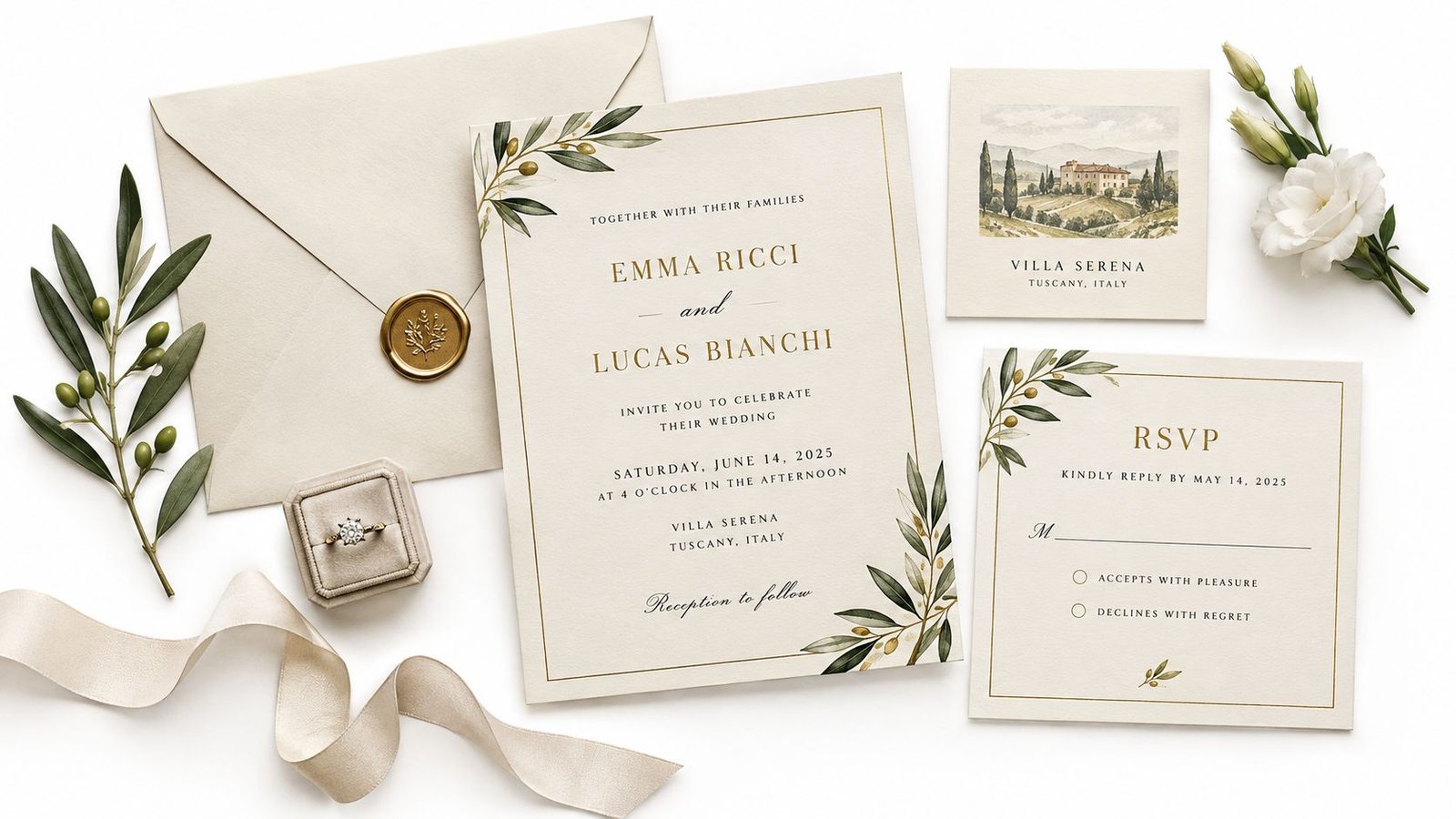
A useful suite may contain:
- a formal partecipazione announcing the marriage
- a reception card for guests invited to the meal
- a bilingual travel or details card
- a response card or clearly stated online response route
- a digital page accessed through a QR code
- a welcome or weekend itinerary when several events are planned
The couple should distinguish between information that must remain permanent and information that may change. Names, date, ceremony location, and reception location belong on the printed invitation. Transfer times, accommodation availability, local recommendations, and map links may be better suited to a digital page that can be updated.
Balance sustainability with access
Sustainable stationery requires more than selecting recycled paper. Options include recycled stock, biodegradable or plant-based inks, seed paper, digital invitations, QR codes, and hybrid formats. At the same time, foil, embossing, and elaborate finishing remain part of the visual language many couples want from an Italian luxury suite.
Each choice has consequences. Plantable paper may need suitable disposal conditions and local growing conditions. Multiple inserts, heavy embellishments, and international shipping can weaken the environmental advantage of a recycled-paper decision. A QR code can reduce paper volume, but it may exclude older guests or anyone without reliable internet access.
The better question is not whether paper or digital is superior by nature. It's which combination reduces unnecessary material while preserving accessibility, tactility, and craftsmanship.
Coordinate guest care before production
Before approving the design, the couple should confirm:
- which guests receive the partecipazione only
- which guests receive reception details
- which information needs an Italian version and which needs English
- the final response date
- the postal category for the assembled envelope
- the offline alternative to any QR-linked content
- who will answer guest questions about travel and accommodation
International guests may also need reliable mobile access after arrival for maps, transfers, and itinerary updates. Couples can encourage guests to browse prepaid eSIM plans as one practical way to stay connected while travelling, without placing that information on the formal invitation itself.
After the wedding, the same attention to cultural tone can continue through carefully worded correspondence. Guidance on wedding etiquette and thank-you cards can help couples maintain consistency after the celebration.
For an Italy destination wedding, stationery should be ordered as part of the wider guest journey, not as an isolated design task. Couples planning in Puglia or elsewhere in Italy can work with their planner, stationer, venue, and family representatives to approve wording, mailing tests, translations, and digital content together. That process produces invitations that look refined, communicate inclusion clearly, and give international guests the confidence to say yes.
Couples planning wedding invitations for Puglia or another Italian destination can contact Princess Apulia for thoughtful destination-wedding planning support, from guest logistics and stationery coordination to the wider celebration experience. Explore the available guidance and services at Princess Apulia.