
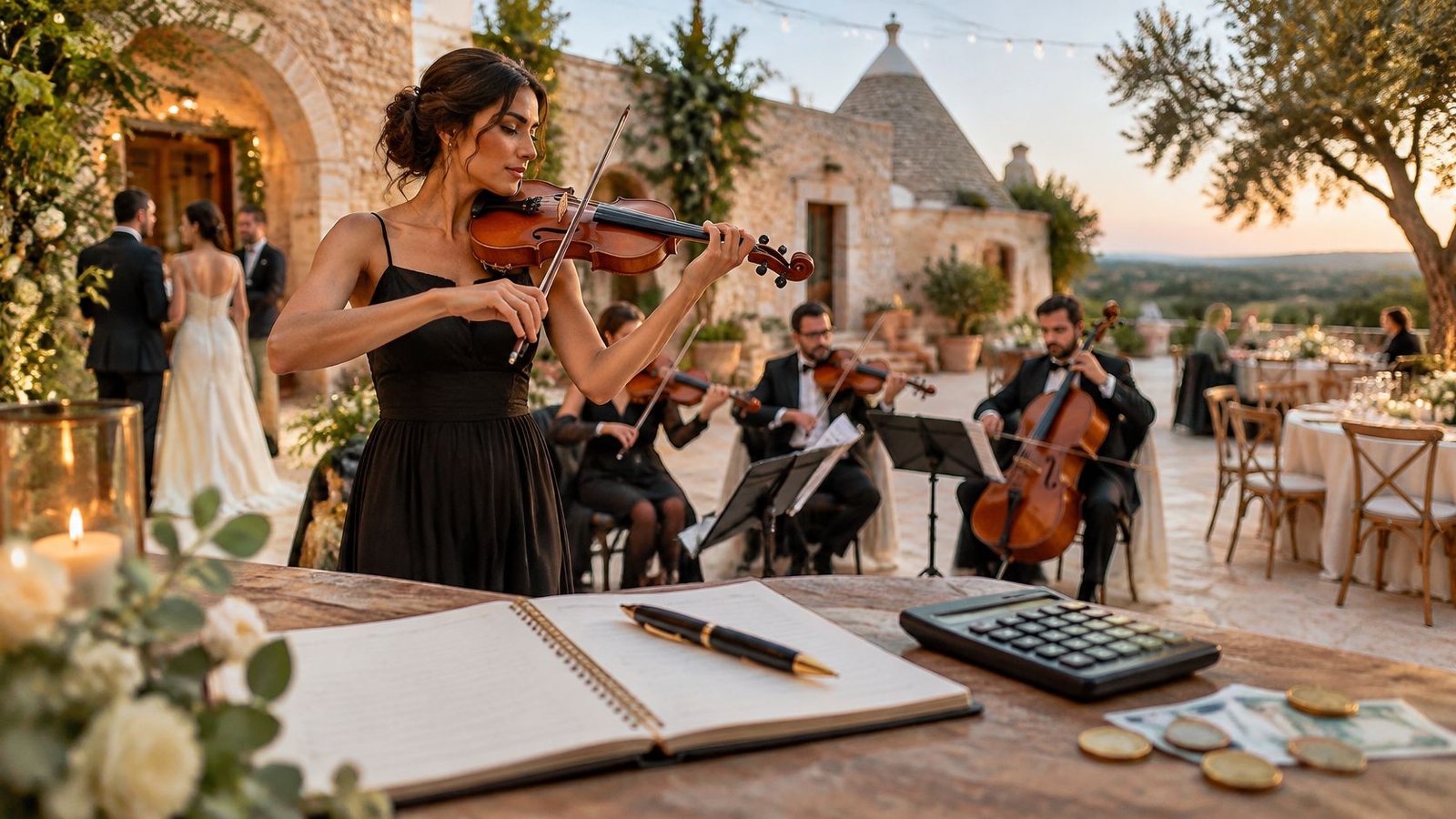
There's a line that appears in almost every destination-wedding budget guide: set aside a fixed share of the total for music, then find the ensemble that fits the number. It reads as prudence. It falls apart at the first real quote, because music is the one part of an Italian celebration where almost nothing is published and almost everything depends on the brief.
Planning from the right numbers is still possible. It just requires separating the fixed from the negotiated: the national rights fee that every wedding pays, the foreign averages that show the shape of the market, and the lines that only exist once a specific ensemble, venue and sequence of moments are confirmed.
What a Wedding Musician Cost Actually Covers
There's no reliable public average for what a musician charges at an Italian wedding in 2026. The only fixed national music cost is the SIAE licence, the performing-rights fee applied to music at a private celebration, and it's priced by guest count and by whether the music is live or recorded rather than by the artist's reputation. Under the official tariff it runs from roughly €270 for live music at a wedding under 200 guests to roughly €575 for recorded music above that threshold. Every artist fee above that line is a bespoke quotation, which is why the useful exercise isn't hunting for an Italian average but learning to read a quote.
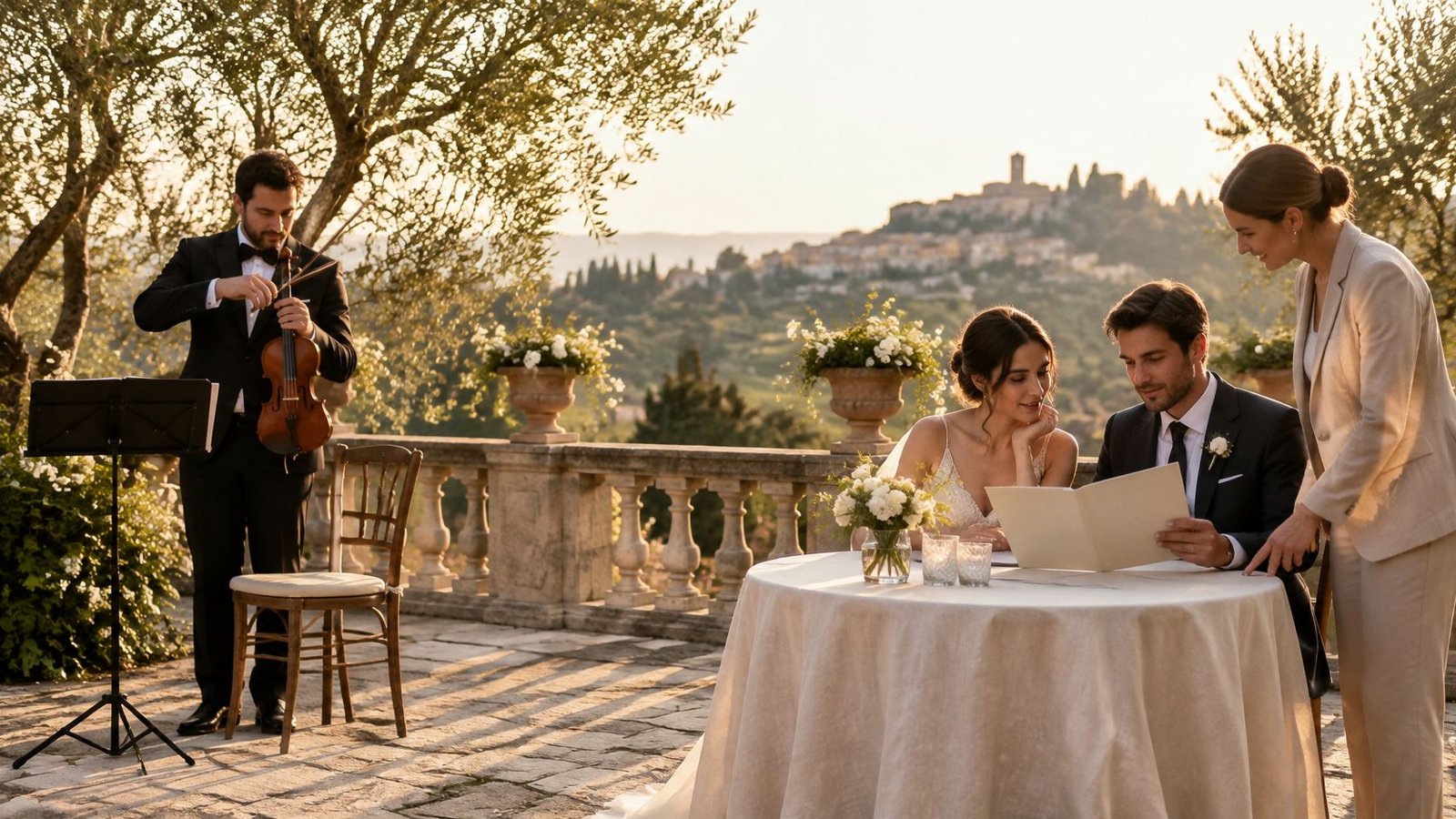
The clearest published contrast comes from the United States, where recent market reporting on wedding musician cost puts a soloist covering ceremony and cocktail hour at about $650, a string quartet for a similar two-hour engagement at about $1,950 (with reported prices from roughly $990 to $4,500), and a live reception band at about $4,500. Those are major-market anchors, not Italian prices, and they should be read that way: they describe how the market behaves, not what a couple will be invoiced in Puglia.
Two Variables Do Most of the Work
The spread isn't arbitrary. How many performers are on the ground, and which part of the day they cover, decide more than any generic hourly rate. A ceremony soloist may arrive with a compact sound system and play for forty minutes. A reception band means several musicians, longer coverage, more setup time and often additional production equipment.
Even inside one country there's no national rate. The same reporting places average live-band spending at about $7,300 in the Mid-Atlantic against about $3,200 in the West, a gap driven by local costs and date demand rather than by the standard of the music.
Published averages also contradict each other, which is worth knowing before treating any single figure as a benchmark. Cost data attributed to WeddingWire in a 2026 guide puts the average wedding band at approximately $2,050, with reported prices from $489 to $5,720 (ThePricer's live band cost guide). Set beside the $4,500 figure, it's a reminder that sample, year and phrasing change the answer.
The number worth budgeting for is a stack, not a rate: artist fee, Italian rights licence, travel and lodging, sound reinforcement, meals, standby time and overtime.
Each line of that stack matters differently, and each is quoted by a different party. The rest of a music budget is built by working through them one at a time.
Ceremony Music Versus Reception Music
Suppliers rarely sell a clean hourly rate, and quotes that look like one usually aren't. United Kingdom benchmarks gathered for 2026 place ceremony musicians at approximately £350 to £1,000 or more, DJs at £500 to £2,000 or more and live bands at £1,500 to £3,000 or more, with marketplace listing averages of about £411 for a ceremony musician, £755 for a DJ and £1,193 for a four-piece function band (VoxBooster's 2026 wedding music statistics). These are a reference from another market rather than an Italian tariff, and the wide bands exist because the products differ.
A package price normally covers arrival, soundcheck, idle time, performance sets, breaks, equipment and dismantling. That's why booked availability, not playing time, is what a couple is really buying. Two quotes of the same value can describe wildly different days.
Mapping a Puglia Day Into Zones
Count the moments that need music at a masseria wedding: the processional and the signing of the register, the aperitivo, dinner, the first dance, the late reception. A single booking rarely plays all five, and the contract should say which ones it does.
Processional choices are usually settled months before the ensemble is booked, often alongside the bridal party songs to walk into the reception, and they should be shared with the musicians in writing rather than agreed on the day.
A string group that plays the vows and a short cocktail set is a different product from a band that stays through dancing. If the ceremony happens in a courtyard or chapel and dinner is served in another building, one sound system may not serve both. A move from outdoors to indoors, or between two properties, can mean duplicated equipment, a second setup and extra labour.
A quote that doesn't state which zones it covers isn't a quote yet. It's an opening position.
The contract should also define VAT, travel-day charges, accommodation, meals, curfew compliance, outdoor noise limits and rain protection for electrical equipment. Compare quotes by delivered coverage per zone, because a lower headline can become the higher invoice once a second system and longer availability are added.
From a Soloist to a Full Band
Ensemble size is the clearest multiplier in the whole budget, and the United Kingdom booking data is unusually transparent about it. Analysis of 1,665 wedding-fee records reported by GigXchange's guide to booking live music gives a median of approximately £1,163 for a three- to four-piece wedding band, with the middle 50 percent of prices falling between £812 and £1,582.
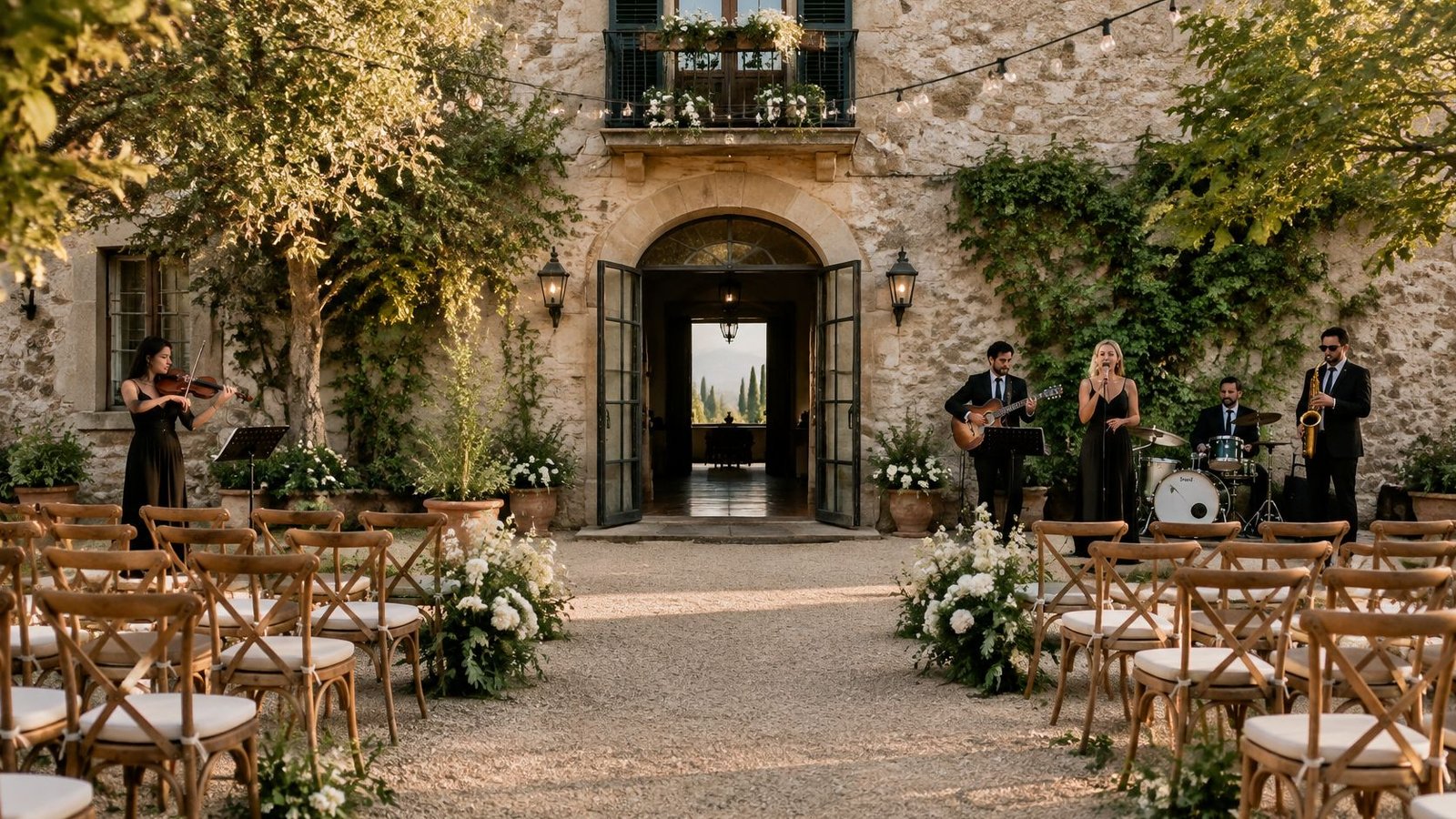
Larger groups of five or more sit at a median of about £1,773, within a middle range of £1,353 to £2,206. Solo wedding musicians are reported at about £354 and duos at about £583. Read down that ladder and the logic is plain: each added player brings another fee, another seat in the car, and often another microphone and monitor.
Why the Step From One Player to Five Costs More Than Five Fees
A four-piece band needs more inputs, more stage space and more electrical capacity than a soloist with a loop pedal. Add a horn section or two vocalists and the production requirements climb again, sometimes to the point where a separate sound engineer is the sensible choice.
For a masseria courtyard or a seaside terrace, that practical threshold decides as much as the fee does. A larger ensemble that can't be amplified properly will sound worse than a well-set-up trio, whatever the quote says.
The Wedding Premium
The same marketplace data separates weddings from general private parties, and the gap is instructive. A three- to four-piece band booked for a private party has a median fee of about £915, against £1,163 for a wedding. Date demand, advance coordination, formal dress, equipment expectations and the cost of turning down other work all sit inside that difference.
Moving from a soloist to a band isn't a volume upgrade. It's a different purchase, with a different cost structure behind it.
Applied to Italy, and without inventing local fees, the pattern suggests matching the ensemble to the moment. A harp or violin for the vows, a duo for the aperitivo, a quartet for ceremony and cocktails, a band for dancing: four different purchases, often made by four different buyers inside one budget. Booking the largest group for the entire day by default is usually the most expensive way to solve a problem that only exists after dinner.
The SIAE Licence Beside the Artist Fee
However the artist is paid, the rights fee in Italy is separate, and it's the one music line that comes from a published national tariff rather than from a supplier's email. SIAE, the Italian collecting society, prices the wedding licence by guest count and by format, and the published figures are VAT-inclusive.
SIAE Wedding Music Licence Tariff
Official SIAE wedding tariff by music type and guest count, VAT included.
| Music type | Guest count | VAT-inclusive fee |
|---|---|---|
| Live music | Fewer than 200 | €268.88 |
| Live music | More than 200 | €406.98 |
| Recorded music | Fewer than 200 | €378.80 |
| Recorded music | More than 200 | €573.80 |
Recorded music costs more because neighbouring rights for phonographic producers and performers are added to the licence. That's why a DJ, a laptop or a console-based setup sits above a live ensemble on the same row of the tariff, which surprises couples who assume a solo DJ is the cheaper option.
Two Switches That Change the Figure
The first is format. A hybrid day with live ceremony music and a DJ for dancing may fall under the recorded-music category, so the couple should confirm which category applies rather than assuming the live rate covers everything.
The second is guest count. A guest list that crosses 200 changes the fee, and a welcome dinner on another night may need its own check. Each event is assessed, not the weekend as a whole.
Ask who files and pays the licence, whether it's already inside a supplier's quote, and how VAT is shown on the documentation. The licence belongs in the budget as its own line, next to the artist quote, never folded inside it.
Travel Fees Overtime and Other Quote Lines
A performance fee is often only the first line of a destination quote, and the gap between headline and total is where budgets break. Travel bookings commonly add fuel or mileage, accommodation and local transfers, and the same pricing guidance for wedding band bookings notes that postponement fees may reach 10 to 30 percent of the base fee, with cancellation fees reaching 40 to 50 percent.

A musician travelling from another Italian region, or from abroad, may also need a travel day rather than just the wedding date. That's a hotel night, a meal and a day of availability that nobody sees in the performance.
Contract Questions Worth Sending Before the Deposit
- Zones and sets: which parts of the day the fee covers, and whether the price is for played sets or for hours on site between them.
- Standby time: a group waiting through dinner is a different booking from a twenty-minute processional, and some quotes price it, others bury it.
- Sound and microphones: whether amplification is included, who supplies ceremony microphones, and whether backline is the band's responsibility.
- Technical rider: stage dimensions, power requirements, input lists, and weather protection for electrical equipment.
- Overtime: the increment, agreed in writing, plus curfew and outdoor noise limits set by the venue or municipality.
- Multi-day weekends: whether a welcome dinner is a second booking with its own fee.
- Taxes and hospitality: VAT, travel-day charges, accommodation and meals.
- Postponement and cancellation: the percentages, and the date from which they apply.
Ask before signing: if sound isn't included, price the hire of a second system before comparing two quotes. The cheaper headline often stops being cheaper at that point.
Puglia sharpens all of this. A ceremony, an aperitivo and a reception may sit in three corners of one estate, or at two separate addresses, so imported production can cost more than a local ensemble that already owns suitable equipment and knows the venue's power supply.
The practical test is simple: the cheapest published fee isn't automatically the lowest total once logistics are counted. Music is also one of several lines that surprise couples, which is why it belongs on the same sheet as the unexpected wedding expenses that surface late in planning.
How to Sketch a Destination Music Budget
Three budget shapes cover most weddings planned for Puglia, and none of them needs an invented Italian price to be useful. Each starts with the same blank lines: ceremony or cocktail artists, reception artists or DJ, sound and a possible second system, travel and lodging, meals, overtime, SIAE, and a postponement reserve.
- Soloist or duo, then recorded music. Live music for the ceremony and aperitivo, with a curated playlist or a small local set for dinner. The smallest number of performers and the simplest technical plan, with the recorded-music SIAE category usually applying if a DJ or laptop handles the evening.
- Live ceremony and aperitivo, DJ for dancing. A hybrid that limits how many players stay through the longest, loudest part of the night. For scale, one United States comparison puts an indicative hybrid live-plus-DJ format at approximately $3,500 to $7,000 (VowConnection's band versus DJ analysis), which is an American anchor rather than a local quotation.
- A full reception band. Appropriate when dancing and a larger stage are the priority, and when the venue can support the power, space and noise limits involved. This is the shape that needs the most careful stage planning and the most detailed rider.
Fill the artist lines only with written quotes. The SIAE figures are the single fixed public number available, and the dollar and pound averages quoted here are a sense check on plausibility, never a substitute for a local proposal.
Where Music Sits in the Wider Budget
For couples comparing venues across the region, transfer times and distances between masserie belong in the same conversation as the music, since they drive both logistics and cost; travel data coverage with RedSim is a useful way to sense-check how far a supplier or a guest will be moving on the day.
Music shouldn't be set beside nothing. The final wedding investment depends on guest count, venue, catering, flowers, music, photography, transport, accommodation and the overall level of service required, as the budget wedding checklist sets out in sequence. Princess Apulia® helps couples understand what different budgets can realistically include from the initial stage, which is usually the point at which a music figure stops being abstract.
If two quotes cover different zones, or different numbers of hours on site, they aren't comparable yet. Normalise the scope first, then compare the money.
Negotiating Scope and the Next Step
Negotiation works better as scope than as discount. Shortening standby time, choosing local players who own their equipment, or keeping live music to the ceremony and aperitivo can move a figure further than a request for a percentage off, and it leaves the supplier room to say yes without resenting the booking.
Put repertoire and language fit in writing, particularly when guests are arriving from several countries and the announcements matter as much as the setlist. Princess Apulia® recommends suppliers such as photographers, videographers, florists, musicians, catering teams, hair and makeup artists and transport providers, and the useful part of that shortlist is knowing which suppliers already work well together on a given estate.
Supplier costs are usually separate from the Princess Apulia® wedding planning fee unless a specific package or proposal states otherwise, so a music budget and a planning fee should be read as two lines rather than one. Where a couple wants help choosing musicians alongside florists, photographers and the rest, full-service planning can include the shortlist, the contracts and budget oversight through to the final guest transfer.
The next step is administrative rather than musical. Write down the guest count, sketch the venue layout, list the moments that need live music, and request quotes against those zones with sound, standby and overtime stated separately.
If that sounds like the point at which a second pair of eyes helps, Princess Apulia® plans weddings in Puglia for international couples and works from the first conversation rather than from a template, which is usually how a music budget ends up matching the day it's meant to describe.