
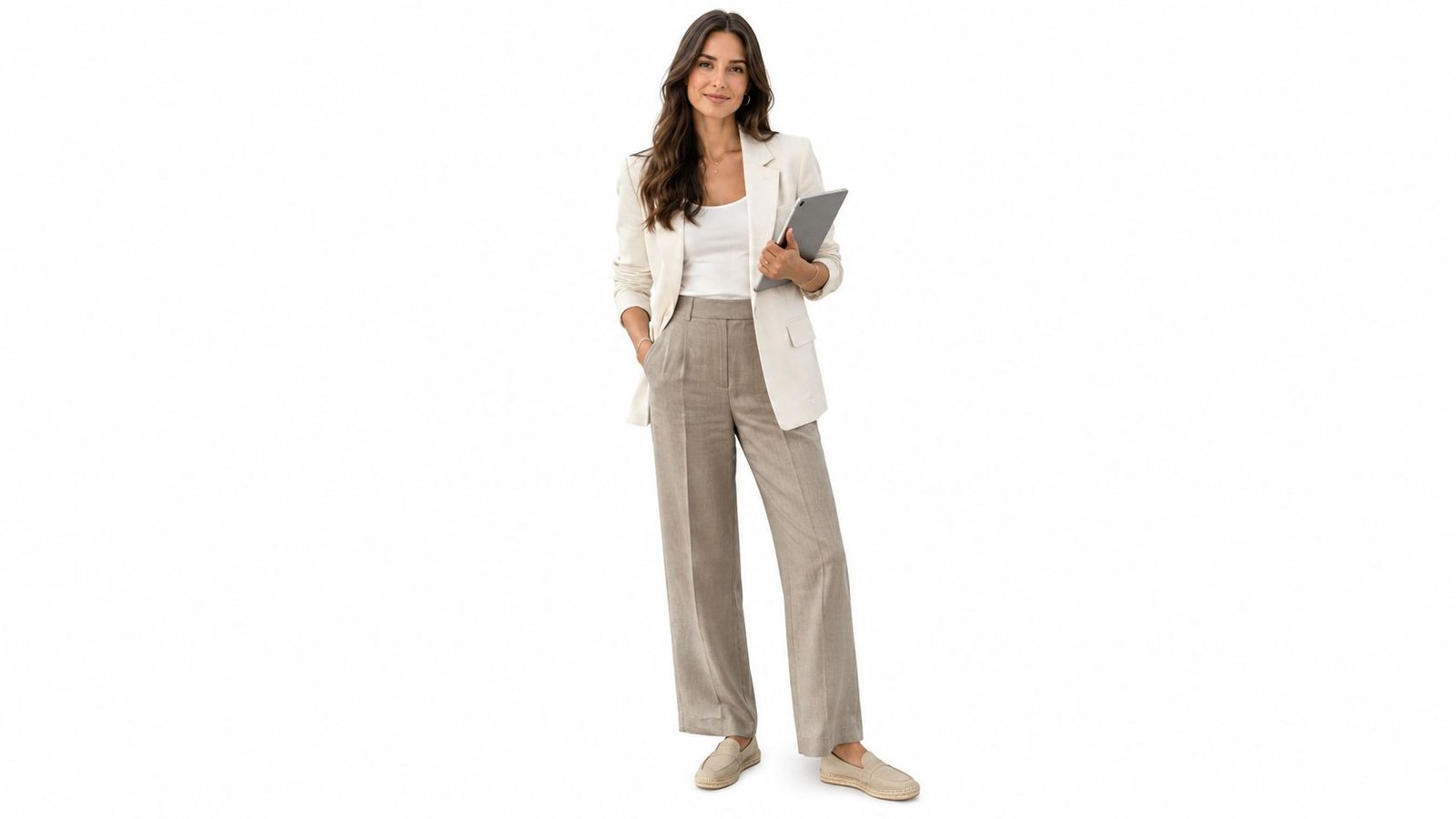
The most repeated advice on wedding planner attire is also the least adaptable: wear black, dress professionally, and stay out of the photographs. That formula can work in an air-conditioned ballroom, but it becomes less convincing when the working day moves between a sunlit masseria, a gravel courtyard, a coastal terrace, and a historic villa with uneven stone floors.
Destination wedding planning in Puglia demands a wardrobe that performs across changing conditions. A planner needs to look composed in front of the couple and guests, while also being able to carry materials, check installations, move quickly between spaces, and remain comfortable through a long event day. The right approach isn't a rigid uniform. It's a considered system based on climate, venue, formality, mobility, and brand presence.
Beyond the Black Uniform
Black remains useful for wedding planners. It photographs discreetly, looks polished, and can help a coordinating team appear visually consistent. But an all-black uniform isn't automatically the most professional choice for a summer wedding in Southern Italy. In strong sunlight, heavy dark fabrics can feel oppressive, while a black outfit may look disconnected from a bright outdoor setting built around stone, linen, sea, or Mediterranean planting.
The environment changes the uniform
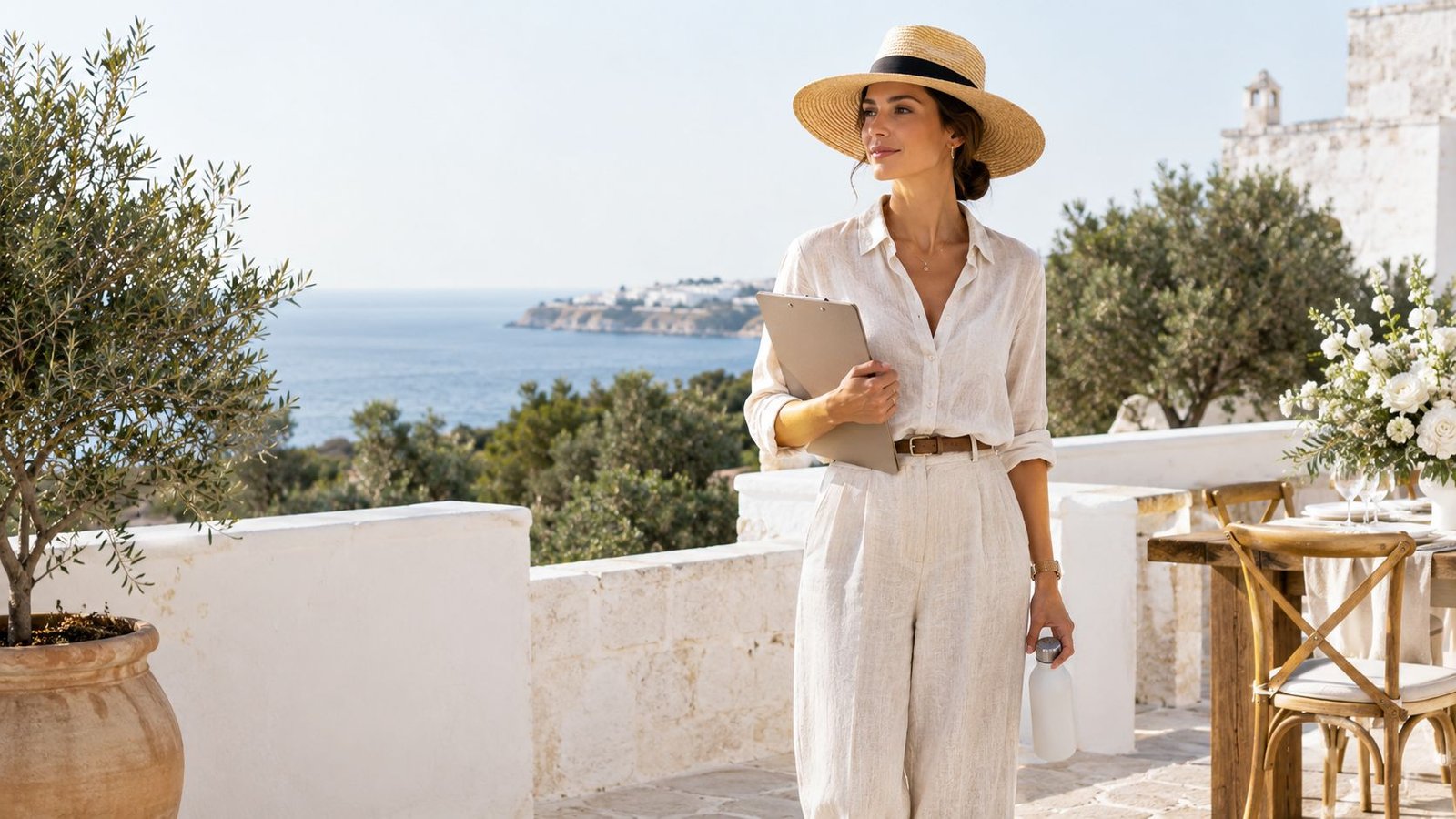
Puglia's wedding venues rarely offer one consistent working environment. A planner might begin with supplier access in a shaded service area, move to a ceremony lawn, cross a sun-exposed courtyard for photographs, and finish at a reception where the temperature and light have changed completely. Clothing that looks appropriate in one part of the venue can become restrictive, overheated, or impractical elsewhere.
The strongest wardrobe decisions start with the day's movement rather than the invitation's aesthetic. Breathable tailoring, restrained colour, and reliable footwear usually matter more than following a fixed black-only rule. Navy, charcoal, stone, olive, cream used carefully, and muted blue can preserve authority while responding more intelligently to a rural or coastal setting.
Practical rule: The planner should look like the person in control of the event, not like another member of the wedding party.
A planner also needs to remain visually separate from guests without appearing theatrical. That separation can come from a structured blazer, a refined shirt, a discreet radio, a clipboard, or an identifiable but understated accessory. It doesn't require a conspicuous uniform.
Presentation must support operations
Destination events often involve long periods of standing, quick changes in location, and unexpected contact with décor, transport equipment, or catering areas. A beautiful outfit that needs constant adjustment creates work at precisely the moment the planner should be focused on the event. The practical guidance for coordinator clothing consistently prioritizes movement-friendly cuts, darker neutrals, and garments that can withstand active work without looking casual (guidance on what wedding planners wear).
This is also why a planner may need a second look rather than one perfect outfit. A light, breathable set can suit daytime coordination, while a sharper jacket or darker layer can bring more formality to the ceremony and reception. For guest-facing moments that include digital interaction or visual sharing, a carefully designed QR code photo table card can help extend the event experience without requiring the planner's clothing to carry every visual detail (QR code photo table card).
The best destination wardrobe is therefore modular. It adapts to heat, terrain, venue character, and the changing visibility of the planner's role.
Understanding the Professional Dress Code Convention
The traditional professional standard is simple: a wedding planner should dress one level above the guests. That doesn't mean competing with the couple or wearing the most elaborate look in the room. It means appearing sufficiently polished to establish authority, while remaining practical enough to handle the work that guests never see.
The convention has a long history in event settings. Industry coverage from 2011 recorded that 33% of planners considered dress codes very important, while 50% considered them somewhat important. The same coverage reported that 19% of planners had asked an attendee to change clothes during a meeting, a useful indication that attire has long been treated as part of professional control rather than personal decoration (historical event-attire coverage).
Authority is created through consistency
At a luxury destination wedding, guests may arrive in carefully selected fashion, and the planner must not look underdressed beside them. A structured jacket, well-cut trousers, a refined jumpsuit, or a modest dress with a fitted layer can all communicate competence. The choice depends on the planner's role, the venue, and the day's physical demands.
The distinction is subtle. Clothing that is too casual can make it harder for suppliers and guests to recognize who is managing the event. Clothing that is too formal, delicate, or visually distinctive can make the planner seem detached from the operational work. The most effective balance is visible polish with low maintenance.
A hospitality perspective reinforces the value of clear expectations. In a 2024 survey, 67% of respondents said that knowing suggested attire in advance would help them feel more comfortable, while 57% said they would change outfits multiple times a day to match occasion needs (event attire expectations and guest comfort). The figures concern event participants broadly, but the implication for planners is practical: dress communicates the nature of the moment, and a multi-stage wedding may call for more than one visual register.
The one-level-above rule needs interpretation
For a formal villa reception, a planner may need a dark suit, a crisp shirt, or an elegant longline layer. For a daytime welcome gathering at a masseria, a breathable, well-fitted outfit can be more appropriate than a heavy formal ensemble. For a beach ceremony, polished separates may offer better control than a full suit or structured dress.
The standard should also accommodate different bodies, identities, and cultural expectations. A gender-neutral wardrobe can include fitted trousers, a relaxed but precise blazer, a high-quality shirt, a refined knit, or a fluid jumpsuit. Modesty may require longer sleeves, higher necklines, or additional coverage depending on the venue and cultural context.
Workwear principles are relevant here because durability matters alongside appearance. Guidance on durable restaurant workwear offers a useful reminder that garments in service environments need to support repeated movement, maintenance, and contact with the public. Wedding planners don't need hospitality uniforms, but they do need clothing that remains credible after a demanding day.
Matching Attire to Venue Type and Formality
A masseria, beach venue, and historic villa may all host luxury weddings, yet they create very different working conditions. The planner's clothing should respect the visual language of the venue without becoming costume-like. Venue awareness is a professional skill, especially when the celebration includes international guests who may read formality differently.
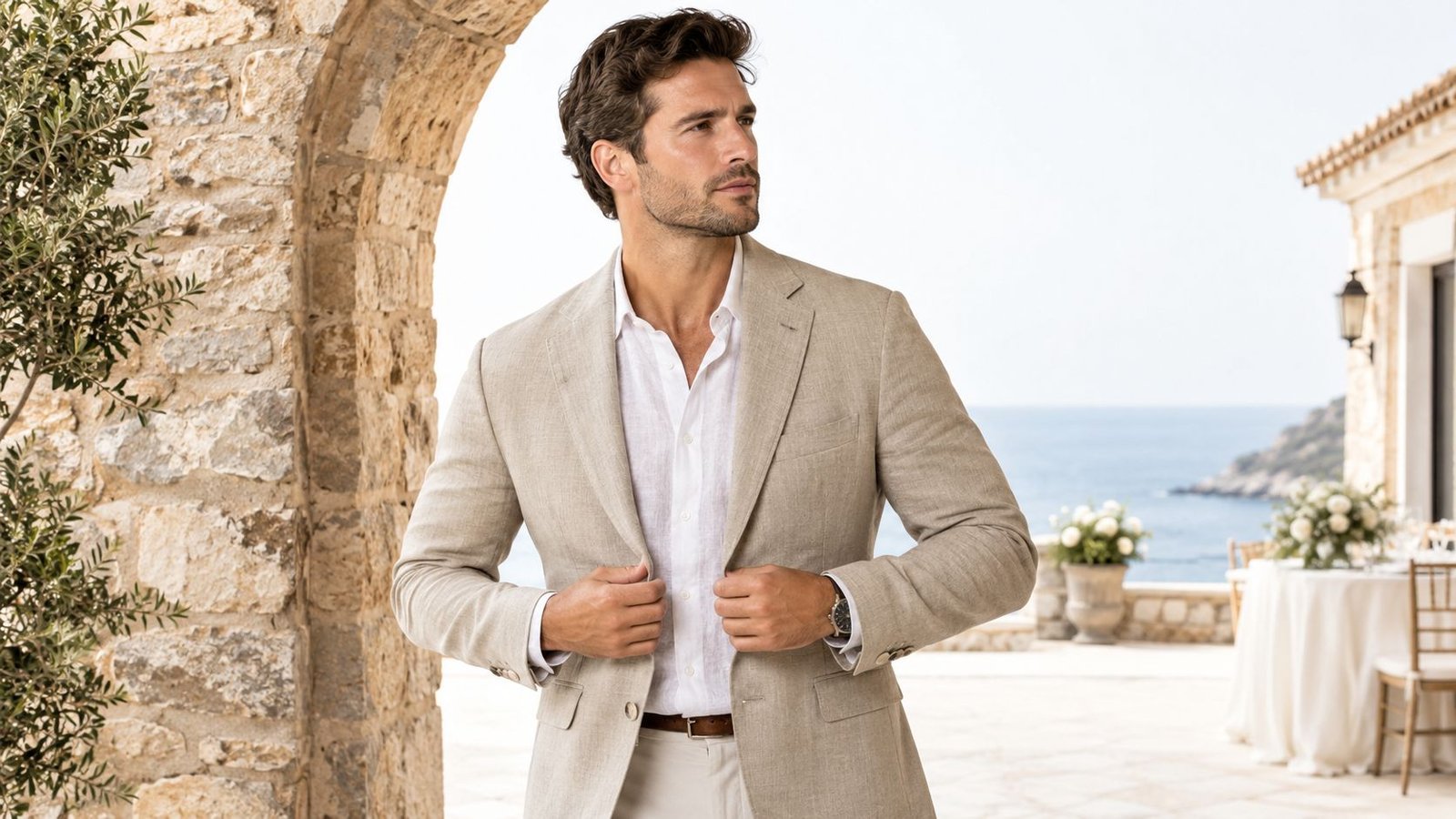
A countryside masseria usually benefits from breathable separates, a soft-structured jacket, and footwear that can handle gravel, grass, and old paving. A beach celebration requires particular attention to stability, sand, wind, and sun exposure. A historic villa or formal resort calls for sharper tailoring, but the garment still needs to permit movement through stairs, corridors, service areas, and outdoor terraces.
| Venue Type | Formality Level | Key Attire Priorities |
|---|---|---|
| Masseria or rural estate | Polished, relaxed formal | Breathable tailoring, practical shoes, muted natural tones |
| Beachfront venue | Refined daytime or resort formal | Secure footwear, lightweight layers, wind-conscious styling |
| Historic villa | Formal to elevated formal | Structured tailoring, discreet accessories, polished finish |
| Luxury resort | Formal and highly guest-facing | Coordinated separates, immaculate details, adaptable layers |
Rustic settings need controlled informality
A linen-blend blazer with fitted trousers can look more considered than a rigid black suit in a rural setting. The risk is that relaxed fabrics can drift into holiday clothing, particularly when paired with sandals, loose shapes, or unstructured accessories. The solution is not to abandon comfort, but to add one precise element, such as a defined shoulder, a pressed shirt, a clean belt, or a structured bag.
For beach weddings, planners should examine the surface before choosing shoes. Sand, timber decking, polished stone, and grass each create different risks. A low-profile shoe with dependable grip is usually more useful than a delicate style that sinks, slips, or requires careful walking. The practical considerations involved in planning a beach wedding in Puglia also show why venue-specific preparation matters before the wardrobe is finalized.
Formal venues require restraint, not fragility
Historic villas and refined resorts can justify darker colours and more formal tailoring. They don't justify clothing that restricts the planner's reach or makes kneeling, lifting, or rapid movement impossible. A suit with a little ease, a dress with a secure hemline, or a jacket that can be removed without disrupting the outfit can preserve formality throughout the day.
The planner should also consider religious spaces, local customs, and the couple's expectations. Shoulder coverage, hemline, and footwear may need adjustment for particular settings. When the venue changes during the day, the wardrobe should change through layers and accessories rather than through an entirely impractical outfit.
Practical Fabric and Footwear Choices for Italian Climate
The physical demands of coordination make mobility the first technical requirement. Wedding planners crouch to check installations, reach across tables, move between rooms, stand during ceremonies, and respond quickly when a supplier or guest needs assistance. Clothing must allow those actions without pulling, gaping, riding up, or requiring constant correction.
Choose fabric by performance
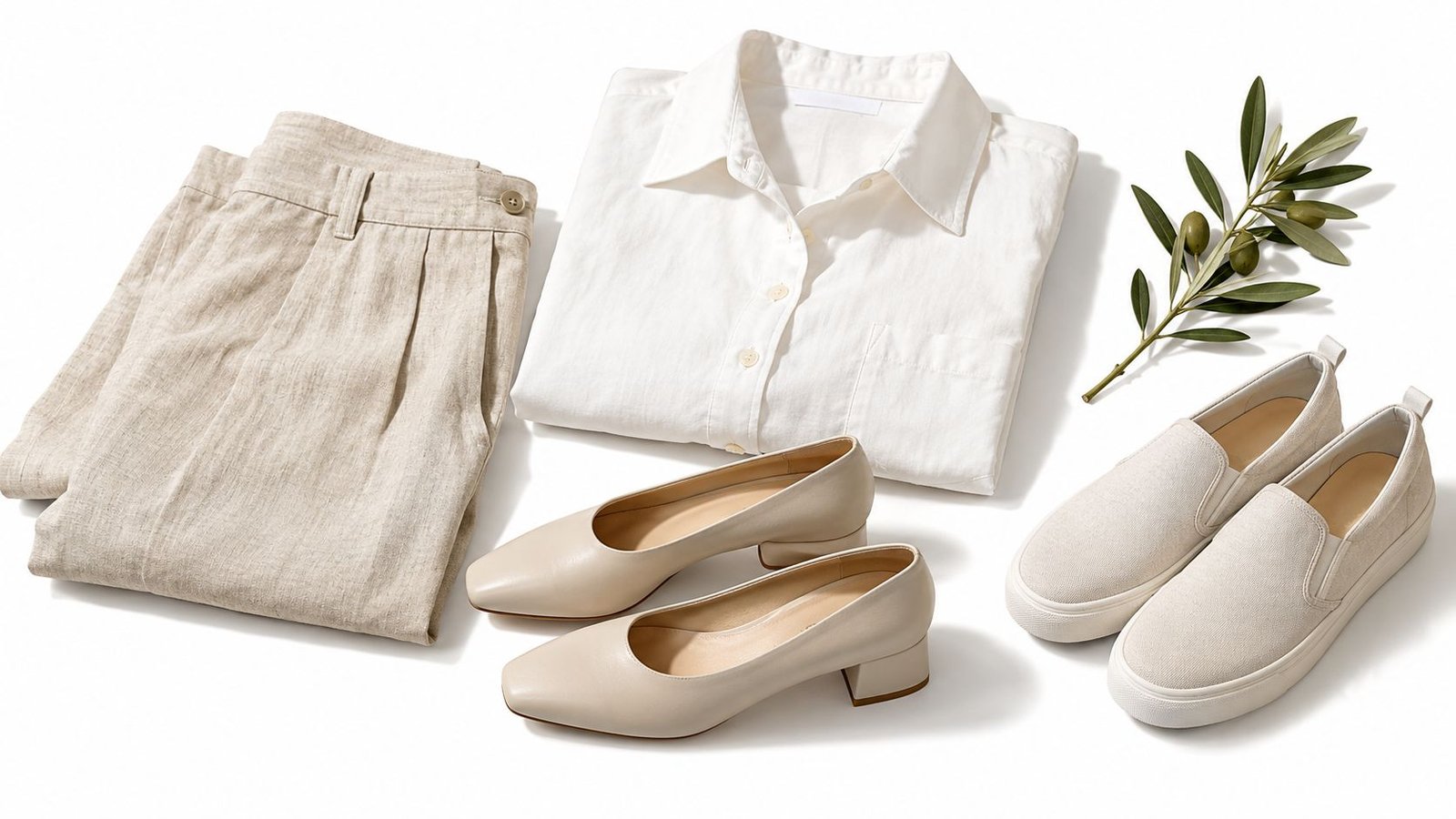
Southern Italian summer conditions favour fabrics that release heat and remain presentable after movement. Linen and linen blends can work well for daytime events, particularly in looser tailoring, although pure linen may crease visibly. A blend can offer a more controlled finish while retaining some breathability. Lightweight wool, cotton poplin, and quality technical fabrics can also be useful when the outfit needs structure and a smoother appearance.
The most reliable approach is to test each garment before the event. A planner should sit, bend, raise both arms, walk briskly, and carry the items normally used during coordination. If a waistband cuts in, a sleeve restricts movement, or a trouser hem catches under the shoe, the problem will become more distracting during the wedding.
Fabric test: If a garment looks polished only while standing still, it isn't ready for a coordination day.
Colour affects maintenance as well as aesthetics. Dark navy, charcoal, and black can disguise some marks more effectively than pale shades, while mid-tones and restrained neutrals can feel better suited to sunlit outdoor venues. White should be handled carefully because it can associate the planner with the bridal party and shows contact with equipment or surfaces quickly.
Footwear should be selected for the ground
Advice for wedding coordinators consistently points toward low or flat shoes, broken-in footwear, modest hemlines, and non-restrictive silhouettes because planners may need to crouch, reach, and move quickly. The same principle applies across Puglia's courtyards, stone paths, lawns, and terraces.
A stable loafer, refined flat, low block heel, or polished slip-on can offer a better balance than a stiletto. The shoe should be worn before the event, tested on the likely surfaces, and paired with a backup option when the day includes several venue types. Footwear that looks elegant but creates pain, slipping, or uncertainty will eventually undermine the planner's presence.
A small operational kit also helps preserve the outfit. Stain treatment, a lint roller, spare hosiery where relevant, hair ties, and a lightweight layer can solve minor problems without turning the planner's appearance into a visible distraction.
Adapting Attire Throughout Multi-Day Event Itineraries
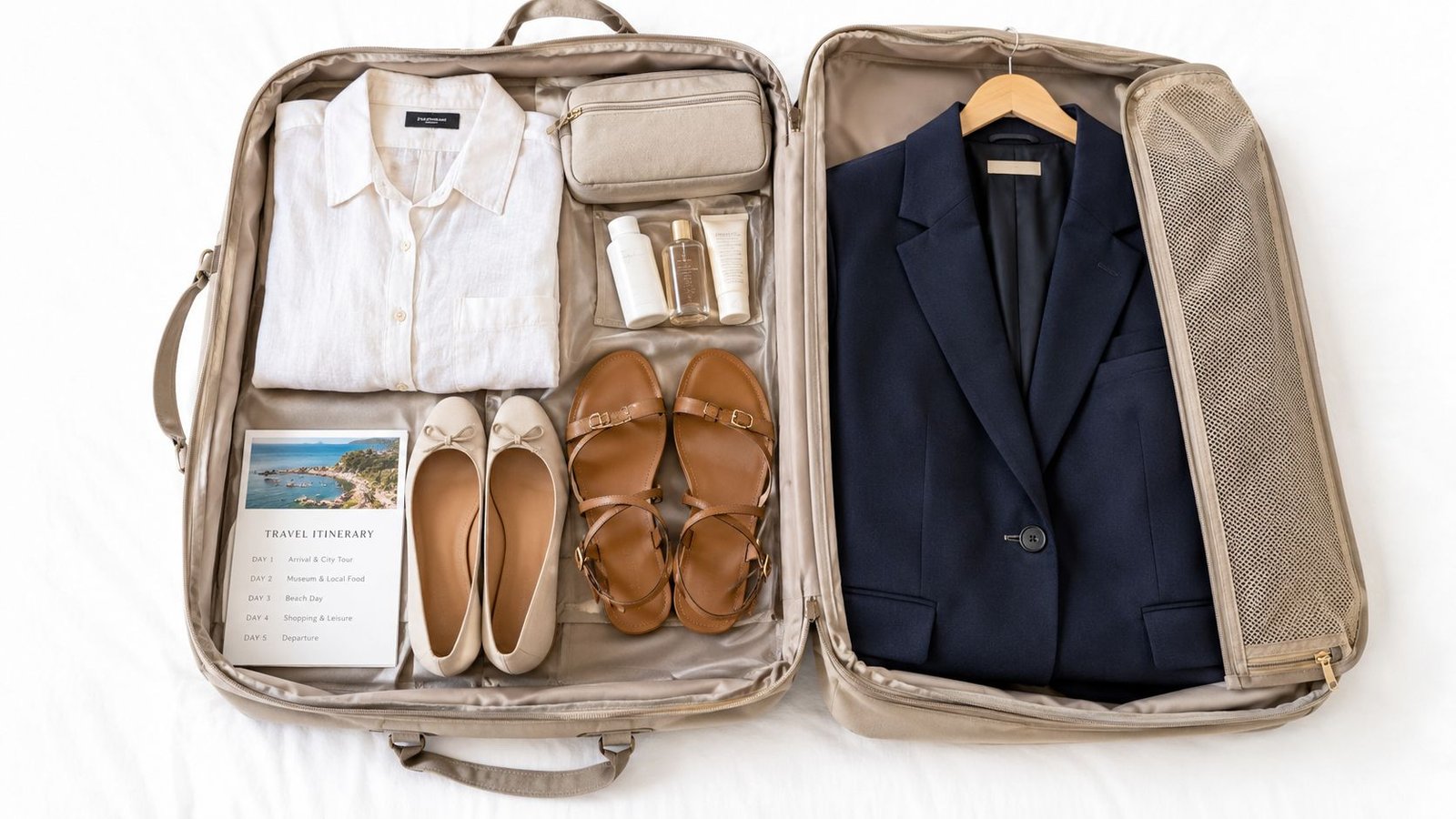
A destination wedding weekend asks a planner to move through several professional identities. The welcome dinner is social and guest-facing. The rehearsal may involve a historic site or ceremony space. The wedding day combines setup, client care, supplier management, photographs, and late-evening oversight. Treating each event as a variation of the same outfit usually creates unnecessary discomfort or an inappropriate level of formality.
A wardrobe can follow the weekend's rhythm
For a welcome dinner, a planner may need a polished but approachable look that allows conversation with the couple, relatives, and venue team. Fitted trousers with a refined shirt, or a simple dress with a lightweight jacket, can establish authority without appearing more formal than the occasion.
A rehearsal at a church, historic property, or outdoor ceremony site may require more coverage and more reliable shoes. The outfit should support movement during run-throughs while remaining respectful of the setting. A jacket, scarf, or longer layer can make the same base look more appropriate without adding a separate full ensemble.
The wedding day deserves the most operationally reliable combination. A planner might begin in a breathable shirt and trousers for setup, add a structured jacket before guests arrive, and keep a second top or complete change available if heat, dust, or contact with décor affects the first outfit. The change doesn't need to be dramatic. It needs to restore comfort and polish.
The format of a three-day celebration, such as the one discussed in this Borgo Egnazia wedding feature, demonstrates why planning the full itinerary matters. Each gathering has its own social temperature, venue demands, and degree of public visibility.
Pack for transitions, not duplication
A compact planner wardrobe should coordinate across days. Neutral trousers or a skirt can work with more than one top. A blazer can elevate a daytime base. Comfortable flats can be reserved for setup, while a more formal shoe can be introduced when the planner's movement decreases.
A useful packing sequence includes:
- Core outfits: Select garments that can work across meetings, rehearsals, and guest-facing moments.
- Layering pieces: Include a jacket, overshirt, scarf, or cardigan for changing interiors and evenings.
- Reliable footwear: Pack a tested working pair and a more formal alternative when the itinerary requires it.
- Recovery items: Carry a spare top, basic repair supplies, and clothing care essentials.
The strongest packing plan is built from the schedule, not from imagined photographs. A planner should identify every change in venue, surface, weather exposure, and formality before choosing what travels.
Modern Professionalism
The idea that professional attire must look like a fixed uniform is losing relevance. Contemporary weddings increasingly embrace personal styling, considered tailoring, and accessories with a clear point of view. That shift doesn't remove the planner's need for authority. It gives planners more intelligent ways to express it.
Personal style can reinforce trust
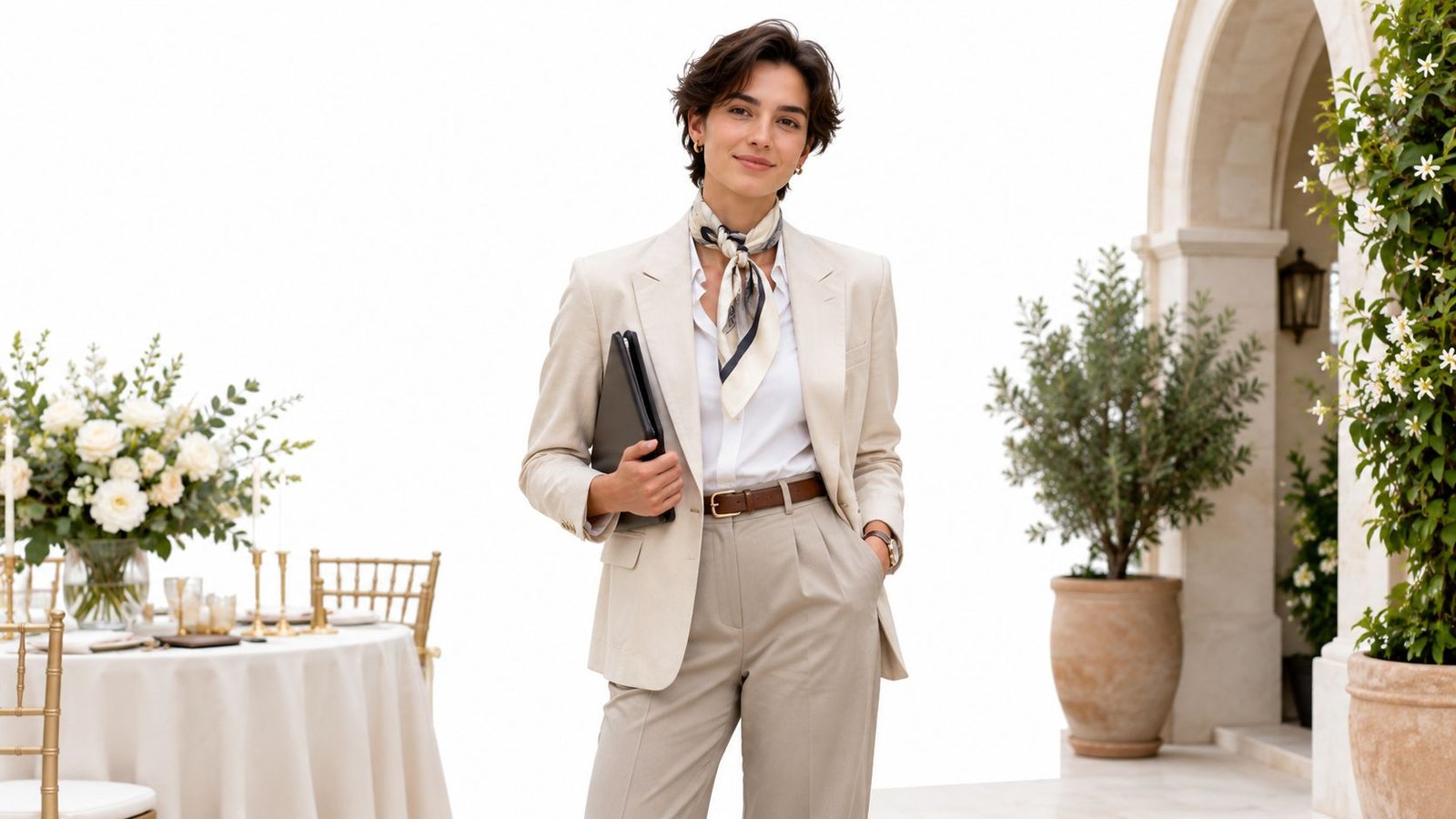
A planner's clothing forms part of the service experience. A carefully composed outfit may signal precision and design awareness, while a discreet dark wardrobe may support a behind-the-scenes operational role. Neither approach is universally correct. The useful question is whether the clothing helps the planner appear capable, culturally aware, and distinct from the guests.
Gender-neutral dressing offers a broad and practical vocabulary. Well-fitted trousers, relaxed suiting, high-neck shirts, overshirts, jumpsuits, longline jackets, and fluid separates can be combined according to identity, comfort, venue, and climate. The objective isn't to erase personal expression. It is to ensure that expression remains appropriate to the planner's responsibility.
Fit does more work than decoration. A garment can be minimalist and still look expensive when the shoulder, sleeve, rise, hem, and overall proportion are correct. A made-to-measure fit guide can help clarify why small adjustments often create a more composed silhouette than additional accessories or stronger colours.
Coordination matters more than imitation
A fashion-forward couple may choose custom tailoring, statement jewellery, or several outfit changes. The planner shouldn't imitate those choices or attempt to become part of the visual story. Instead, the planner can echo the level of intention through precise fit, controlled colour, and one recognizable detail.
That detail might be a silk scarf, an architectural brooch, a distinctive watch, a refined belt, or a signature jacket. It should remain subordinate to the couple's styling and the event's visual identity. In a culturally varied destination setting, restraint also helps the planner avoid making assumptions about dress expectations that differ between families and venues.
Italian fashion references can inform the mood without turning the planner into a runway participant. The discussion of the Dior Cruise 2021 collection offers an example of how place, craft, and visual language can shape an editorial approach to clothing. For planners, the lesson is not to reproduce a collection, but to understand how a coherent silhouette and a thoughtful accessory can create presence.
Modern professionalism is therefore neither all-black uniformity nor personal styling without limits. It is intentional clothing that performs, communicates authority, and leaves the couple at the centre of the event.
Princess Apulia can support couples planning destination celebrations in Puglia by connecting venue, itinerary, guest experience, and local planning considerations through its wedding-focused editorial and planning resources. The practical wardrobe question belongs within that larger conversation, because a planner's attire is one part of how an international wedding feels organized and culturally attuned.
Before confirming an event wardrobe, planners should review the venue surfaces, expected formality, ceremony requirements, weather exposure, setup responsibilities, and opportunities for a discreet change. Couples hiring a destination planner can raise these questions during the planning process and ask how the team will remain polished across welcome events, ceremony logistics, reception oversight, and the full wedding weekend.
For a Puglia wedding that moves between masserie, villas, beaches, and historic spaces, contact Princess Apulia to discuss planning support built around the destination, the venue sequence, and the practical experience of the couple and their guests.