

A budget wedding checklist for Italy should start with a blunt correction, a budget wedding is not a cheap wedding. In Puglia, and across Italy, the challenge is not cutting every category down, it’s deciding which costs are structural, which are optional, and which ones protect the guest experience. Couples who arrive with a hometown budget model often discover that the destination format changes the math before styling even enters the picture.
The smartest approach is to treat the budget as a sequence of decisions, not a pile of percentages. Venue rules, catering minimums, supplier travel, VAT, SIAE, transport, and multi-day hospitality shape the final number long before florals or stationery do. The goal is a wedding that feels coherent, generous, and well-run, not one that looks inexpensive on paper and expensive in problems.
Why a Budget Wedding in Italy Is Not a Cheap Wedding
A destination wedding in Italy runs on a different financial logic than a hometown celebration. The first mistake couples make is assuming the budget can be built by shrinking the usual U.S.-style categories. That logic ignores the structural costs of travel, accommodation blocks, and vendor logistics, all of which arrive before the decorative choices do.
The market data shows why this matters. In The Knot’s 2026 Real Weddings Study, the average U.S. wedding cost was $34,200, based on surveys of 10,474 couples married in 2025, while couples with budgets of $0–$15,000 spent $8,900 on average and those above $40,000 spent $70,300 on average. That spread proves the point, a “budget” checklist is really a prioritization exercise, not a universal cost cut.
The Italian reality changes the order of priorities
In Italy, the venue and food usually sit at the center of the budget because they shape everything else. Forbes Advisor reported that the average U.S. wedding cost climbed from $29,000 in 2023 to $33,000 in 2024, then $36,000 in 2025 in Zola’s reporting, a rise of about 24% across three years, and Zola’s 2026 First Look Report placed venue spending at $8,573 and catering at $6,927 Forbes Advisor on average wedding costs. For couples planning in Italy, that kind of pressure hits earlier because venue terms, staffing, and guest flow are part of the first negotiation, not the last.
A true budget wedding checklist in Italy starts by protecting the parts guests will remember and trimming the parts they won’t. That usually means investing in the venue, the food, the logistics, and the supplier team that can execute cleanly in a foreign market. Everything else should answer to that core.
Practical rule: if a line item does not improve guest comfort, timing, or the couple’s actual experience, it should not outrank the essentials.
The Core Cost Categories for a Destination Wedding in Italy
A realistic Italian budget starts with the categories that drive the rest of the plan. Venue and catering typically consume the largest share, because they determine capacity, service style, timing, and the shape of the guest experience. Photography, video, florals, transport, stationery, attire, beauty, and planning support sit behind them, but they still need to be budgeted early because they are not small add-ons in a destination format.
Start with venue, catering, and planning support
Venue and food are the first hard commitments, not the finishing touches. A common rule of thumb keeps venue, rental fees, food, and alcohol together at no more than 40% of the total budget, though that rule should bend to the couple’s priorities as long as the whole plan still equals 100% Vogue’s wedding budget planning calculator guide. One detailed breakdown also assigns 40–50% of the budget to venue, food, and bar combined, with 10–15% for photography and videography, 8–15% for planning services depending on scope, and 10–15% for contingency For De Weddings checklist.
For destination weddings, planning support is not a luxury line. It is the thread that keeps contracts, schedules, logistics, and supplier coordination from drifting apart. Princess Apulia’s own planning resources frame budgeting as a category-based exercise, and couples comparing catering options in Puglia can use this guide to wedding catering in Puglia as a practical starting point.
Use a category map, not a shopping list
The useful way to read the checklist is by function, not by decoration. Venue and catering define the operating environment. Photography and video preserve the weekend. Florals and design shape the atmosphere. Transport and accommodation protect the guest journey. Stationery and beauty support the presentation, but they should never be allowed to crowd out the things guests feel.
For couples considering villa settings, Approved Experiences Traveler villa tips is a helpful reference for understanding how villa rentals behave differently from hotel-based events. That matters in Italy, where private properties can look flexible on the surface but still carry event-specific constraints that affect the budget.
| Category | Share of Budget | Notes |
|---|---|---|
| Venue, catering, and bar | 40–50% | Usually the biggest share, because it sets capacity, staffing, and service structure |
| Photography and videography | 10–15% | Worth protecting because the visual record can’t be recreated later |
| Planning services | 8–15% | Higher for full-service destination coordination, lower for limited support |
| Contingency | 10–15% | Keeps the budget from collapsing under overtime, small changes, and late fees |
| Transport and guest logistics | Variable | Depends on location spread, guest count, and whether ceremonies and receptions are separate |
| Stationery, beauty, music, florals, attire | Variable | All useful, none should consume the core budget before the essentials are set |
Hidden and Underestimated Costs in Italian Weddings
The most expensive surprises in Italy are usually not dramatic. They’re administrative, logistical, and tax-related. Couples often compare vendor quotes as if they were home-market estimates, then discover that the final invoice includes layers they never planned for. That’s where a destination budget gets distorted.
Tax, licensing, and service charges change the real number
Italy applies 22% VAT on most wedding services, and international couples frequently miss that when they compare quotes against tax-free or differently taxed home markets. SIAE fees, the Italian copyright society charges for music, apply to recorded and live music and can be substantial depending on venue and duration. Overtime also matters, because once the schedule runs long, staff, musicians, photographers, and transport providers can all invoice extra.
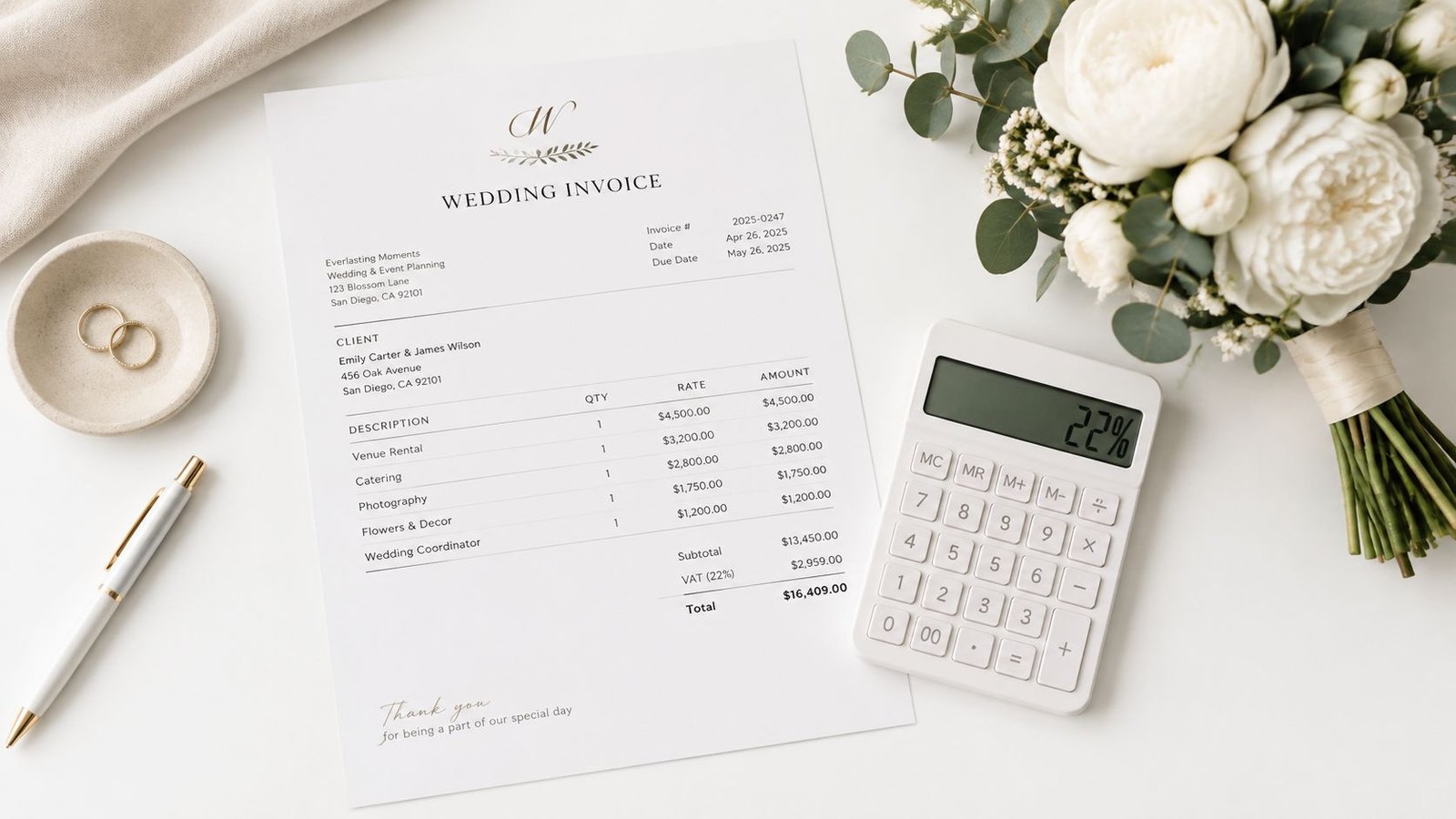
Those are not optional extras. They are part of the cost of producing an event in Italy. For a couple planning from abroad, the safest approach is to request quotes that clearly state whether VAT is included, whether music rights are covered, and how late finishes are billed.
Logistics pile up faster than couples expect
Supplier travel and accommodation are another common blind spot. When photographers, florists, musicians, or planners are coming from Milan, Rome, or outside Italy, the destination itself becomes part of the line item. Legal paperwork also adds friction, because translation, apostille, and consular steps can increase the administrative cost of getting married.
A good budget wedding checklist should also reserve room for service staff meals, gratuities, parking, setup and breakdown fees, technical production, and the chain reaction that comes from a multi-day schedule. Princess Apulia’s guide to unexpected wedding expenses is worth reading alongside the budget, because these are exactly the kinds of costs that erode a polished plan.
The couples who stay calm are rarely the ones with the biggest budget. They’re the ones who asked the annoying questions before the deposits were paid.
Where You Can Save and Where Cutting Corners Backfires
Saving money in Italy should mean protecting the guest experience while removing waste. The wrong kind of saving creates friction, delays, or venue trouble. The right kind trims surface complexity without lowering the standard of hospitality.
Smart savings versus false economies
| Where You Can Save | Where Cutting Corners Backfires |
|---|---|
| Choose a weekday ceremony or an off-peak date in Puglia | Booking a venue without checking permits, noise rules, and event permissions |
| Keep stationery digital or minimal | Self-coordinating outside vendors without handling travel and accommodation properly |
| Use family-style catering when it suits the venue and guest count | Skipping wedding insurance on a destination event |
| Simplify the bar menu instead of expanding it | Hiring a single photographer without any backup gear or contingency plan |
| Consolidate events in one location when possible | Splitting every moment across multiple venues and then paying for extra transport |
| Reduce printed inserts and extra paper goods | Assuming last-minute transport can be arranged cheaply for a large guest group |
The strongest savings usually come from fewer moving parts. One venue for ceremony and reception, a simpler beverage plan, and a cleaner stationery suite all reduce operational strain. In Puglia, where masserie, churches, and reception spaces are sometimes separated by distance, transport can become a budget line that grows with every extra stop.
Save on choices, not on resilience
What should not be cut is the infrastructure that prevents failure. Insurance matters because destination events carry more variables. Proper vendor contracts matter because they prevent surprise fees. A backup plan for weather, transport, and timing matters because guests are flying in and expecting a smooth weekend, not a logistics puzzle.
Family-style catering can be a sensible simplification when the venue and menu suit it. Printed paperless stationery also makes sense if the guest list is well organized and the itinerary is clear. But trying to save money by underbidding transport, skipping legal checks, or ignoring venue permissions usually creates a larger bill later.
Mapping the Checklist to Your Planning Timeline
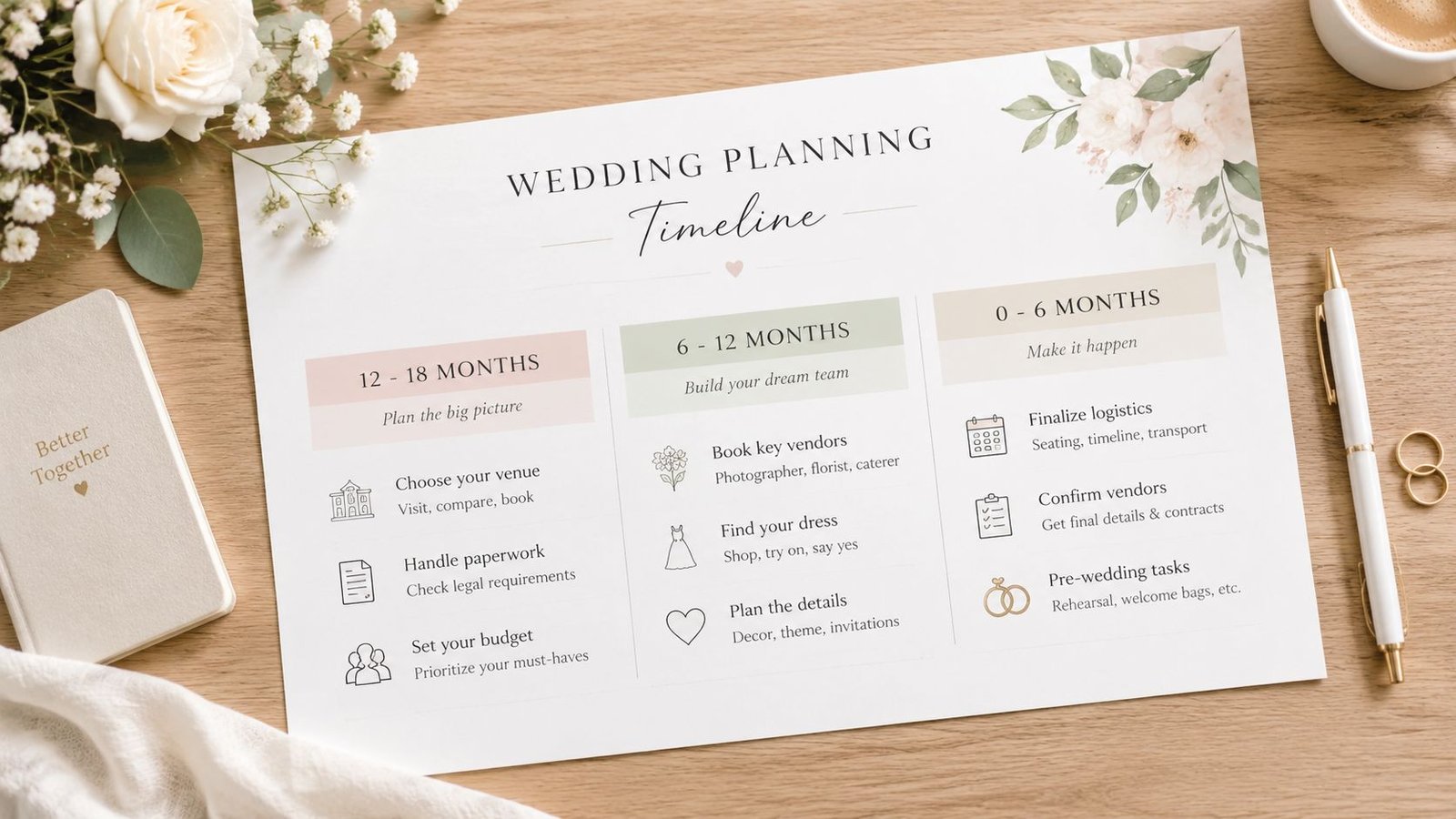
A destination wedding budget behaves better when it’s attached to a timeline. Without deadlines, couples drift, pay deposits too late, and lose negotiating power on the categories that matter most. Italian weddings reward early commitment, especially in high season.
12 to 18 months out
This is the window for the venue, date, legal paperwork, and core suppliers. Those decisions set the budget’s foundation because they affect availability, travel assumptions, and the shape of every other quote. Delaying entertainment or florals is manageable. Delaying the venue is not.
This is also the stage where couples should decide whether the celebration is a single-day event or a multi-day one. That one choice changes catering, transport, and accommodation planning immediately. A budget that ignores that distinction usually gets corrected later, and not gently.
6 to 12 months out
This is the working phase for stationery, guest communications, attire fittings, menu tastings, and music planning. It’s also the point where SIAE paperwork and currency comparison become more relevant, because more suppliers are now being locked in. The value of this window is control, the trade-off is that fewer vendors remain available if the couple waited too long.
For couples organizing a smaller celebration, Princess Apulia’s guide to intimate weddings abroad is a useful companion to the budget plan. It fits well with the reality that a smaller guest list changes the economics of almost every category, especially catering, transport, and accommodation.
0 to 6 months out
The final stretch is about guest logistics, welcome events, and contingency reserves. This is when shuttle timing, room blocks, late vendor coordination, and backup budgets matter most. Couples who spend their cushion early usually end up negotiating under pressure, which is the least efficient way to plan in a foreign market.
A practical planning stack also helps. The final checklist should be tracked in a single currency and paired with a decision log. That log should state what’s already been conceded and what still can’t move.
For couples who want to organize the whole budget and task list cleanly, a simple spreadsheet structure helps more than a dozen scattered notes. use ABC Hire for wedding rentals can be a useful reference for thinking through rental dependencies when the event requires more than a venue package.
Guest Experience Moments That Quietly Reshape the Budget
The budget changes as soon as the wedding becomes a weekend. Welcome dinners, farewell brunches, shuttles, and room blocks turn a single event into a hospitality program. That’s exactly why destination couples need to budget around the guest experience, not just the ceremony.
Multi-day hospitality shifts the spending pattern
A welcome dinner can absorb more of the budget than couples expect because it adds another catering moment, another venue setup, and often another transport solution. Farewell brunches do the same. When the celebration spans several days, the event stops being a single invoice and becomes a sequence of connected services.
In Puglia, this matters even more because guests may need movement between masseria, church, reception site, and hotel. Shuttle rentals scale with guest count, and every extra transfer adds timing risk. The budget should reward smoother sequencing, not more complicated routing.
Simplify the moments that guests feel least
Not every hospitality moment needs to be formal. A casual pizza night or relaxed rehearsal dinner can protect atmosphere without duplicating the scale of the wedding meal. That kind of consolidation keeps the weekend warm and social while avoiding unnecessary repetition in catering and staffing.
The better question is not whether a couple can add more events, but whether each event improves the guest journey. A single well-run welcome gathering often does more for the tone of the weekend than two underfunded add-ons. Guests remember clarity, comfort, and ease.
If the guest experience already feels complete, adding another event is usually about preference, not value.
Smart Priorities That Protect an Italian Wedding Budget
The safest Italian wedding budget is built on a short list of essentials. Venue, date, supplier travel assumptions, legal paperwork, and guest logistics should be locked before decorative decisions get attention. That ordering keeps the budget from being reshaped by late availability and avoidable service premiums.
Protect the budget before the styling gets seductive
A contingency line should sit in the plan from the beginning, not after the main categories are spent. A sensible range is 10 to 15 percent held back for supplier overtime, late tax ID verification, and last-minute transport changes For De Weddings checklist. That cushion is especially important for couples planning from abroad, because one delayed transfer or one extra vehicle can upend the margin fast.
Track every quote in a single currency and ask whether each supplier can apply the reverse charge mechanism for non-EU couples when relevant. That conversation can materially affect the final invoice, so it should happen before any deposit leaves the account. Tax treatment is not a back-office detail in Italy, it is part of the budget strategy.
Use a decision log, not wishful thinking
The most protective habit is a one-page decision log. It should list the three essentials and the three concessions already made. That forces trade-offs into the open before the budget hardens into something the couple never intentionally chose.
A destination wedding in Italy works best when the budget is treated like a design tool. Spend on the moments guests feel, cut the parts that create friction, and lock the liabilities early. For international couples planning in Puglia, that is the difference between a well-managed weekend and a stressful one.
For couples planning a destination wedding in Italy, the next step is simple. Build the budget around venue, food, transport, and contingency first, then pressure-test every other category against guest experience and logistics. Princess Apulia’s planning resources can help couples shape those decisions into a workable plan, and the strongest move now is to review the venue, supplier, and guest-event structure before any deposit is paid.