
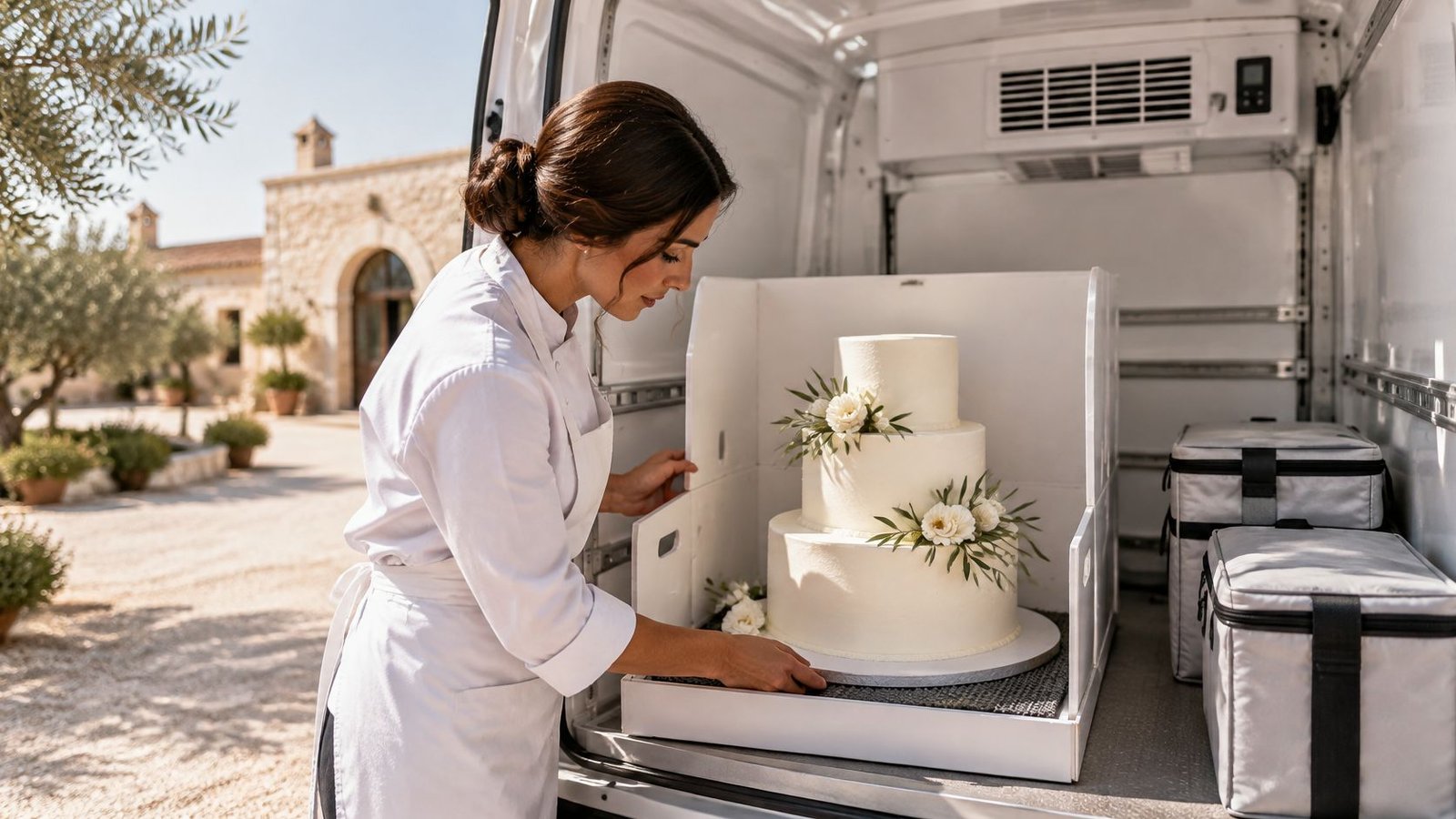
A couple has chosen the cake, agreed the flavour with a baker in one town, and booked a masseria, hotel or coastal venue in another. The remaining question sounds simple until the wedding week arrives. Who moves the cake, in what vehicle, and where does it go when it arrives? Knowing how to transport wedding cake safely means answering those questions before anyone lifts a box.
Transport isn't a single drive. It's a chain of custody that runs from bakery counter to vehicle, from vehicle to refrigerator, and from refrigerator to the table where the cake is stacked, checked and finally cut. Each handover needs a named person, a suitable cool space and a method that suits the filling inside.
Assign Responsibility Before the Cake Leaves the Bakery
Say the baker works in a town centre, the couple is staying at a hotel nearby, and the reception is at a masseria outside town. The cake might leave the bakery with one driver, wait in a hotel corridor, then travel again with someone else. None of those moves is difficult on its own. Problems start when each person assumes another person has agreed to receive, refrigerate or assemble it.
That route should become a short written record before any box is closed. The record doesn't need technical detail. It needs names, places and times, plus a clear line between what the baker does and what the venue does. The baker stays responsible for the cake itself, its structure, packaging and handling instructions. The couple's task is narrower. Every handover needs a named person attached to it.
Questions to settle in writing
- Delivery scope: Does the baker deliver, stack and carry out light repairs, or does delivery end when the cake is indoors?
- Named receiver: Who accepts the cake on arrival, checks the boxes, and signs or confirms that they arrived?
- Storage place: Which refrigerator or cool room will hold each tier, and has someone confirmed that the shelves fit the boards?
- Assembly: Who stacks the tiers if the baker can't travel, and has that person agreed to do it?
- Cake details: What are the filling, icing, fresh fruit and fresh flowers, since those decide how the cake must be chilled?
A porter, florist or coordinator shouldn't inherit any of these tasks by default. Each person needs to agree in advance and receive the baker's instructions. A florist may place flowers on a finished cake without being qualified to stack tiers. A venue manager may open a service entrance without having space in a refrigerator. Those are different jobs, and the plan should say so.
This is also where couples often discover the practical gap between professional coordination and informal help. The guide to the difference between a professionally organised wedding and one arranged with friends and relatives is relevant here because transport fails at handovers, not only on the road. A helpful guest with a large car isn't a substitute for an agreed receiver, a checked refrigerator and a person briefed to assemble the cake.
A transport plan isn't complete when a driver is found. It's complete when someone named is waiting at the other end.
Match the Method to Filling and Heat
The method follows the filling. A firm sponge with a stable sugar finish and no perishable filling presents a different problem from a cake layered with mascarpone, custard or fresh cream, and treating both alike leads either to unnecessary cost or to a genuine food safety risk. Telling a driver to keep the cake cool sets no number, no container and no deadline. The right method depends on what is inside the cake, how warm the route will be, how long the cake sits outside refrigeration at each transfer, and whether the venue can refrigerate it the moment it arrives.
Couples don't need to become food safety specialists. They do need to ask the baker one direct question: does this cake need a continuous cold chain, or does it need protection from heat and movement for a short, controlled journey? The answer decides the vehicle, the container and the timing of every handover.
Start with the filling
Cakes containing cream, dairy or buttercream need more care than a firm cake with no perishable filling. UK local-authority home catering advice recommends keeping them cool with ice packs and limiting time outside refrigeration. Chill thresholds differ between countries, so the baker's local rules and recipe instructions should govern the decision. The principle travels everywhere. A perishable filling needs measured cold at each stage, from the bakery bench to the vehicle, from the vehicle to the hotel refrigerator, and from there to the venue cool room. A cabin that feels cool proves nothing about the temperature inside the box.
A delicate Italian cake makes the distinction concrete. A couple considering a mille-feuille wedding cake in Italy should ask how the cream, pastry and fruit will be held before assembly, because the appearance of the finished cake says nothing about how it was handled. Crisp pastry, soft cream and summer heat pull in different directions. The baker may prefer late assembly close to service, which changes the transport plan entirely.
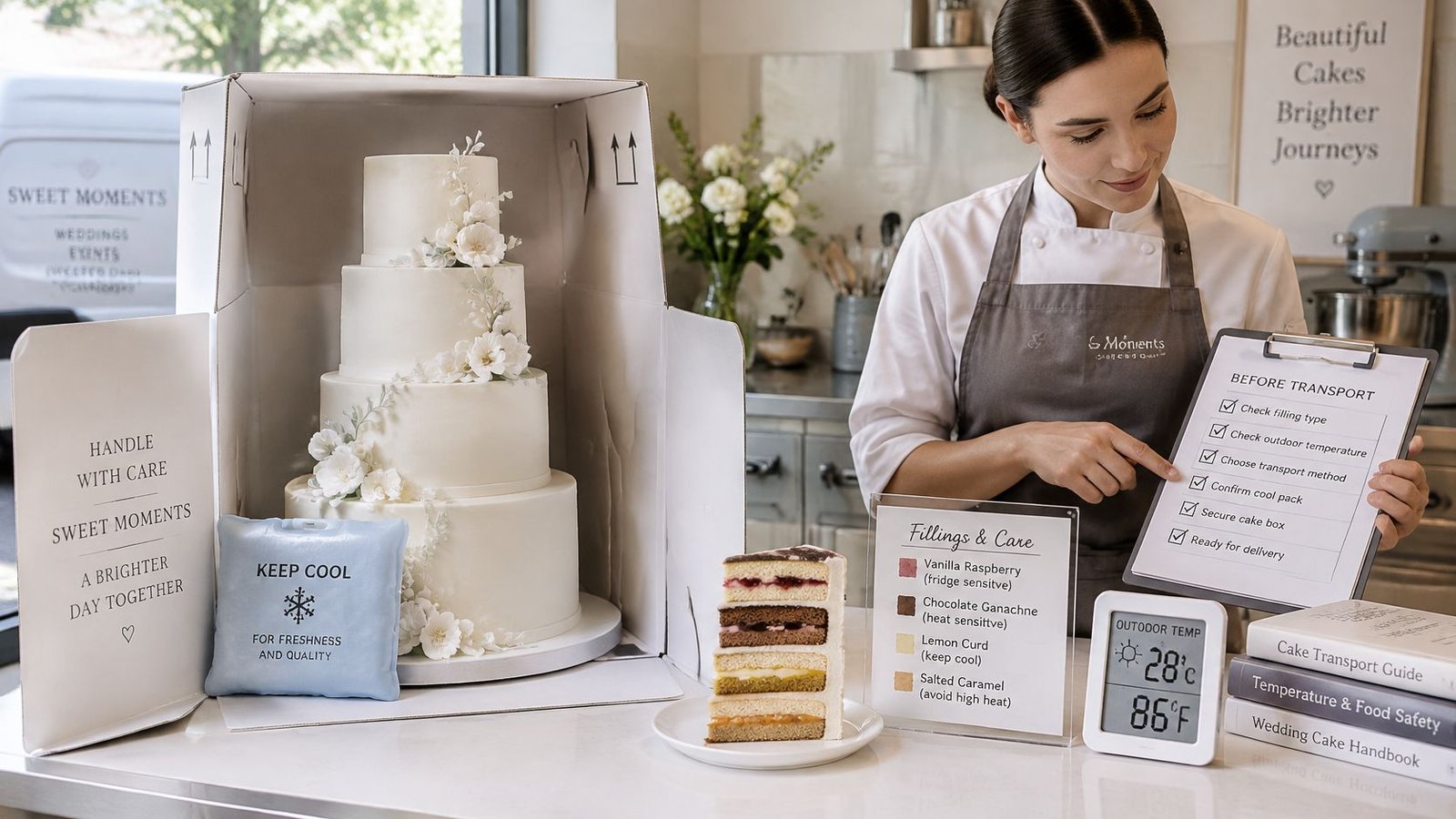
Compare the three practical options
An ordinary air-conditioned car can suit a short run with a firm cake. Cool the cabin before loading, keep the box level, and take the cake straight into a cool room on arrival. That option weakens when loading happens in a sunny courtyard, when traffic slows on a coastal road, or when nobody is waiting to receive the cake.
An insulated box with ice or frozen gel packs adds a buffer for perishable fillings. Packs must stay off the finish, and the box still needs a prompt refrigerator at the other end. Insulation slows warming for a limited time and buys margin at each handover.
A refrigerated vehicle is the safer choice for long routes, uncertain traffic, outdoor receptions or a venue that can't refrigerate the cake promptly. It costs more and needs booking earlier. In return, the couple never stretches a car journey beyond what the filling allows.
| Method | Suited to | Conditions |
|---|---|---|
| Ordinary air-conditioned car | Firm cake with no perishable filling | Short trip, level box, straight into a cool room |
| Insulated box with ice or frozen gel packs | Cream, custard, mousse, mascarpone or other dairy fillings | Packs kept off the finish; held at the baker's stated limit for the whole journey |
| Refrigerated vehicle | Long routes, unpredictable traffic, outdoor receptions or a venue unable to refrigerate promptly | Use instead of stretching the time limits |
Why air conditioning alone isn't enough
Air conditioning helps, and a chilled cabin is better than a hot boot. It gives no temperature reading, though. Cabin temperature rises when doors open, when sun hits the windows, and when the driver stops. A cake also warms during the short walks at each end of the journey: from bakery to car, from car to hotel kitchen, and across a stone courtyard in Puglia in summer.
Heat exposure therefore starts counting the moment the cake leaves refrigeration. Loading, traffic delays, the hotel handover and waiting beside an outdoor reception all add to the total. That single shift in thinking often changes the chosen method, because the drive itself is frequently the shortest part of the time the cake spends outside a fridge.
The agreed result should be written down in plain terms: the filling and icing, the chosen vehicle or container, the expected journey time, and the refrigerator waiting on arrival. If any part of that sentence is vague, the method hasn't been chosen. The baker should confirm it, because the recipe may impose stricter handling than general guidance.
How to Pack, Chill and Drive the Cake
Packing, chilling and driving work as one sequence. A cake loaded warm into a perfect box is still warm. A cold cake placed on a sloping seat can still slide. Good transport separates two risks that couples often confuse. Food safety depends on temperature, time and cleanliness. Structural safety depends on support, level surfaces and gentle movement. A method must control both.
Temperature is the measurable part. The U.S. Food and Drug Administration guidance advises keeping cold perishable food at or below 40°F (4°C) during transport and using a cooler with ice or frozen gel packs. It also sets a limit of no more than two hours at room temperature, reduced to one hour when surrounding temperature exceeds 90°F (32°C). Those figures are maximum safety limits, not a target delivery window.
USDA safe handling guidance adds the practical check. The USDA guidance on safe handling of take-out foods recommends an insulated cooler with ice or frozen gel packs and checking temperature with an appliance thermometer, while keeping a refrigerated cake at or below 40°F (4.4°C). The thermometer matters because a box can feel cool on the outside while the food inside has warmed.
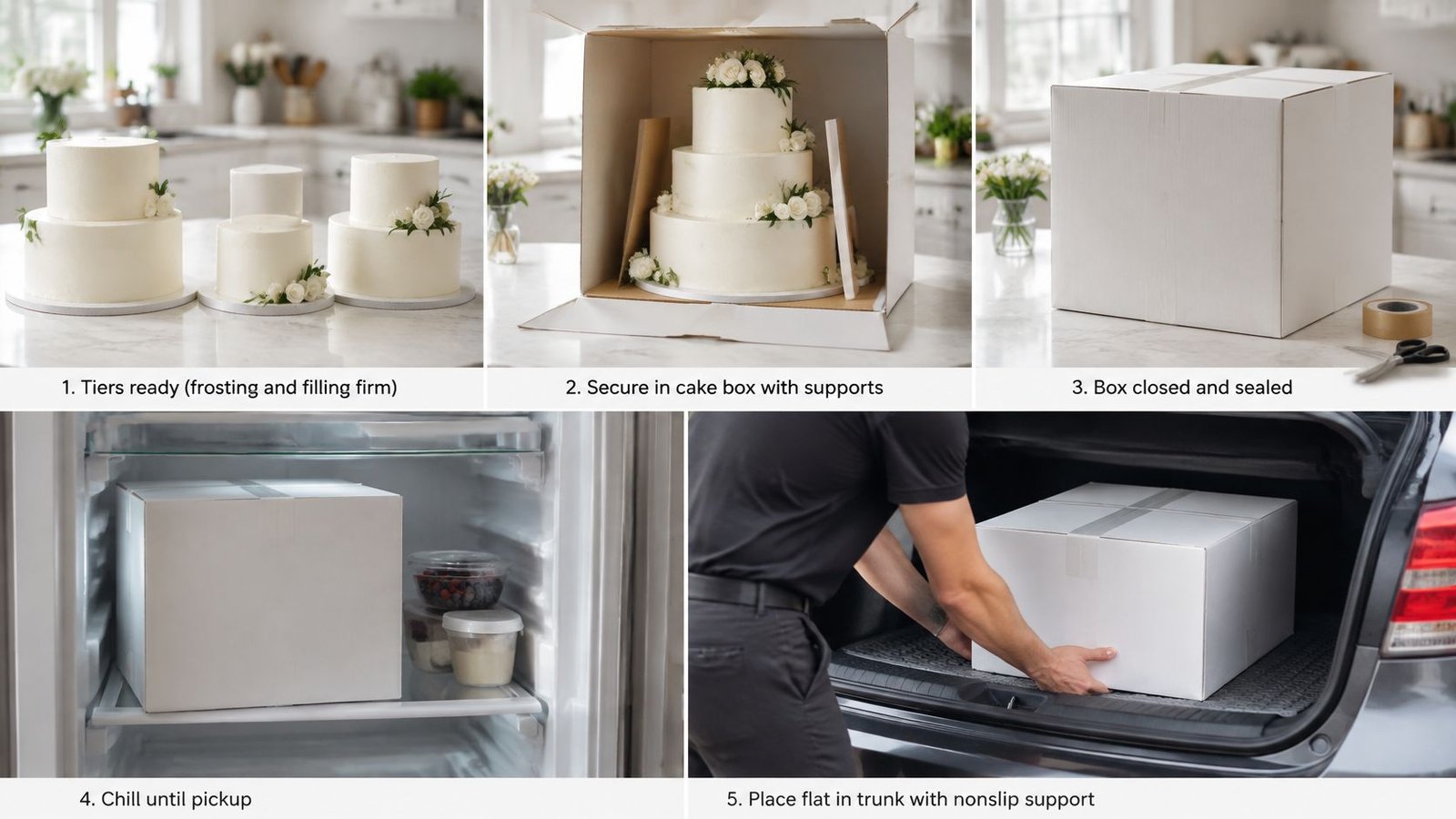
Five moves in order
Chill before departure: Chill the fully boxed cake until the frosting and filling are firm. Cold buttercream resists small knocks better than soft buttercream, and a firm filling is less likely to shift under the weight above it. Keep tiers separate unless the baker has a specific structural reason to travel them stacked.
Box each tier securely: Use clean, food-safe boxes or sealable containers, with each tier centred on a sturdy board and prevented from sliding. Nothing should press into buttercream or fondant. Couples comparing box sizes and board clearances can use cake packaging advice from Monopack as background, then confirm the final box choice with the baker. A box that's too large allows movement. A box that's too tight damages the finish during loading.
Load into a cooled, level space: Cool the cabin before the box comes out of the bakery, shade the box while it's carried, and place it on a flat, non-slip surface in the passenger compartment. A seat slopes. A lap moves. A boot heats up and hides problems until the car stops. The floor area, cleared and level, gives the box the steadiest base, subject to the vehicle's layout and the baker's instruction.
Drive for the cake, not the schedule: Use gentle acceleration, braking and cornering. Keep stops short and purposeful. Don't leave a refrigerated cake in a parked car, and don't let direct sun fall on the box through a window. If traffic threatens the time limit, the driver should contact the receiver rather than improvising a long wait outside the venue.
Refrigerate first, assemble second: Move the cake directly into a refrigerator or cool holding room on arrival. Assembly comes afterwards, on a clean, level table, using the baker's boards, dowels and repair kit. Opening boxes in a warm doorway for photographs or inspection wastes the cold that protected the cake on the road.
Protect the finish without breaking the cold chain
Cold packs create a trade-off. They protect perishable fillings, but packs placed directly against fondant or buttercream can cause condensation and localised freezing. Both mark a smooth finish. The baker should position packs so cold air circulates without contact, often with a barrier between pack and cake box. Couples shouldn't rearrange that setup in the car because it looks untidy.
Condensation also explains why a cake shouldn't move repeatedly between cold and warm rooms. Each change can leave moisture on the surface, soften decoration and blur sharp edges. One controlled move from refrigerator to assembly table is better than several short moves for checking, photographs and discussion.
Practical rule: A non-slip mat controls movement only. It doesn't control temperature, contamination or time.
Separate tiers, with one condition
Separate tiers reduce the consequences of vibration. A bump shifts one boxed tier rather than stressing a tall, stacked structure. Separate boxes are also easier to fit into refrigerators and insulated containers. The condition is assembly. A trained person needs time, a clean workspace, level support and the correct boards and dowels at the venue.
A cake travelled stacked by an experienced baker may still be the right choice for a short route. That decision belongs to the baker, who knows the internal supports and the firmness of the finish. What couples should avoid is assuming that a finished multi-tier cake is the normal way to travel. In many destination wedding routes, it's the least flexible option.
Where the baker's instructions differ from these steps, the baker's instructions win. Recipes, icings, season and distance change the safe method. The couple's role is to make sure the vehicle, timing and receiving space match those instructions, rather than asking the driver to improvise around them.
Plan Puglia Roads and Wedding Weekends
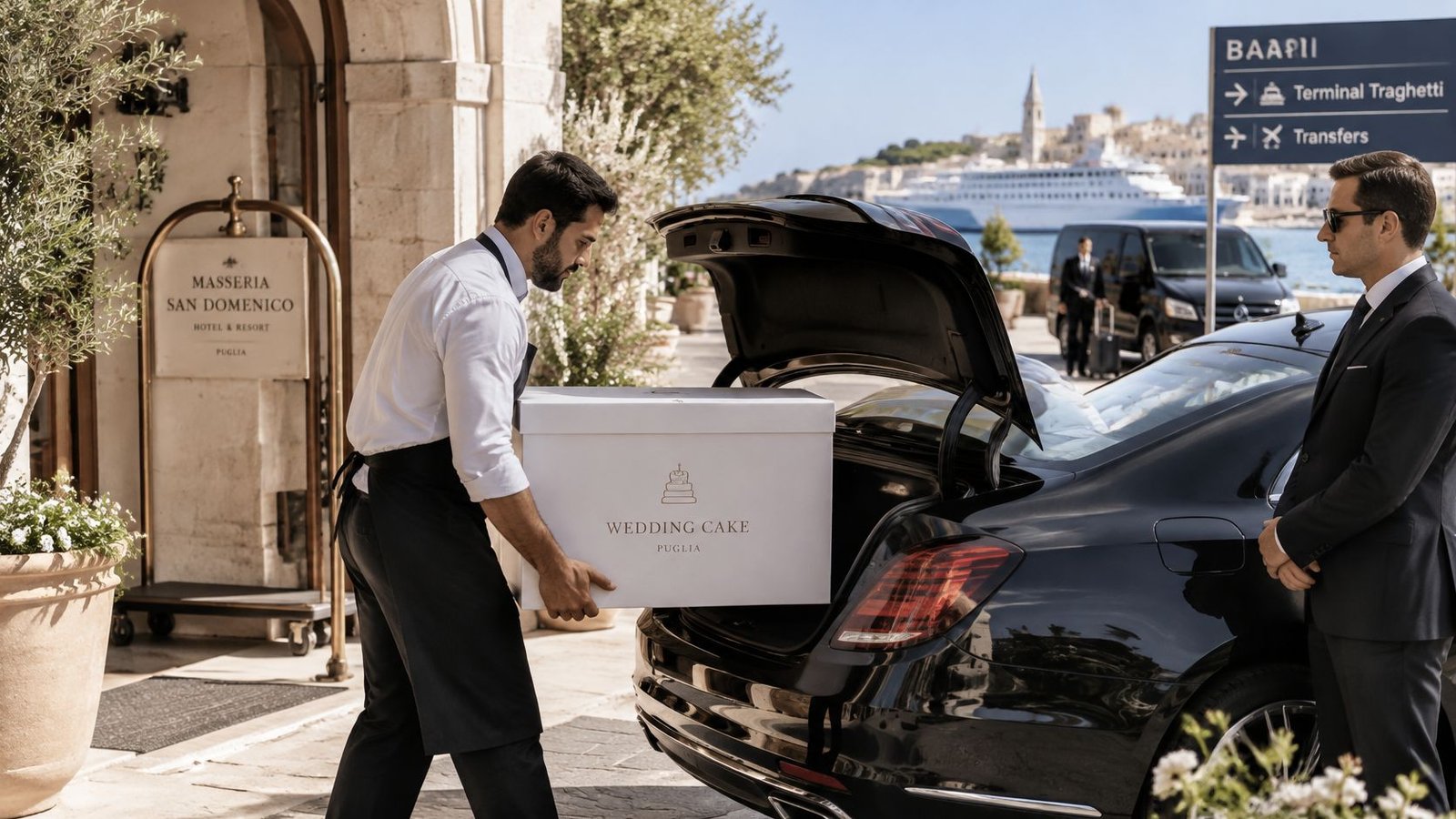
The risk is easiest to see on a Puglia route: a cake leaves the bakery, enters a hotel through the luggage door, changes vehicle for the rural transfer, then crosses gravel or garden paths to a masseria kitchen. The longest exposure may sit outside the car, in corridors, courtyards and service rooms where nobody has clearly taken charge.
Design the cake around those logistics before fixing the display plan. Guidance collected by America's Test Kitchen on transporting a cake safely supports the practical basics behind that approach, including carrying tiers separately and securing the board. For a Puglia wedding weekend, those basics need a documented handover around them. A secured board still leaves open who opens the kitchen door, who checks the tiers and where the cake waits during the ceremony.
Write the chain of custody
- Acceptance: Who receives the cake from the baker or driver, and where exactly does that handover happen?
- Storage: Which refrigerator or cool room holds it between arrival and service, and who has access?
- Condition check: Who records the time of arrival and notes any damage before boxes are opened further?
- Assembly: Who stacks the tiers, places fresh decoration and moves the finished cake to its table?
- Repairs: Who is authorised to repair a smudge or replace a flower, and who must be called first?
- Service move: At what point does the cake leave the cool room for photographs, cutting and plating?
Each answer should name a person, not a department. “The hotel will handle it” isn't a chain of custody. A named banqueting contact, a checked refrigerator and an agreed arrival time are.
Clean handling belongs in the same plan. Tiers should travel in clean, sealable, food-safe containers, protected from contamination. They shouldn't be stored beside raw food or placed where luggage, animals or cleaning products create avoidable risk. Labels matter once boxes are separated: the assembly person should know which tier is which without opening every lid in a warm room.
Ask the venue the unglamorous questions
A venue visit should include the cake route, not just the reception terrace. Couples should ask where a delivery vehicle can stop, whether access is level, and whether the cake must cross gravel, steps, grass or a crowded bar area. A refrigerator should be seen, not assumed. Shelf height and depth matter as much as temperature, particularly for wide boards.
Choose the holding point by filling and heat, not by the fact that a venue feels cool inside. Air conditioning keeps guests comfortable; the cake needs a refrigerator or cool room the baker accepts for that filling and that season. The same room also needs a clean, level table large enough for boxes, boards and assembly tools. Without that space, a team may stack tiers in a corridor or move the cake repeatedly while looking for room. Neither is a food safety plan.
Where a cake will be held longer than a short transfer, the baker can advise whether an appliance thermometer should sit in the holding refrigerator. That check turns a vague assurance that the room feels cold into information the baker can use. The venue should confirm who monitors it and what happens if the refrigerator is opened repeatedly during service preparation.
Fit the cake into a multi-day schedule
Wedding weekends add welcome dinners, pool parties and farewell brunches. The cake shouldn't shuttle between events for convenience. It should stay at one agreed cold holding point and move once, close to service. Every extra move adds lifting, warming, vibration and another handover.
Outdoor receptions need the same discipline. A cake displayed early for styling may spend valuable time in heat before guests eat it. The schedule should state when it leaves refrigeration, when photographs happen, and when cutting begins. If the reception is outdoors in high summer, that timing may influence the filling itself. A recipe that can't tolerate the planned display period shouldn't be rescued by optimism.
Flights and ferries change the answer more sharply. For international couples, a finished cake in passenger luggage is rarely a sensible plan. A local baker who delivers to the venue removes airport transfers, ferry queues and multiple drivers from the chain. If a design element must travel, non-perishable decoration is a safer candidate than a filled tier, and the receiving baker should agree before anything is packed.
If wider planning support is coordinating the weekend, include the cake route in that schedule. The baker's rules still decide filling, icing firmness and heat limits. The standard to hand every driver and receiver is concrete: fewer moves, fewer hands, one cold holding point, and a tested route from vehicle door to refrigerator.
Judge Damage Before Anyone Repairs It
Check safety first, then structure, then appearance. Treat the arrival inspection like triage: the order determines whether anyone should begin repairs. A cosmetic mark can wait. A warm box, broken seal or tilted tier changes the question from finish to serviceability.
Before opening the packaging, record what happened during transport, who accepted the cake, and when it entered the refrigerator or cool room. If the car stopped, the box tipped or refrigeration was unavailable on arrival, include that detail. A report that the journey “took a while” gives the baker little to work with. The useful account names the stage where the chain of custody changed.
What can usually be corrected
A small smudge, loose sugar flower or slightly shifted decoration can often be corrected by the baker in a cool room. Spare icing, a clean palette knife and clean hands are the basic tools. The correction should wait until the cake is cold, level and clear of the doorway, where handling remains controlled.
A tilted box that is still cold and sealed needs a calmer response. Level it, let it settle, and call the person named for assembly. Opening it on an uneven surface can turn a minor shift into real damage. That person should inspect boards and dowels before deciding whether a tier has moved.
Fresh flowers and fruit can usually be replaced when suitable spare material is available. A melted cream filling calls for a different judgement: smoothing the surface changes appearance only, while the filling's stability still depends on temperature, time and structure.
The FDA discard point for perishable food is more than two hours outside refrigeration, or more than one hour above 90°F (32°C). Beyond that threshold, the repair response is wrong because improving the surface cannot reverse the exposure.
| Arrival finding | Action |
|---|---|
| Small smudge or loose sugar flower | Baker corrects with spare icing and a clean palette knife in a cool room |
| Tilted box that is still cold and sealed | Level it, let it settle, and call the named assembly person |
| Beyond the FDA discard window stated above | Discard; smoothing the finish changes appearance only |
| Left in a parked car or stored beside raw food | Discard as perishable |
| Wilted flowers or fruit | Replace the decoration; melted filling remains a food-safety problem |
Where the line sits
If packaging no longer protects the cake, or storage has created a contamination risk, appearance stops being the main question. The baker or responsible food handler should judge whether the cake can be served. Couples, planners and venue staff can provide facts and protect the working area, while reconstruction remains within the role agreed with the baker.
That restraint protects the finish and the guests. A professional can distinguish a cosmetic mark from an unstable tier or an unsafe filling. A cool, quiet space and an accurate account give that judgement the best chance of being right.
Confirm the Handover Before Cake Day
Send the note while there is still time to change the plan: a few days before the wedding, to both baker and venue, on one page. It should contain only facts already agreed: collection or delivery time, rough route duration, wedding month, filling and icing, any point where the cake may sit in sun, whether tiers travel separately, which vehicle is used, and who signs for arrival.
Keep the roles already assigned earlier in the chain of custody out of the note; name them only in the confirmation replies. What the venue must answer is practical: refrigerator space, a level work surface, where the cake waits for an outdoor or multi-day celebration, and when it moves to the dessert table. What the baker must answer is technical: boards, dowels, and a small repair kit if assembly happens on site.
Couples aligning cake timing with the wider menu can check the things to remember before choosing wedding catering in Puglia so kitchen access, service timing and storage do not compete. Where Princess Apulia® coordinates the schedule, the planning service can collect these confirmations; responsibility for the cake stays with the baker.