
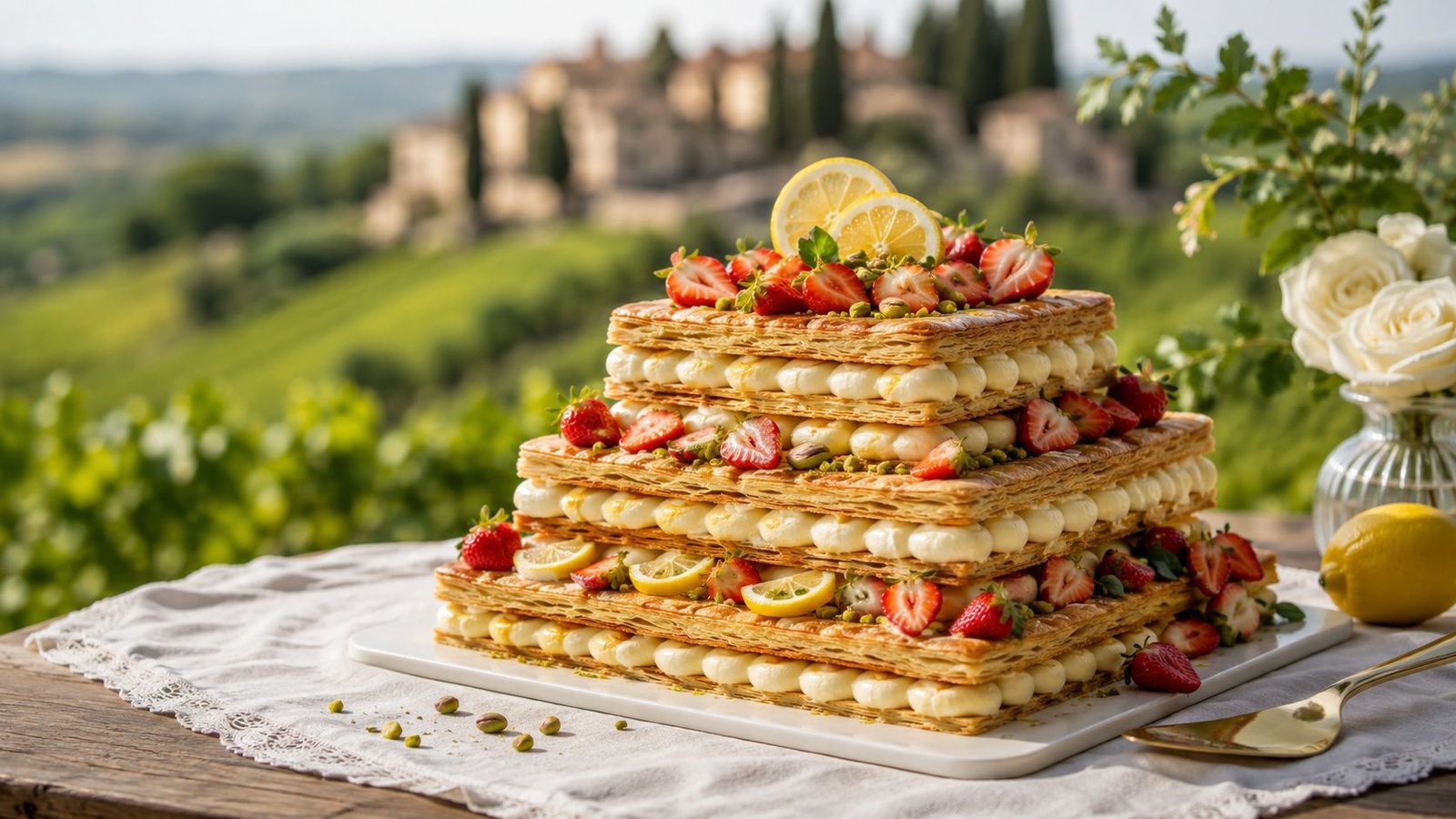
International couples planning a wedding in Italy often begin by asking about a traditional tiered cake, then quickly discover that many of the most memorable Italian receptions end in a different way. Instead of a dessert created mainly for display, they are introduced to the mille feuille wedding cake, known in Italy as the millefoglie wedding cake: a layered pastry that feels lighter, more sociable, and far more connected to the rhythm of dinner service.
This matters because a millefoglie is not simply another cake design. It changes the way dessert is presented, the way the cake-cutting moment unfolds, and the way guests experience the final course. At weddings in Italy, especially at destination celebrations in Puglia, Tuscany, and along the coast, the cake is often assembled or finished close to the moment it is served. That freshness is part of its appeal, and part of the planning.
For couples hosting a reception in a masseria, a courtyard, a historic villa, or an outdoor summer setting, a millefoglie often feels more natural than a tall fondant cake. It is elegant without being rigid. It is celebratory without feeling overly formal. It also requires the right conversations early on, not only about flavour and appearance, but also about timing, refrigeration, staffing, kitchen access, and service.
What Is a Millefoglie Wedding Cake?
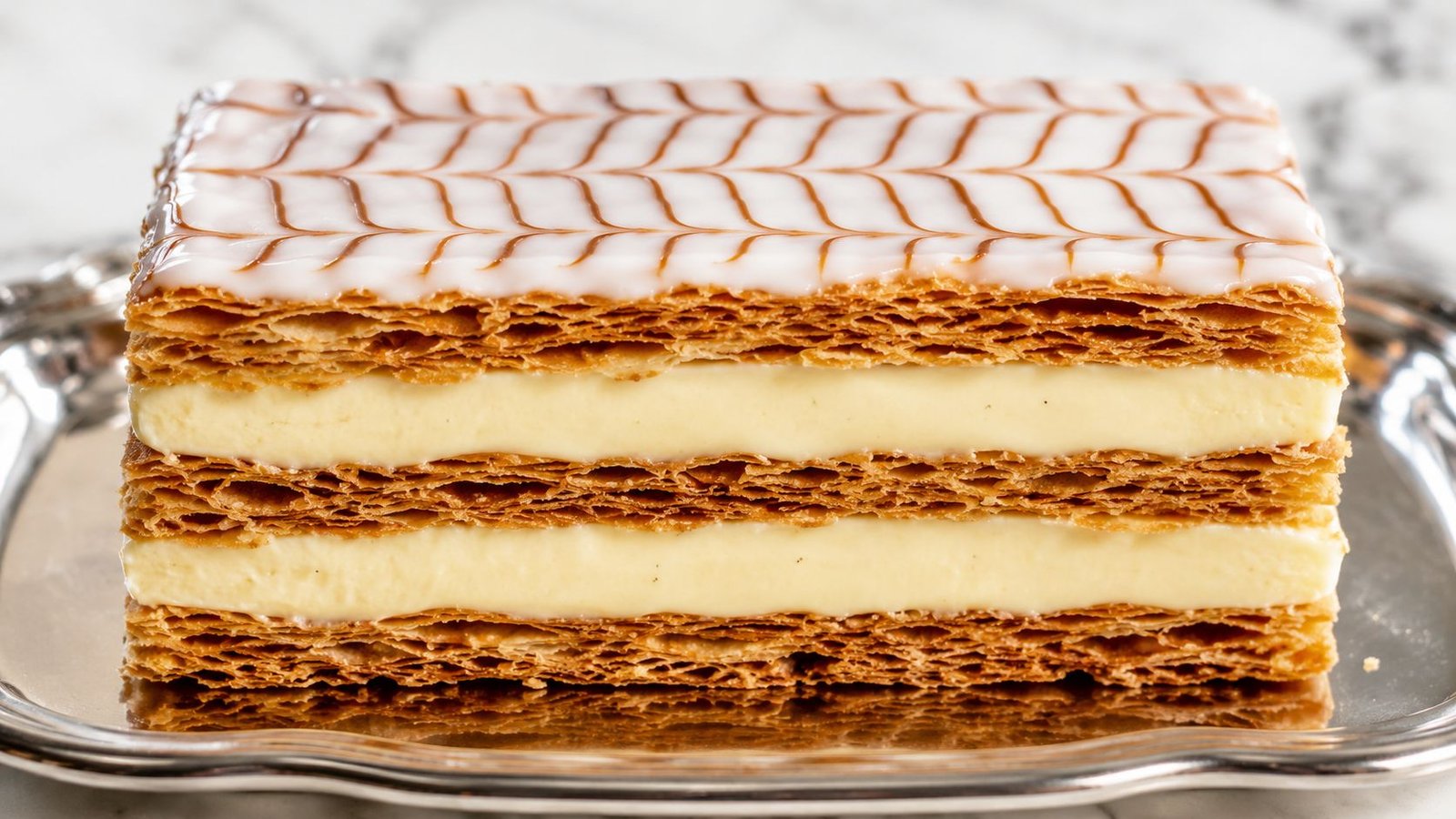
A millefoglie wedding cake is a layered pastry dessert built with crisp sheets of puff pastry and soft cream fillings, usually finished with sugar, fruit, or a light decorative flourish. Its charm lies in contrast: delicate pastry, cool cream, and a finish that can be refined or relaxed depending on the style of the reception.
At a wedding, that contrast gives the mille feuille wedding cake a very different role from a conventional tiered cake. Guests are not being served a symbolic slice of something that has spent hours on display. They are being offered a dessert that is valued for freshness, texture, and timing. In other words, it belongs to the meal as much as to the celebration.
This is one reason the millefoglie wedding cake feels so at home in Italy. It suits receptions where food is central to the atmosphere, and where the final course is expected to feel generous, elegant, and genuinely enjoyable to eat.
Mille-Feuille vs Millefoglie: What’s the Difference?
The terms are closely related, but they do not always suggest the same style of service. Mille-feuille is the French name and is often associated with a more formal patisserie presentation, with neat structure and a classic iced top. Millefoglie is the Italian term, and in the wedding context it usually refers to a more flexible, more convivial presentation that suits large celebrations particularly well. A pastry history guide explains the name and the classic layered structure.
Although couples do not need to understand professional pastry production, the crispness of millefoglie depends heavily on the quality of the laminated pastry. For readers interested in the technique behind this type of pastry, this guide to perfect croissant lamination technique offers a closer look at how laminated dough develops its characteristic layers.
The historical distinction is useful, but couples do not need a long lesson in pastry history to make a wedding decision. Mille-feuille has French roots and a well-documented patisserie tradition, while millefoglie is its familiar Italian counterpart with a strong place in celebratory dining. This historical account traces the pastry’s early documentation and later development. In Italy, what matters most is not the textbook definition but how the dessert is served: freshly finished, generously portioned, and integrated into the flow of the reception.

Why Millefoglie Works So Well at Italian Weddings
A millefoglie suits many Italian weddings because it reflects the way receptions here are often hosted. The emphasis is usually on the table, the menu, the cadence of service, and the shared pleasure of eating well. Dessert is not treated as a decorative afterthought. It is part of the hospitality.
That is why the dessert feels particularly right in settings such as masserie, vineyards, historic villas, and coastal venues. It can be polished without appearing stiff. It can be abundant without seeming heavy. And unlike a tall fondant cake, it makes sense in a context where food is expected to feel fresh, seasonal, and visibly cared for.
It is also versatile. Some couples want a single ceremonial cake-cutting moment. Others prefer several cakes, or portions plated more discreetly by the catering team. Others include millefoglie within a broader dessert offering. For readers considering how it fits into the wider sweet course, our guide to the wedding dessert buffet offers useful context.
Venue style shapes the experience more than many couples expect. A courtyard dinner under summer lights calls for a different dessert rhythm from a ballroom reception. Even examples outside Italy can be useful when thinking about how setting, layout, and service flow influence the way a cake is presented, as this overview of a Sonoma wedding venue shows.
The essential point is simple: millefoglie works best at weddings where food is part of the identity of the event, not a decorative formality at the end of it.
The Live Millefoglie Wedding Cake Experience
One of the most distinctive aspects of a mille feuille wedding cake in Italy is that it may be assembled or finished shortly before the cake-cutting moment. This is what many couples and planners informally refer to as the live millefoglie experience, and it is one of the reasons the dessert can feel so memorable at an Italian reception.
In practice, the pastry chef or catering team prepares the components in advance, then completes the final layering, finishing, or decoration close to service. Guests may see the last stage of the cake coming together, or they may simply encounter the result: a dessert that arrives fresh, crisp, and far more vivid than something prepared too far ahead.
This is not theatre for its own sake. It is tied to the nature of the dessert itself. A technical guide from Great British Chefs notes that mille-feuille is best served immediately when crispness matters, or held only briefly if necessary. The technical guidance on serving and holding explains why crispness changes so quickly. Another recipe source also notes that while refrigeration is possible, texture changes over time, which is why many teams prefer to prepare fillings ahead and complete assembly on the day. The serving guidance highlights the importance of refrigeration and prompt presentation.
At weddings, this creates a very particular atmosphere. The cake-cutting is no longer only a staged photograph. It becomes part of the service itself. In some receptions, the final touches happen in view of guests, often with berries, powdered sugar, cream, or decorative details added just before the couple cuts the cake. It introduces anticipation, but in a way that still feels culinary rather than performative.
For destination couples, this is one of the most useful things to understand early in the planning process. A live millefoglie requires coordination between pastry chef, caterer, planner, and venue. The team needs to agree on where the final finishing will happen, how the cake reaches the cake table, how long it can remain there before cutting, and how quickly portions will then be plated and served.
This is also why the dessert is so well suited to Italian weddings that place hospitality at the centre. Rather than separating the cake from the meal, the live millefoglie folds the final course into the social life of the evening. It can mark the transition from dinner to music and dancing with far more warmth than a conventional display cake ever could.
Popular Millefoglie Styles and Flavours
The most successful millefoglie wedding cakes usually feel appropriate to the season, the setting, and the menu that came before them. They are generally lighter in spirit than heavily frosted cakes, and they benefit from fillings and finishes that bring freshness as well as richness.
Classic combinations often feature pastry cream with strawberries or mixed berries. The balance works for a reason: cream offers familiarity, fruit adds brightness, and the overall result feels festive without becoming overly rich. Pistachio cream, especially with raspberries or other red fruit, is another favourite in Italy, appreciated for its depth and for the way it can feel more regionally expressive.
For coastal or summer receptions, lemon-based versions often sit beautifully within the wider menu. Citrus notes can feel especially right after a meal built around seafood, vegetables, olive oil, and lighter southern flavours. Chocolate and hazelnut variations are more at home in evening receptions or cooler-season celebrations, where a fuller finish can feel more in keeping with the tone of the event.
The visual approach can vary just as much as the flavours. Some couples prefer the classic iced top associated with traditional mille-feuille. Others opt for a softer Italian presentation with powdered sugar, berries, edible flowers, or a finish that feels slightly more relaxed and table-centred. Neither approach is inherently better. The right choice depends on the wider aesthetic of the wedding and on whether the cake should feel precise and graphic or generous and convivial.
Regional flavour can also make the dessert feel more rooted in place. Couples planning a southern Italian celebration may find inspiration in local ingredients and the broader language of the menu. Our article on Puglian cuisine and its flavors, traditions, and scents can be a useful starting point when thinking beyond generic fruit combinations.
Planning Millefoglie for a Summer Wedding in Italy
Summer is when many destination weddings in Italy are at their most atmospheric, and also when a millefoglie asks for the most thoughtful planning. Heat is only part of the question. Outdoor movement, distance between the kitchen and the reception area, humidity, late dinner timings, and the overall schedule of the evening all affect how successfully the cake will be presented.
This matters especially in southern Italy, where receptions often unfold outdoors across several spaces. The cake that appears effortless on the table may depend on a carefully managed sequence behind the scenes. The pastry chef needs an appropriate preparation area. The venue needs reliable refrigeration. The caterer needs a clear plating plan. The planner needs to ensure that the cake-cutting moment is timed around the dessert at its best, not simply inserted wherever the programme has a gap.
Humidity deserves particular attention, especially near the coast. Because millefoglie depends on crisp pastry for part of its appeal, it is less forgiving than desserts intended for prolonged display. That does not make it unsuitable for summer. It simply means the final assembly and presentation should be treated as an operational decision, not a decorative afterthought.
Couples choosing an outdoor wedding should therefore ask practical questions early. Is there a cool room or protected preparation area for finishing the cake? Is the route from kitchen to courtyard straightforward? Will portions be plated immediately after cutting? Is the service team experienced with a dessert that benefits from prompt presentation? The answers to these questions often determine whether the millefoglie feels effortless or unnecessarily difficult.
Millefoglie Wedding Cakes in Puglia
Puglia is one of the most natural settings for a millefoglie wedding cake, not only because of its food culture but because of the way many weddings are hosted here. Masserie and private estates often centre the reception around long outdoor dining, generous service, and menus that feel grounded in the region. In that context, millefoglie makes immediate sense.
It suits the architecture of a stone courtyard. It works beautifully on a dedicated cake table styled with ceramics, fruit, and restrained florals. It also reflects a distinctly Italian understanding of dessert, one that values freshness and visible preparation over height and ornament alone.
At the same time, Puglia rewards good logistical planning. Many receptions move between aperitivo areas, courtyards, lawns, and dance spaces. The distance between the working kitchen and the cake-cutting location can be considerable. Some venues are excellent at plated desserts but less naturally suited to last-minute pastry finishing. Others handle this style of service extremely well, provided the timing is built into the event from the beginning.
This is where wider catering decisions become especially important. Our guide to choosing wedding catering in Puglia helps place the cake within the broader realities of staffing, kitchen access, ingredient quality, and service flow.
For couples still comparing venues, the right property is not only visually appealing. It should support the style of hospitality they want to create. A well-equipped masseria can be particularly suited to this style of service when the kitchen, preparation area and cake-cutting location are planned together.
Serving and Guest Numbers
Guest numbers are one of the first practical questions couples ask about a mille feuille wedding cake, and rightly so. But unlike a conventional tiered cake, millefoglie is not best planned through generic online formulas. The right quantity depends on the guest count, the style of construction, the service format, and the wider dessert offering.
A single ceremonial cake may work perfectly for one reception and be impractical for another. Several smaller cakes may suit a larger event, or a venue with separate service points, far better. In some cases, individual portions are the most elegant and efficient solution, especially when the catering team wants consistent plating and a smooth service rhythm across many tables.
The wider menu matters too. If the reception includes a dessert buffet, fruit, petit fours, or additional pastries, the role of the millefoglie changes. It may remain the main cake-cutting dessert, or become one element within a broader final course. This is why quantities should always be calculated by the pastry chef or caterer in direct relation to the guest list and the service plan, not by a universal chart.
Rather than asking for a standard size guide, couples should ask their team to recommend the most suitable format for the reception. An experienced pastry chef or caterer will think not only about how many portions are needed, but about how the dessert will actually be cut, plated, moved, and served on the night.
Questions to Ask Your Caterer or Pastry Chef
A millefoglie wedding cake is at its best when the practical discussion is as clear as the aesthetic one. Before confirming the design, couples should ask:
- Has the pastry team handled wedding-scale millefoglie service before?
- Will the cake be assembled fully in advance, or finished close to service?
- Where will the final assembly or finishing take place?
- Does the venue have suitable refrigeration and preparation space?
- How far is the cake table from the kitchen?
- Who is responsible for transporting, cutting, plating, and serving the cake?
- Would one large cake or several smaller cakes make more sense for the reception flow?
- Will the millefoglie be the only dessert, or part of a wider sweet offering?
- Which flavours are most appropriate for the season and setting?
These questions are especially important for destination weddings, where couples may assume the cake simply arrives ready-made. At its best, millefoglie rarely works in such a simplified way. It rewards timing, coordination, and a team that understands how to preserve texture while still creating a graceful public moment.
Final Planning Advice
The appeal of a mille feuille wedding cake in Italy is not only visual. It is experiential. Chosen well, it brings together pastry craft, service rhythm, and the relaxed sophistication that define many Italian celebrations.
It is also a choice that rewards realism. Couples should not treat millefoglie as a standard wedding cake in different clothing. It has different strengths and different practical needs. The best results come when the dessert is planned in conversation with the venue, the caterer, the pastry chef, and the schedule of the evening.
For weddings in Puglia, that usually means thinking carefully about courtyards, summer service, kitchen access, refrigeration, and the timing of the cake-cutting moment. It also means embracing what makes the dessert compelling in the first place: freshness, conviviality, and a sense that the final course belongs naturally to the celebration around it.
For couples considering a wedding in southern Italy, Princess Apulia® can help coordinate the venue, catering, timing, and local insight that a millefoglie wedding cake deserves. Explore more at Princess Apulia®.