
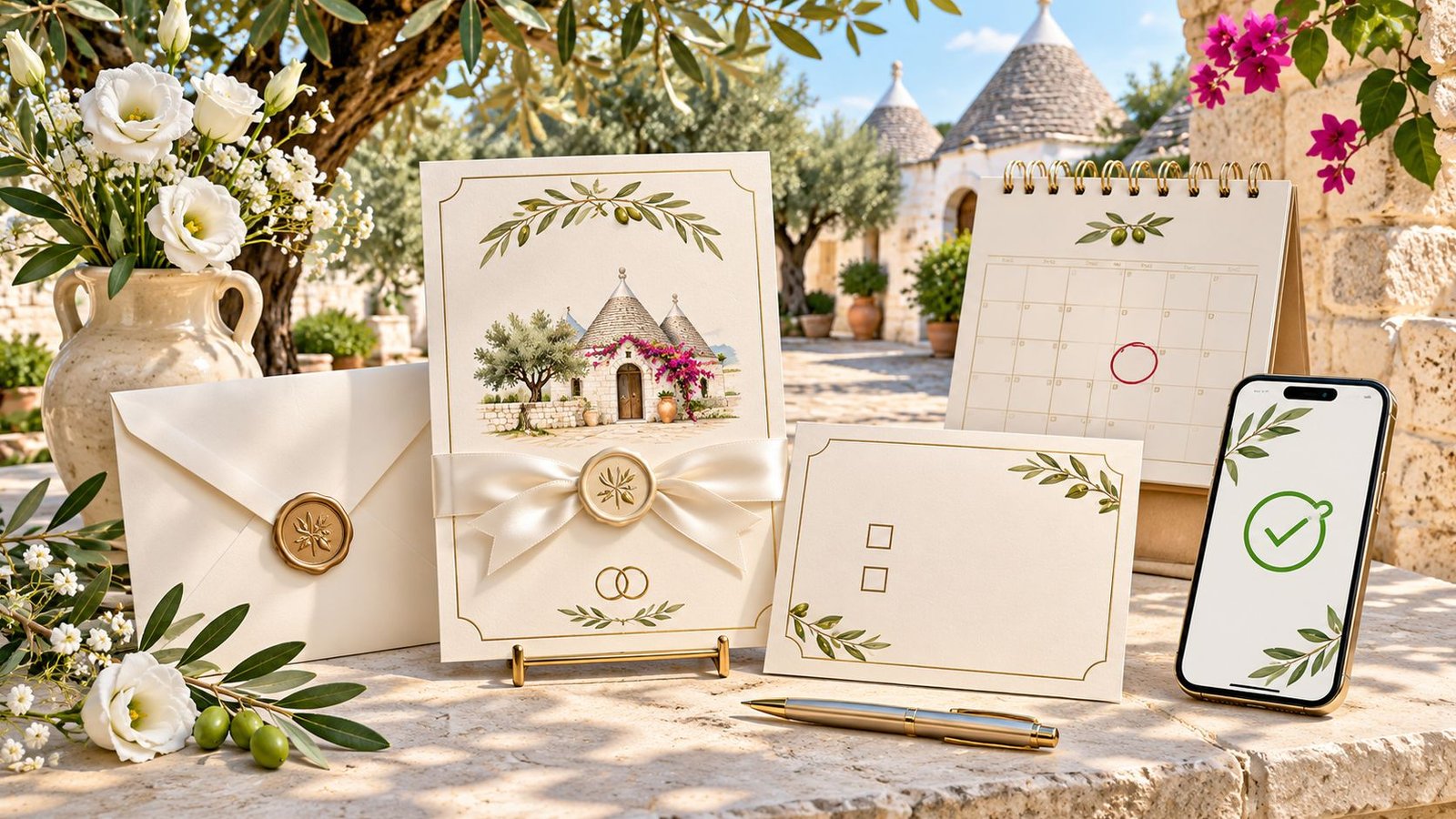
Which reply would a couple planning a wedding in Puglia rather receive: a prompt yes from a guest who will spend the next year paying for flights and four nights in a masseria, or an early, unambiguous no that frees a seat, a room and a place at the welcome dinner?
Conventional wedding etiquette RSVP advice answers a narrower question. It tells guests to reply quickly and tells couples to set a deadline, as though the only real risk were an envelope arriving after the seating plan has gone to print. A destination wedding changes the arithmetic. The reply is a decision about money, annual leave, passports and several days away from home, and the honesty of that decision matters at least as much as its speed.
The etiquette itself is old and uncomplicated. Applying it to a celebration that stretches across a weekend, draws guests from several countries and is often planned from abroad takes a little more thought.
Why the RSVP Still Matters for a Wedding in Italy
RSVP comes from the French phrase "Répondez s'il vous plaît," which means "please reply." The courtesy is old; the function is operational. A host who knows the number can plan seating, catering, drinks, transport and the shape of the reception, which is why Emily Post's wedding etiquette guidance treats the reply as a social contract rather than a nicety.
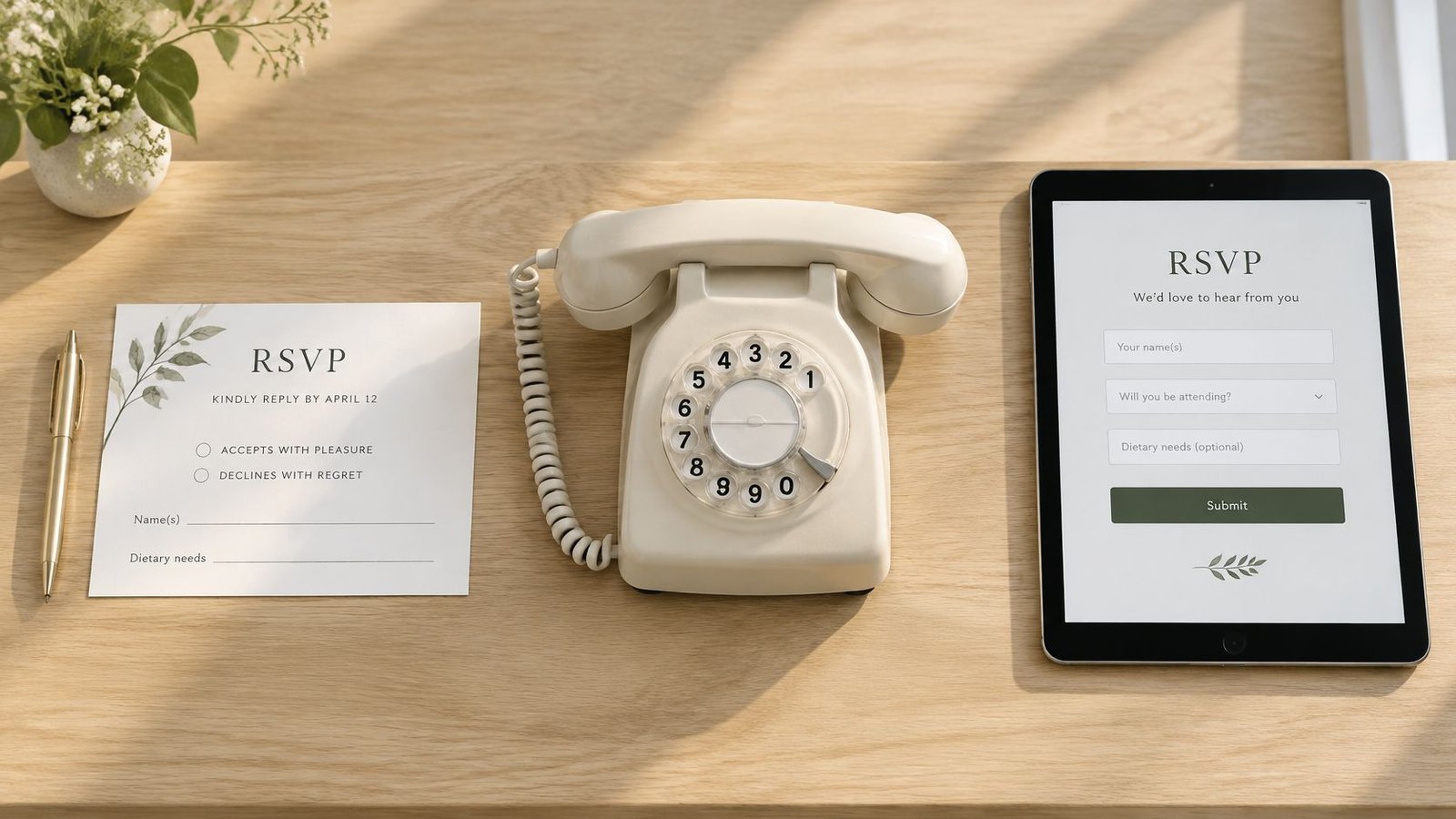
Guests answer by the method the couple asks for. An enclosed reply card goes back in its envelope. A listed telephone number means a conversation with the host, not a message passed along secondhand. An email address or online form means an electronic reply. The common thread is that the guest uses the route offered rather than the one that happens to be easier.
The timing expectation is just as clear. Emily Post advises replying within a day or two of the invitation arriving, and never later than the stated deadline. That holds whether the answer is yes or no. Silence isn't a soft refusal or a placeholder for maybe; it leaves the couple guessing at the one number they can't guess.
A reply is a promise. The couple reserves the chair, orders the meal and books the seat on the coach because of it.
In Puglia that promise carries more weight than it does for a single afternoon in a local church. Wedding weekends usually run across several days, with a welcome dinner, the ceremony and a farewell brunch, and guests arrive on different flights. Room blocks, transfers and per-event catering all move with the count. A guest who accepts and later can't come should say so as soon as the position changes, which gives the couple room to adjust supplier numbers instead of absorbing the cost of a chair nobody sits in.
Get the sequence right and the rest follows: dates, then channels, then the details that move a count, then the two cases couples dread, a decline and a silence.
Working Backwards From the Wedding Date to Set RSVP Deadlines
A reply date is the point where a couple stops collecting intentions and starts committing money. Set it by working backwards from the wedding and the deadlines suppliers give you, rather than choosing a date because it looks neat on an invitation.
For a standard invitation, common etiquette guidance places mailing about six to eight weeks before the ceremony. Guests travelling from abroad may need more time to arrange flights, accommodation, passports, time off work and childcare. The reply date generally falls at least two to three weeks before the wedding. That interval gives the couple time to organise catering and seating, while leaving guests a clear window to decide. The reference entry on wedding invitations describes the same sequence: sending the invitation, receiving replies and confirming final numbers with the venue are separate steps, each with its own deadline.
Destination weddings can make attendance a more considered decision. Travel costs and a schedule that includes several events may affect whether a guest can say yes. A clearly stated deadline, paired with a considerate invitation, gives guests space to decide and gives the couple a more useful count.
Three dates, not one
- The mailing date. For a wedding with local guests, send invitations six to eight weeks ahead. Allow longer for a destination wedding, since arranging flights, leave and childcare takes time. A wedding weekend with a welcome dinner and farewell brunch also asks guests to plan for more than the ceremony itself.
- The reply-by date. Set it at least two to three weeks before the wedding, or about a month ahead if the schedule allows. Guests need a firm date by which to confirm their plans. For a destination celebration, set it with travel and accommodation decisions in mind.
- The confirmation date with the venue and suppliers. Contract terms determine these cut-offs, which may differ between suppliers. Ask each one to confirm its deadline in writing when the contract is signed. A caterer's final count and a hotel's room block may need attention on different dates, so the couple should not treat the guest reply deadline as the only date that matters.
What the response pattern tells you about timing
Replies tend to arrive in waves, not at an even pace. RSVPify's event data reports that 57.6% of responses arrive within the first five weeks after invitations are sent, that the busiest single week is week three, and that roughly half of replies arrive by about four and a half weeks. The response-timing figures from RSVPify suggest why sending invitations with enough lead time matters: the main wave of replies needs to arrive while there is still time to follow up and prepare supplier counts.
| Milestone | Typical timing | Source |
|---|---|---|
| Invitation mailed | About 6 to 8 weeks before the ceremony, earlier for destination guests | Common etiquette guidance |
| Reply-by date | At least 2 to 3 weeks before the wedding, or about one month if the schedule allows | Common etiquette guidance |
| Response pattern | 57.6% of replies within five weeks of sending, peak in week three | RSVPify event data |
| Guest reply | Within a day or two of receiving the invitation, no later than the deadline | Emily Post guidance |
| Final numbers to suppliers | Set by each venue or supplier contract, so confirm the date in writing at booking | Venue and supplier contracts |
For a broader view of how invitations and replies fit into the planning calendar, use this wedding checklist by month to place those dates alongside venue bookings, tastings and supplier confirmations.
Collecting Replies by Card, Phone or Digital Form
The channel a couple chooses decides how clean the record will be, and no single route suits every guest on an international list.
Three reply routes exist, and the case for keeping more than one of them open is stronger than it looks.

| Route | Best suited to | Record kept | Points to watch |
|---|---|---|---|
| Printed reply card | Guests who prefer paper and invitations to the reception | Physical card returned in its envelope | Not normally used for ceremony-only invitations |
| Telephone | Invitations that list a number | Host hears the answer directly and has to write it down | Time zones for international guests |
| Email or online form | Guests who work digitally | Time-stamped electronic record | Avoid forcing account creation and offer a human fallback |
Why a hybrid system protects the count
The printed card remains the quietest option. It suits guests who like paper, and it's normally issued with reception invitations rather than ceremony-only ones, because its job is to deliver an accurate reception count. The telephone works for invitations that list a number, where the guest speaks to the host directly, though it's also the easiest route to lose: whoever takes the call has to write the answer down and pass it on.
Digital replies leave a time-stamped record and cost nothing to send, and they've stopped being an edge case. In the wedding survey data cited by Aisle's guide to how wedding RSVPs work, 8% of couples used digital-only RSVPs and 19% offered both printed and digital options. The practical question isn't whether an online reply is polite. It's whether the system works for a guest who isn't confident online, lives in another time zone or is invited to only part of the weekend.
Keep at least one human fallback. A telephone number, an email address or a planner's contact beside a mobile-friendly form stops technology from deciding who gets counted, and skipping account creation removes the most common reason an older guest abandons a form halfway through.
Give every event its own field. A welcome dinner, a ceremony and a farewell brunch can carry different capacities, costs and levels of formality, so the weekend shouldn't be presented as one indivisible yes or no.
For international guests, state the time zone attached to the deadline, prepare reminder wording in a second language where the list calls for it, and explain how to change an answer before the cut-off.
Couples weighing printed suites against digital ones will find the wording and paper questions covered in this guide to wedding invitations in Italy.
Choose one primary channel, print it on every invitation and label the alternatives clearly. An unclear route is one of the simplest ways to lose a reply.
Handling Plus-Ones, Children and Dietary Information
A guest list rarely goes wrong because somebody replied late. It goes wrong because the invitation left the party size open to interpretation, and the couple discovers the gap when the caterer asks for a final number.
A plus-one is a decision the couple makes in advance and states on the invitation or the reply card. The invitation names the people it covers, and the reply confirms every person in the party, not only the one who opened the envelope. A guest who assumes an extra place exists is usually acting in good faith, which is exactly why the wording has to remove the guesswork rather than rely on it.
The rule that prevents most errors: an invitation should name every person it covers, and a reply should confirm every person attending, event by event.
Children, and why the wording matters
Whether children are invited, which events they attend and how the reply should name them all belong in the same sentence. A child can change a seat, a meal and a place on a transfer, so a reply that says "we'll see" leaves three counts open at once. If children are welcome at the welcome dinner but not at the ceremony, say so plainly. Guests rarely take offence at a clear rule and often take offence at a rule they were expected to infer.
Dietary information belongs to the meal, not the personality
Ask about allergies and dietary needs in a question tied to the meal, and keep them separate from preferences. An open line reading "please note any allergies or dietary requirements" gathers what the kitchen needs without asking guests to choose between labels that may be unfamiliar to them. State the date by which the caterer needs those details, because it usually falls before the reply date rather than on it.
Four things belong on every reply: each named guest confirmed, each event accepted or declined, dietary needs stated, and any assistance with travel requested. Wording that closes those four questions is worth more than a dozen reminders later.
How to Decline Gracefully When Travel Costs Matter
A guest weighing a four-day trip to Puglia is running numbers that the couple should respect. Accepting an invitation means agreeing to the travel and events involved, and guests need room to decide whether those commitments fit their budget.

The costs can be substantial. NerdWallet's research on wedding guest travel puts average estimated lodging and transportation at $1,989 for guests attending a wedding that requires an overnight stay, and found that 46% name travel costs as a major consideration when deciding whether to attend. NerdWallet also reported that 57% of respondents in a separate 2025 survey had declined, or expected to decline, a destination wedding because travel and accommodation were too expensive. A 2024 Bank of America survey reported by CNBC found that 56% of Americans would decline a close friend's or family member's wedding invitation if they couldn't afford to attend.
Making the no easy to say
Clarify which events are optional and what the couple is hosting, so guests can estimate the full cost rather than guess. Share realistic accommodation ranges and transport information. Clear expectations about the hotel guest experience at destination weddings can also help guests understand what to expect during their stay.
Give guests a private way to decline because of cost, without asking them to itemise their finances. Set a travel decision date before the formal RSVP deadline for those who need to book flights early. The earlier a guest can say no, the more accurately the couple can plan the guest count and event arrangements.
A kind decline option treats the RSVP as consent to the time, travel and expense involved. Avoid language that equates attendance with loyalty. A guest who cannot afford the journey and says so early gives the couple a clearer count, without having to explain personal finances. When the invitation makes "no" an acceptable answer, guests have a straightforward way to reply.
Late Replies, Changed Plans and Follow-Ups
The morning after the reply date, some names still have no answer. The problem here is process, and the fix is a fixed order of steps. A blank reply works like an unconfirmed restaurant booking: the place stays held until someone has spoken to the guest. Silence is not a decision, and it is not a no.
- Sort the list the day the deadline passes. Three columns: confirmed, declined, outstanding. Guests in the third column are unknown, not absent, and no caterer should be told otherwise until someone has spoken to them.
- Telephone the outstanding names as soon as the reply date has passed, and no later than two to three weeks before the wedding. Emily Post's guidance on taking RSVPs by phone recommends the call rather than reading silence as acceptance. For a guest still weighing flight prices, that conversation is often the first moment a kind no feels possible, which keeps the headcount honest.
- Ask for news the same day plans change. An accepted guest who can no longer travel should tell the couple immediately, because the caterer's final count may still be open and a freed place can be offered to someone else.
- Keep one master record with dates. Every addition, cancellation and meal change gets the date it was confirmed, so the number sent to suppliers matches the number the couple is working from.
- Fix a final cut-off for supplier changes. Confirm it in writing with the team running the weekend, and treat that date as the end of the exercise rather than a target to negotiate.
On a destination wedding the consequences travel further than the plate. A cancellation at the welcome dinner can empty a seat on a transfer and release a room in a block the hotel is still holding, which is why the phone call in step two is worth more than an email nobody opens.
Changed plans are ordinary. Some guests who first said yes later find they cannot attend, and plenty of replies miss the date the couple hoped for. A system built only for the tidy cases will be wrong at the moment it matters.
A follow-up that names the event and the date the answer is needed gets a faster reply than a general reminder, because it tells the guest exactly which decision is outstanding. One named question, one clear yes or no, is how a late reply turns into a guest count the couple can trust.
Confirm Your Guest List and Set Your RSVP Timeline
A guest list is not finished when the names are typed. It is finished when each name carries a reply the couple can trust, including a clear and kind way to say no.
Write down the wedding date, the expected guest count and the events each person is invited to before anyone orders stationery. A single ceremony needs one answer. A welcome dinner, a ceremony and a farewell brunch need separate ones, so a guest who can manage only part of the weekend can accept that part instead of sending a polite yes for everything. Travel cost belongs in that choice. Name an earlier date for people who must book flights, and a decline can still free a seat, a room and a plate.
Read the venue and supplier cut-offs first, then set the guest-facing reply date earlier whenever a contract deadline sits close behind it. Pick one primary channel, whether card, phone or digital form, and one person who will answer a confused guest. Plus-ones, children and meal notes go into that same policy, settled before printing.
A wedding planning timeline broken down by month sets those reply dates beside the other deadlines competing for the same weeks.
Couples planning from abroad often start with Princess Apulia® by sharing the date, the guest count and the kind of celebration they are imagining, which shows what is possible in Puglia before the list is treated as final. For larger destination weddings, Princess Apulia® recommends starting the planning 12 to 18 months in advance, so the invitation and reply dates sit inside the schedule rather than at the end of a rush.
Before you print, write the sentence a guest will act on: the date the answer is needed, the events it covers, and how to decline. If that sentence is not yet true, hold the list.