
What happens when the piece a couple loves most is right for the memory but wrong for the moment? A wedding music violin and piano programme has to answer that question before it answers any question about popularity. In Puglia and across Italy, the same melody behaves differently in a stone church, a masseria courtyard and an open seafront terrace. Reverberation, wind, guest movement and the length of a processional all change how much the piano can carry and how long the violin must sustain.
Repertoire choice works best when it begins with the point in the day. An entrance needs shape and certainty. Vows need space around the text. Cocktail hour needs music that can absorb movement without forcing attention. The first dance needs a clear emotional centre. A history of wedding music traces much of the modern ceremony repertoire to the Baroque and Romantic eras, and explains how violin and piano reduce orchestral, operatic and organ melodies into a compact chamber format that suits churches, villas and masserie.
That compact format has trade-offs. Two players can create intimacy in a courtyard, yet they cannot fill every acoustic gap the way a larger ensemble might. I would choose the programme around the venue and the hour first, then decide which familiar pieces can survive that setting without being overplayed. Couples who want words at the centre of the reception can also explore personalized first dance lyrics as a separate commission.
1. Canon in D by Johann Pachelbel (arranged for violin and piano)
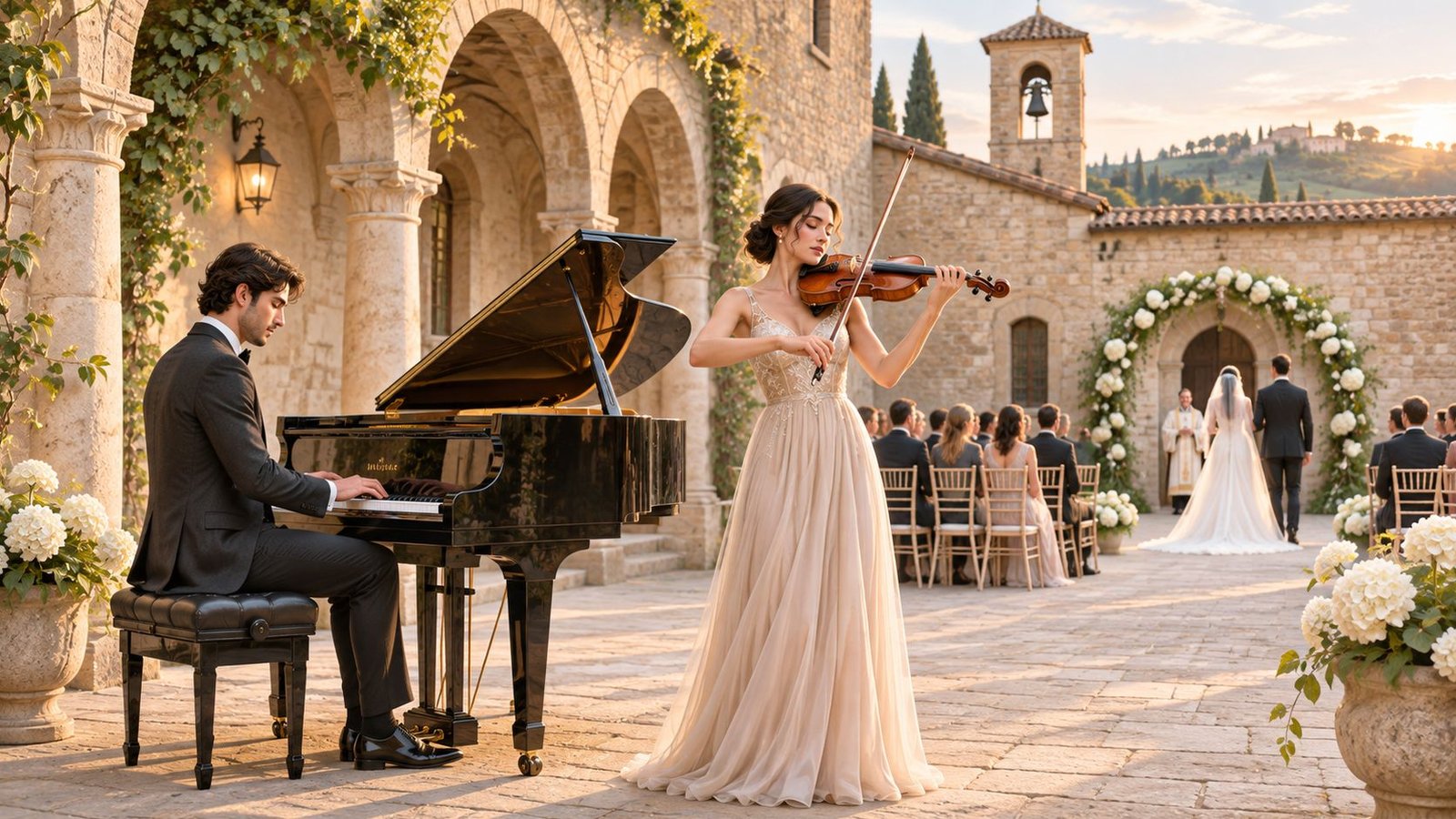
Pachelbel wrote the Canon around 1680 for three violins and basso continuo, and that scoring explains why it survives reduction so well. The repeating eight-bar bass line passes to the piano while the violin takes the entering melodic lines one at a time, so the piece builds without ever demanding volume. That cumulative shape is what makes it a processional work rather than a concert piece.
In a stone church near Ostuni or Lecce, the reverberation does half the work and the pianist can play almost nothing. In a masseria courtyard the same arrangement thins out badly, and the violinist has to sustain longer lines to keep the melody legible.
Timing the entrance
Say the bridal party enters from a side gate rather than the back of the nave. The walk is shorter than the phrase structure, so the musicians need an agreed cut point, not an improvised fade. Couples planning entrances for the whole party can map the order using this guide to bridal party songs to walk into a reception, then hand the same running order to the officiant.
Practical rule: a 2024 University of North Texas dissertation on collaborative violin and piano performance notes that the piano can drown out the violin, and recommends matching the violinist's dynamics and phrasing while avoiding excessive sustaining pedal when clarity is needed.
2. Ave Maria by Franz Schubert (arranged for violin and piano)
Schubert published the melody in 1825 within his Op. 52 as Ellens dritter Gesang, a setting of a passage from Walter Scott's The Lady of the Lake that was later fitted to the Latin liturgical text. The violin is unusually well suited to it because the line behaves like a voice: it breathes, it hesitates, it leans on a single note before moving.
That devotional association is the reason to place it carefully. It belongs at a moment of stillness, during a reading, a candle lighting or the signing, and it sits awkwardly straight after anything brisk.
Three things worth settling before the ceremony:
- Text and rite: ask the officiant whether the Latin setting or a version for violin and piano fits the ceremony, since some Italian parishes apply their own rules to non-liturgical music.
- Key and range: the transcription is often shifted to suit the violinist's register, and a lower key can leave the melody buried under the piano's left hand.
- Exact version: coverage of current wedding music trends notes that couples increasingly request specific song versions with timing mapped in advance, so name the arrangement rather than just the title.
For a worked case, consider a civil ceremony in a villa garden with a single reading of about two minutes. The duo plays the first statement and closes on the cadence, holding the remaining verses in reserve for late arrivals.
3. Ode to Joy from Symphony No. 9 by Ludwig van Beethoven (arranged for violin and piano)
The theme from the finale of the Ninth, completed in 1824, is the most reliably recognisable melody on this list for a multinational guest list. Guests arriving from several countries tend to know it, which matters when the rest of the programme leans Italian or unfamiliar.
Its problem is scale. The symphonic original is broad and slow-building, and a recessional rarely lasts long enough for that pace.
Writing the ending first
Ask the musicians to prepare a short, decisive closing phrase before rehearsing anything else. In a courtyard exit where guests immediately crowd the couple, the music has to stop cleanly rather than trail off, and a written ending is what makes the handover to the aperitivo feel intentional.
That handover is worth planning as one sequence. Reporting on wedding music trends describes couples increasingly combining live musicians with DJs, which means the recessional is often the last acoustic moment before recorded music takes over. Pairing the Beethoven with a lighter Italian piece for the drinks terrace keeps the transition from sounding like a change of event. Outdoors, the piano lid position and the violin's projection matter more than the arrangement itself, since wind carries the melody away from guests standing downwind.
4. Air on the G String by Johann Sebastian Bach (arranged for violin and piano)
The Air from the Orchestral Suite No. 3 in D major, BWV 1068, is a sustained melody over a walking bass, and it's the most useful piece here for the parts of the day nobody photographs. Guest seating, the signing of the register, the pause while a photographer repositions the family group: all of these need music that doesn't ask to be listened to.
The Air fails outdoors more often than any other piece on this list, because its whole effect depends on a quiet, even accompaniment that open air simply removes.
In an intimate chapel it needs no help at all. On a seafront terrace it usually needs a discreet microphone on the violin, with the piano left unamplified so the balance stays natural.
Budget conversations tend to start here, since seating music is the easiest section to extend or trim. Gig Heaven's classical duo listings put the average price for a classical duo, including violin and piano pairings, at $400 in 2026, with listed prices ranging from $140 to more than $900. Those are marketplace listings rather than Italian destination fees, and travel, instrument provision and overtime change the picture considerably, as this breakdown of wedding musician costs explains. Ask for a quotation that separates the musician fee from the sound package and any arrangement commissions, so an extra half hour of seating music doesn't arrive as a surprise line item.
5. Meditation from Thaïs by Jules Massenet (arranged for violin and piano)
Massenet's Méditation, the orchestral interlude from Thaïs premiered in 1894, is the most overtly emotional choice available to a violin and piano duo. It's also the one most often misused, because its arching line and rubato pull attention towards the musicians at exactly the moment a couple may want attention on their vows.
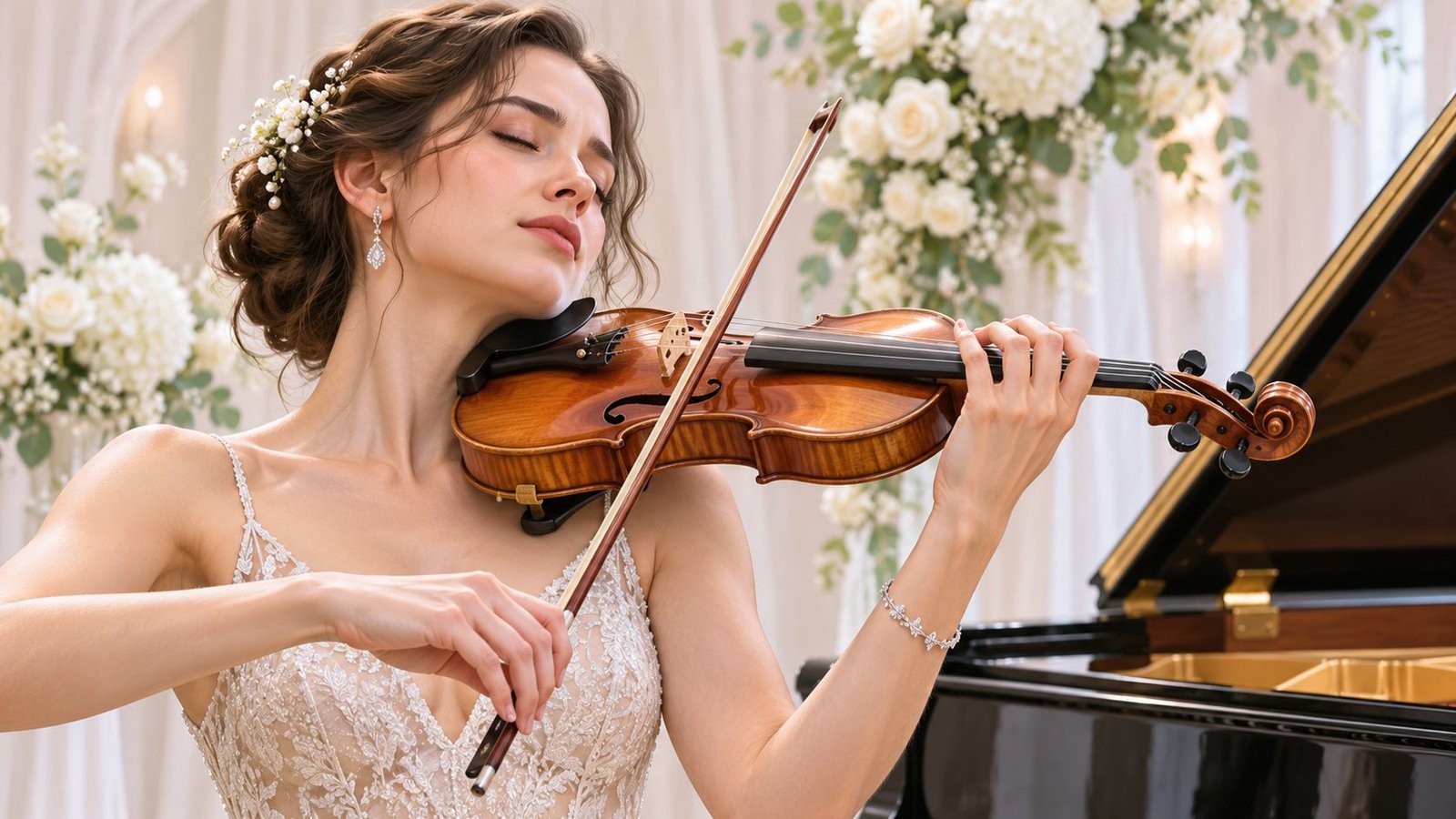
Placement solves most of it. Used as a romantic interlude before the ceremony, or as a first dance for a couple who'd rather not sway to a pop ballad, it works beautifully. Used underneath spoken vows, it competes.
Choosing the section, not the whole work
The full piece runs longer than most ceremony slots allow, so agree which portion the duo will play and where the pianist will breathe with the violinist's rubato. A worked example: for a first dance on a terrace, the duo plays the opening statement and the return of the main theme, then resolves, leaving the couple standing rather than waiting for the music to finish.
Amplification is usually necessary for that setting. DRS Music's pricing page lists a violin and piano classical duo for wedding ceremony music at $1,075 in 2026, alongside a $375 ceremony sound package, which illustrates how sound is commonly quoted as a separate item rather than folded into the performance fee.
6. Adagio from Vivaldi's Concerto in G minor, RV 315 ('L'estate')
Is there a more direct way to bring Italian music into a Puglia wedding than Vivaldi? The Adagio from L'estate gives a violin and piano duo a slow, clearly drawn line with enough melancholy to feel ceremonial without turning theatrical. In stone churches, it sits well against the natural sustain. In masseria courtyards, it keeps guests settled before the officiant or the couple's entrance. On open seafront terraces, it carries less force than a fuller Romantic piece, which can be an advantage at a quiet seating or reflective reading.
Choose the adagio over the allegro. The storm passages from the same concerto are thrilling in concert and disruptive during a processional or reading. If someone asks for "Summer", confirm the movement by describing the tempo and character: the slow Adagio for ceremony, the fast allegro for concert-style impact or a lively post-ceremony moment.
Confirm the arrangement and its duration with the musicians before the ceremony, since baroque slow movements vary in length depending on the repeats taken. For a civil ceremony in a historic masseria, the Adagio under the reading of the articles gives the officiant a calm bed of sound without covering the words. The violin should carry the melodic line, while the piano keeps the accompaniment light, especially where stone walls and vaulted rooms hold sound longer than expected.
The duo does not have to carry the whole weekend. A short account of pizzica and the tarantata tradition describes a Salento tradition built on energetic movement and rhythmic tambourine patterns, performed live at welcome parties, receptions and post-wedding celebrations. Let violin and piano hold the ceremony and aperitivo, then bring in traditional players when the evening calls for dancing. Couples weighing formats can start with this practical guide to Italian wedding musicians.
7. Pavane pour une infante défunte by Maurice Ravel (arranged for violin and piano)
Ravel composed the Pavane in 1899 and published the piano version in 1900, drawing on the slow, stately dance form. That gives the piece a formal poise without the weight of a grand operatic scene. It is the least familiar work here, and that can be an advantage for couples who want ceremony music with restraint, historical elegance and room for the setting to speak.
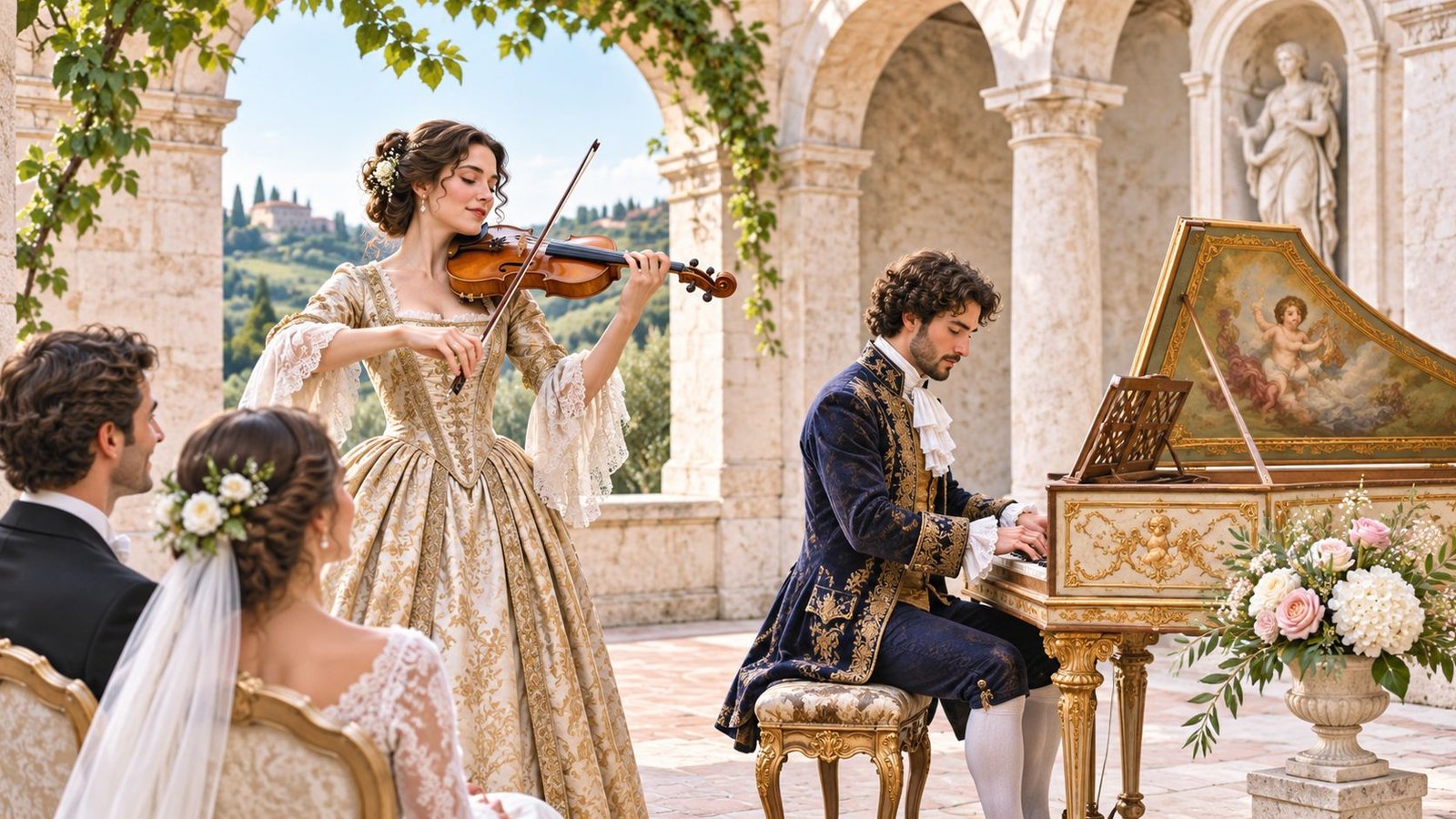
The trade-off is recognition. Guests who do not know it will hear refined music rather than an obvious cue, so it belongs in a reflective slot or a quiet cocktail-hour transition. In a stone church, its measured pulse can sit under a reading or moment of stillness. In a masseria courtyard, it needs a slower entrance and a clear pause before applause, because the open space softens attack and lets sustain do the work. On a seafront terrace, wind and conversation can flatten the line, so the violin should carry the melody without pushing into operatic volume.
A roundup of wedding music statistics estimated that approximately 30% of couples use a live singer or musician during the ceremony and cocktail hour, and noted demand for acoustic versions of popular songs. That demand needs handling with care. One or two familiar melodies among the Italian and French material make the programme feel personal. A run of cover requests makes the whole programme feel generic.
Volume discipline: the pianist should shape the accompaniment so the pavane's measured pulse stays intact, and the duo should stop while conversation is still easy rather than playing through the speeches.
How the seven pieces compare by wedding moment, setting and recognisability
The useful comparison is not which piece is most beautiful. It is how a violin and piano arrangement behaves at a specific moment, in a specific Puglian setting. Stone churches hold resonance around a slow sacred line. Masseria courtyards let melody travel outward, but also expose thin textures. Open seafront terraces give the violin air, while the piano needs shelter, placement and careful balance.
| Item | Best wedding moment | Main practical consideration | Amplification need |
|---|---|---|---|
| Canon in D by Johann Pachelbel (arranged for violin and piano) | Processional or guest seating | Familiar structure helps guests settle, while the repeating pattern can feel long in a hot courtyard | Usually acoustic indoors; consider support on a wide terrace |
| Ave Maria by Franz Schubert (arranged for violin and piano) | Reading, vows or quiet interlude | Its stillness suits contemplative moments, especially in a chapel or stone church. Place it after a pause rather than brisk entrance music | Acoustic in sacred interiors; support may be needed outdoors |
| Ode to Joy from Symphony No. 9 by Ludwig van Beethoven (arranged for violin and piano) | Recessional or celebratory exit | The theme carries immediate lift, so it works best when the doors open and the room is ready to release | Often useful outdoors, especially when guest conversation rises |
| Air on the G String by Johann Sebastian Bach (arranged for violin and piano) | Guest seating, signing or quiet reflection | The line is calm rather than declarative, so it supports arrival and transition more than a major entrance | Acoustic in intimate chapels; check projection in gardens |
| Meditation from Thaïs by Jules Massenet (arranged for violin and piano) | Interlude or first dance | Its sweeping violin line can compete with spoken vows. Give it a moment where the music is the focus | Acoustic in controlled rooms; support helps in large courtyards |
| Air from Orchestral Suite and Italian Sacred Repertoire (Vivaldi, Adagio from Concerto in G minor, RV 315, 'L'estate' excerpts) | Seating or reflective transition | Italian repertoire can give the programme a local identity, but the faster 'L'estate' material needs a clear cue and a settled room | Acoustic in small stone spaces; support depends on terrace size |
| Pavane pour une infante défunte by Maurice Ravel (arranged for violin and piano) | Reflective moment or quiet interlude | Refined and restrained, it rewards attentive listening and works better as a transition than as a ceremonial signature | Acoustic indoors; avoid exposing the piano on an open terrace |
A practical rule: match the piece to the room before matching it to the emotion. A church can carry a sacred association with dignity. A courtyard can carry a processional well, but only if the timing leaves space for guests to stand, settle and listen. On the coast, wind and conversation change the balance faster than repertoire does.
I would keep the most recognisable melodies for moments with movement, such as seating, exits and first dances. Quieter pieces belong where the programme needs air. That gives the ceremony shape without turning seven fine works into a generic sequence of wedding classics.
Building the Programme Around the Venue and the Hour
A couple choosing violin and piano for a Puglia wedding should begin with the setting, then the hour, then the piece. A courtyard, a stone church and a seafront terrace each treat sound differently. The same violin line that feels clear in a chapel can thin out across an open terrace, while a piano that feels gentle indoors may carry too strongly during vows outside.
Test the programme against the actual ceremony layout whenever possible. Guest bodies absorb sound, stone reflects it, and a piano placed against a wall behaves differently from one turned into the space. Confirm the permitted volume, the soundcheck window, power access and the indoor fallback before booking musicians. Princess Apulia® works best with couples who value quality, trust professional guidance and want a carefully planned wedding experience rather than a purely transactional service, and that approach applies to music as much as to venue selection and suppliers. See Italy wedding venues for venue context.
For outdoor ceremonies in Puglia and elsewhere in Italy, agree the weather plan in writing. Princess Apulia® evaluates backup options, indoor spaces, covered areas and alternative timelines for outdoor weddings, and the music plan should follow whichever version of the day is running. Acoustic pianos are vulnerable to heat and humidity, so a shaded, stable position and a covered alternative matter as much as the repertoire.
Then share the final order of pieces with the ensemble, the officiant and the coordinator, with cue points rather than song titles alone. Let the music follow the ceremony timing, with each entrance, reading, vow and exit clearly marked in the running order. That shared sequence helps everyone understand when the music begins, when it pauses and when it carries the room forward, a principle that runs through this complete guide to hosting a destination wedding in Puglia.
Couples planning from abroad rarely have the chance to stand in the courtyard and hear how a violin carries across it. Full-service planning follows the project from its earliest decisions to the final guest transfer, covering venue selection, design direction, suppliers, contracts, budget oversight, accommodation, transport, production schedules and coordination of the wedding events. Send the venue, the ceremony type and the moments that matter most through the Princess Apulia planning enquiry page, and build the music brief from there.