
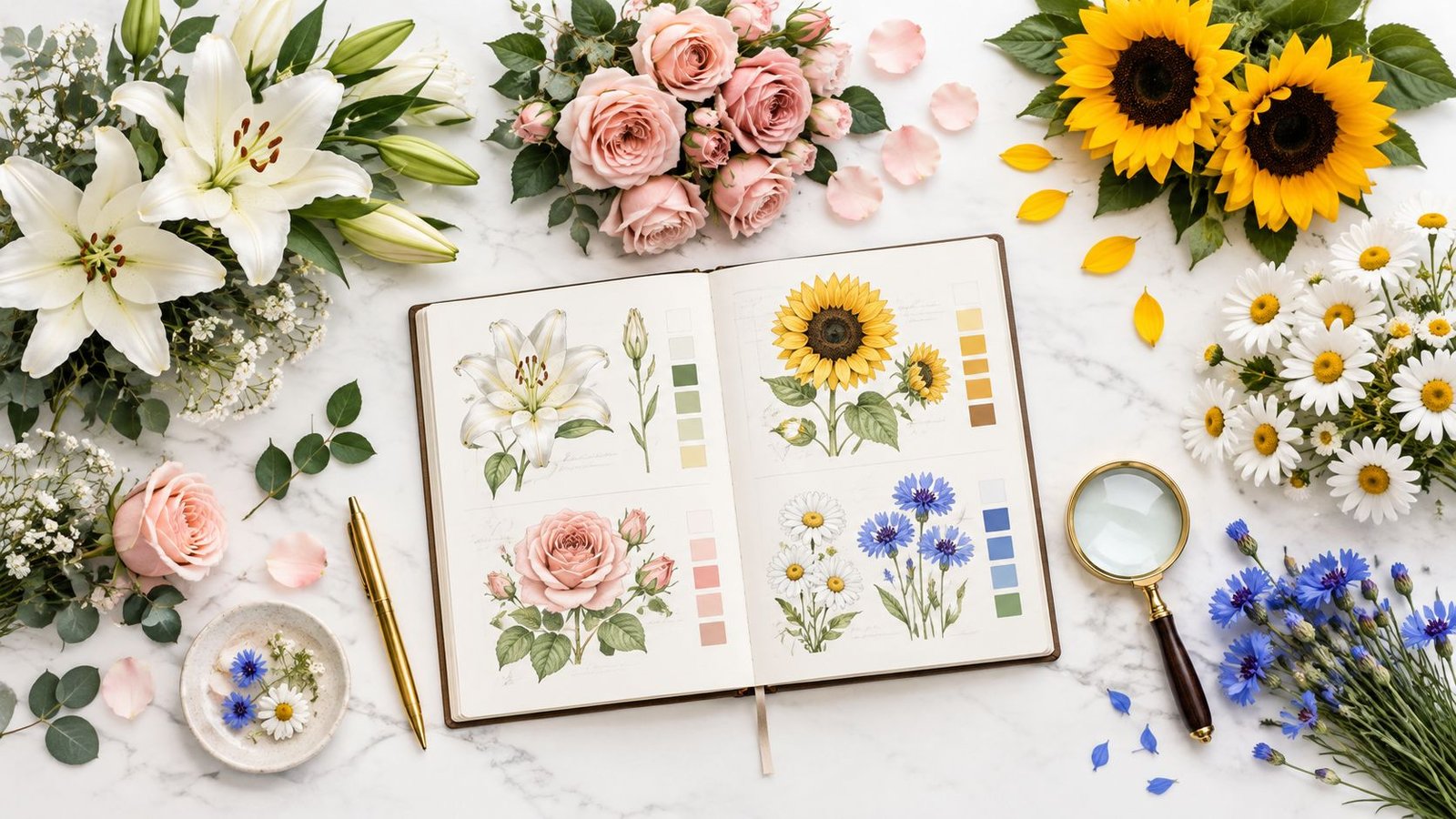
A couple planning a wedding in Puglia may know exactly what they want: white lilies for the ceremony, blush roses for the tables, perhaps a few sunflowers for the welcome dinner. Then the florist asks for the Italian names, the preferred variety, the shade, and the intended use. A translation app may produce a word, but it rarely clarifies whether that word means a personal name, a general botanical term, or a regionally specific plant.
That distinction matters. Flower Italian names belong to several overlapping worlds, including given names, everyday vocabulary, poetic symbolism, regional identity, and professional botanical identification. For an international wedding, the safest approach combines all of them, so the brief communicates not only the flower's appearance but also the exact material the florist should source.
The Communication Challenge in Italian Floristry
A florist in Puglia, Rome, or another Italian destination may understand “white lily” differently from an English-speaking couple. The Italian word giglio identifies a lily in everyday use, but a wedding brief still needs to clarify whether the couple means a Madonna lily, another lily type, an open bloom, a bud, a particular stem length, or a specific shade of white.
The same problem appears with rosa, which means rose and also functions as a traditional feminine given name. Margherita means daisy, yet it is also a familiar personal name. Iris works in both languages as a flower reference and a given name, while fiore means “flower” in general rather than identifying one species. A literal translation can therefore be grammatically correct and practically incomplete.
What can go wrong
A vague request creates several opportunities for misunderstanding:
- Common name ambiguity: One Italian term may cover several related plants or regional usages.
- Cultivar confusion: The same flower type can have different forms, colors, and commercial names.
- Pronunciation errors: English speakers may pronounce an Italian word in a way that makes it difficult for a supplier to recognize.
- False botanical confidence: A translated name can sound precise without identifying the actual species.
- Design substitution: If the requested material isn't available, a florist may suggest a visually similar replacement that changes the meaning or texture of the arrangement.
A clearer conversation starts with the Italian common name, followed by the English equivalent and a visual reference. For professional sourcing, the brief should then add the scientific name, cultivar where relevant, color, size, and intended use.
Practical rule: A translated flower name begins the conversation. It shouldn't end the specification.
This method also helps couples participate in design decisions rather than receiving a translation they can't assess. The result is especially useful for multilingual invitations, menus, escort cards, and ceremony programs, where a flower may be chosen partly for its linguistic or cultural meaning.
Essential Italian Wedding Flower Vocabulary
A florist meeting in Italy can go off course on a single word. I have seen couples ask for “lily” and mean the elegant giglio, while a supplier starts thinking about a different plant family or a church symbol. For wedding work, the useful vocabulary is not just a translation list. You need the everyday Italian name, a pronunciation you can say clearly, and enough botanical precision to avoid an expensive substitution.
Start with the category words. Fiore means “flower” and fiori means “flowers.” A florist is commonly a fioraio or fioraia. Those terms help in conversation, but wedding sourcing usually depends on the individual bloom named below.
| English Name | Italian Name | Pronunciation Guide |
|---|---|---|
| Rose | rosa | ROH-zah |
| Lily | giglio | JEE-lyoh |
| Daisy | margherita | mar-gheh-REE-tah |
| Sunflower | girasole | jee-rah-SOH-leh |
| Orchid | orchidea | or-kee-DEH-ah |
| Hydrangea | ortensia | or-TEN-see-ah |
| Violet | viola | vee-OH-lah |
| Daffodil | narciso | nar-CHEE-soh |
| Peony | peonia | peh-OH-nee-ah |
| Tulip | tulipano | too-lee-PAH-no |
| Freesia | fresia | FREH-zee-ah |
| Carnation | garofano | ga-ROH-fa-no |
These guides are approximate, not formal phonetics. Italian spelling is more regular than English, but a few sounds still catch foreign clients. In margherita, gh keeps the hard “g” before e. In giglio, the gl is a palatal sound, closer to the “lli” in “million” than to a plain English “g.” Peonia is often heard as “peh-OH-nyah,” and girasole carries the stress in the middle. If you want extra rehearsal before speaking with a supplier, use a resource designed to build Italian speaking confidence.
One more distinction matters. Some names cross into personal naming culture, which can confuse stationery wording or verbal requests. Rosa, Viola, Margherita, and Iris may refer to a flower, a person, or both depending on context. Others require botanical care because similar-looking words point to different plants. Giglio is a true lily. It should not be blurred with sound-alike terms or regional plant names.
Build the request in three parts:
- Say the Italian name.
- Add the English equivalent.
- Attach a visual and botanical reference, such as the scientific name, cultivar, color, and intended use.
That is the level of clarity suppliers can act on.
Floral Names in Italian Naming Culture
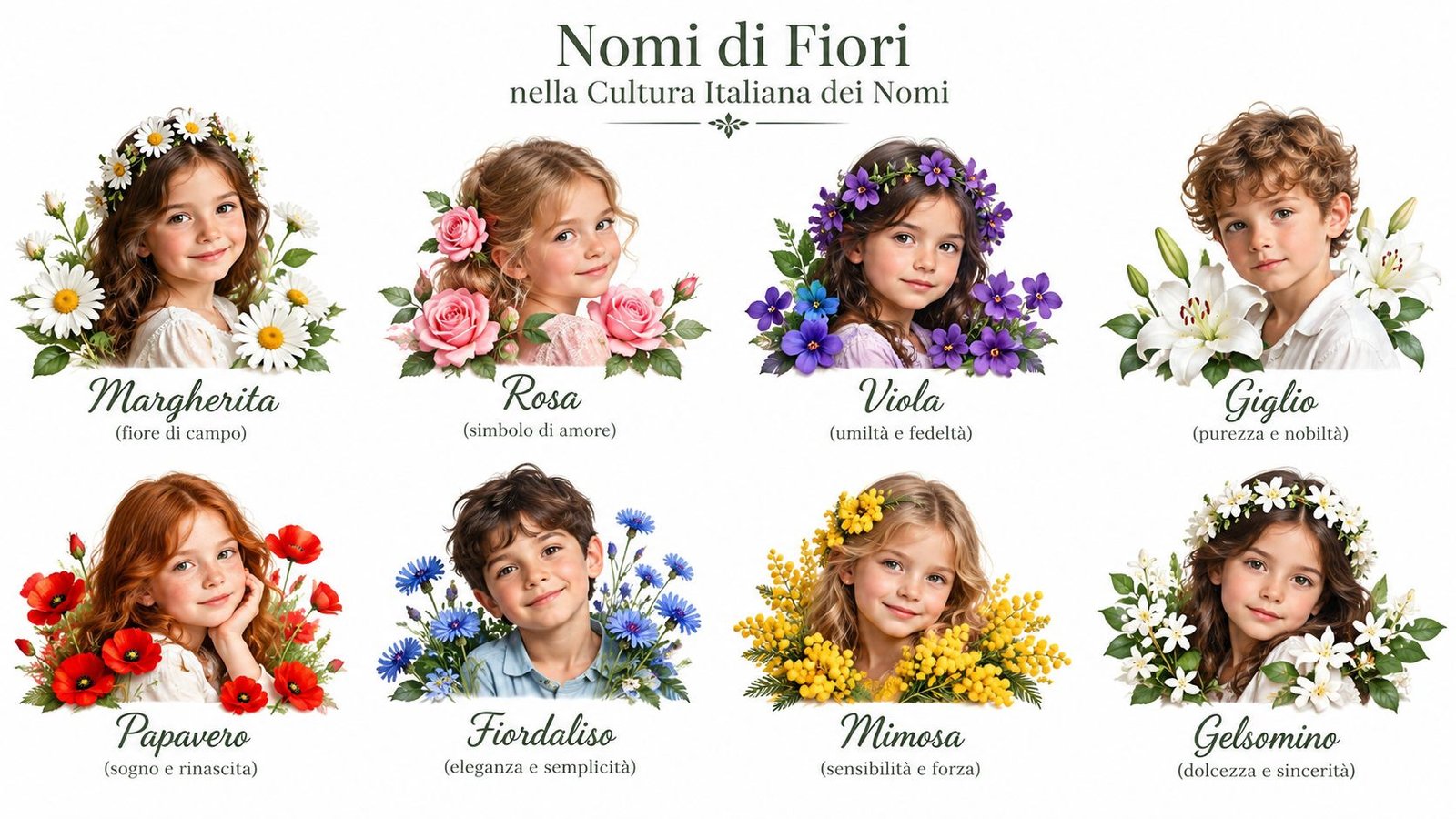
The overlap between flowers and personal names gives Italian wedding details an additional cultural layer. Viola, Margherita, Rosa, and Iris can identify a flower, a person, or both, depending on the sentence. That makes them attractive choices for stationery and favors, but it also means a designer should know whether the word is being used botanically or symbolically.
In the Italian female given-name rankings discussed by Treccani using ISTAT data for 2021, Viola ranked 33rd, Margherita 42nd, Iris 77th, Rosa 91st, and Jasmine 97th. Jasmine is the international form associated with the Italian Gelsomina. These figures show that at least five flower-associated names appeared among Italy's top 100 female given names in that dataset, rather than existing only as literary or traditional references. The rankings are reported in Treccani's discussion of flower names and Italian naming culture.
Different histories behind familiar names
Viola comes directly from the Latin name for the violet and is associated with the flower's range of colors. Margherita corresponds to the daisy and also belongs to a long Christian and European naming tradition. Rosa derives from the rose, a flower with especially broad symbolic use across Western culture.
Iris refers to the iris and connects etymologically with the Greek word for rainbow, an allusion to varied colors. Jasmine, meanwhile, reflects the Persian word yasamin and entered Italian usage partly through international forms. These histories make the names useful for more than decoration. A couple choosing one for a favor tag, a reading, or a floral motif can connect it to language, religion, classical culture, or international exchange.
The practical distinction remains important. Viola on an invitation might be a guest's name, a color reference, or a flower. Margherita on a menu could describe a daisy-inspired design, while in another context it may identify a person. Context and capitalization help English readers, but a bilingual design team should still confirm the intended meaning before printing.
Historical Roots of Italian Floral Vocabulary
Italian flower vocabulary developed alongside gardens, art, trade, and botanical study. The words used in a modern wedding brief therefore carry more than a visual meaning. They sit within a cultural history shaped by Mediterranean cultivation and by the movement of plants, names, and horticultural knowledge across political and commercial networks.
Research on Italian archives records that plants native to Crete and Greece were cultivated in Italian botanical gardens during the 15th to 17th centuries, when Crete was under Venetian rule. That history shows that Italian plant culture wasn't formed only from species growing locally. Gardens also became places where imported plants were observed, cultivated, named, and placed within new artistic and social contexts.
Renaissance gardens as visual language
The clearest evidence appears in Renaissance art. The Villa Farnesina in Rome identifies 170 species of fruits and flowers in Giovanni da Udine's fresco decoration, completed in 1518, as documented in research on Italian botanical representation. The plants signaled prosperity and love, and the selection combined Mediterranean varieties with species arriving in Europe through newly expanded connections after the discovery of the Americas. The historical account is available in this study of Renaissance plant culture and the Villa Farnesina decoration](https://www.tandfonline.com/doi/full/10.1080/11263504.2021.2013333).
That setting helps explain why flowers in Italian wedding design often operate on several levels at once. A bloom can be a color accent, a religious reference, an emblem of status, or a reminder of Italy's long relationship with cultivated terrain. Names such as rosa, iris, and margherita sound simple because they remain familiar, but their wider vocabulary grew through centuries of gardens, images, and botanical documentation.
Why this matters for a wedding
A floral concept based only on an English translation can feel generic. A concept that considers the history behind the Italian term can be more coherent. A couple might use a Renaissance-inspired palette for a historic venue, choose a daisy motif that echoes margherita, or use giglio in a ceremony where its Christian symbolism feels appropriate.
The historical approach doesn't require reproducing an old garden. It means selecting flowers with awareness of the cultural associations already present in the language. That awareness helps a wedding feel connected to Italy without relying on decorative clichés.
Regional Italian Flowers and Local Identity
Italy's floral language changes with place. A wedding in Puglia shouldn't automatically use the same botanical vocabulary or symbolic references as a celebration in Sicily, Tuscany, or the Alps. Regional associations are useful starting points, but they're cultural conventions rather than official botanical designations.
A published regional table links Abruzzo with fiordaliso, or cornflower, Puglia with geranio, or geranium, and Sicily with zagara, or orange blossom. The same framework associates Basilicata and Calabria with giglio, Campania with garofano, Liguria with bouganville, Lombardy with camelia, Marche with ortensia, Molise with primula, Piedmont with anemone, Sardinia with iris, and Tuscany with giglio. These associations are outlined in this regional guide to Italian flowers and their cultural meanings.
Comparing a standard term with a local reference
A standard Italian name is usually the safest starting point for a supplier conversation. Geranio tells a Puglian florist that the discussion concerns geranium, while zagara gives a Sicilian celebration a more specific orange-blossom vocabulary. The first is a broadly recognizable flower term; the second carries a stronger regional and sensory identity.
Symbolic associations can also influence the choice. The regional framework connects cornflower with simplicity, carnation with love and distinction, bougainvillea with welcome, hydrangea with gratitude, primrose with new beginnings, iris with courage, and orange blossom with purity or fertility. These meanings should guide editorial and design decisions, not be presented as universal rules followed identically by every Italian community.
For an international couple, regional language works best when it supports the setting rather than replacing it. In Puglia, geranio may complement a relaxed Mediterranean palette, but it shouldn't be treated as a mandatory local flower. A venue's architecture, the season, supplier availability, and the ceremony style still matter more than a symbolic chart.
A better regional brief
A useful request can read: “The wedding is in Puglia. The design should feel Mediterranean and connected to the location. Please propose geranium and other suitable seasonal materials, then confirm each flower's Italian common name, scientific name, and availability.”
That wording leaves room for professional judgment. It also prevents a regional association from becoming a rigid rule, which is important because cultivated flowers, native plants, and commercial wedding stems don't always follow the same geographic boundaries.
Professional Sourcing and Botanical Precision
Common names are useful for conversation, but they're not reliable enough for a final procurement document. Regional language varies, some names describe more than one species, and a supplier may recommend a substitute that looks similar but behaves differently in a bouquet or installation.
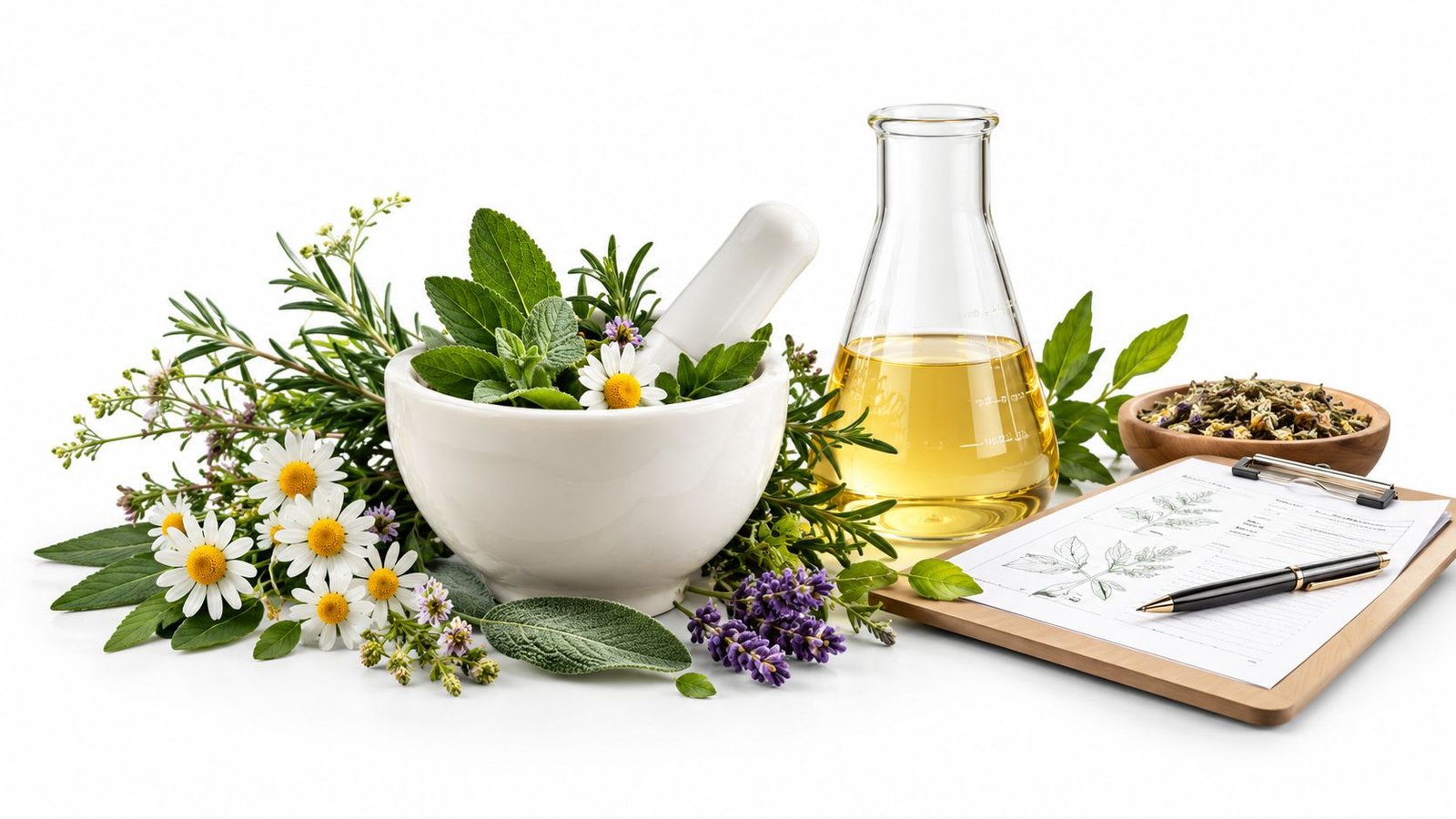
A national flora portal records accepted names for more than 11,000 taxa, and its data are periodically updated. That makes an authoritative flora database a stronger reference than a translated list when a wedding involves unusual plants, exact cultivars, toxicity concerns, seasonality, invasive status, or substitution risk. The terminology resource also distinguishes the technical meaning of fiore, the plant structure bearing reproductive organs, from everyday usage and records regional names such as gigaro for Italian arum in Apulia. Couples and planners can consult the Italian botanical terminology resource when a specification needs verification.
The five-part flower specification
A florist's brief should identify the material in a consistent order:
- Accepted scientific name. This establishes the botanical reference.
- Italian common name. This makes the request usable in local conversations.
- Cultivar, where relevant. Cultivar details can distinguish shape, color, or commercial form.
- Color and visual requirement. “White” may still need clarification about warmth, markings, or contrast.
- Intended use. State whether the flower belongs in a bouquet, ceremony installation, table design, or boutonnière.
A request for peonia, for example, is more useful when it identifies the accepted scientific name and cultivar, then states the desired color and whether the stems are intended for a bridal bouquet or a table arrangement. A request for gigaro requires even more care because a regional common name may be unfamiliar outside the area and the plant may not be appropriate for an event installation.
Supplier-ready wording: “Please confirm the accepted scientific name, Italian common name, cultivar, color, and proposed use for every non-standard flower.”
Couples can also organize a visual reference folder by arrangement rather than by flower alone. A bouquet image, ceremony image, and table image should each state which elements are essential and which can be substituted. For accessory planning, the same precision is useful when considering flower crowns for a bride at a wedding farm venue.
Sustainability and Native Italian Flora
A flower that sounds Italian isn't automatically native to Italy, locally grown, or environmentally suitable. “Italian-inspired” design can still rely on imported stems, non-native plants, or materials that don't belong in the surrounding habitat. A responsible brief separates visual style from provenance.
Official environmental data records 8,241 native vascular plant entities in Italy, including 1,702 endemic species, creating a broad botanical palette for regional and sustainable design. The figures come from official Italian biodiversity data. They don't mean that every native plant is suitable for cutting, protected-area collection, or event use. They do show why a generic list of imported wedding flowers gives an incomplete picture of Italian flora.
Design with the landscape, not against it
A sustainable floral conversation should begin with the venue and region:
- Ask about provenance: Find out whether stems are locally cultivated, imported, or collected.
- Respect habitat: Never assume wild harvesting is permitted or appropriate.
- Use seasonal logic: Select materials that suit the event period and local growing conditions.
- Protect pollinators: Discuss whether a proposed seed mix or decorative plant includes non-native species.
- Plan substitutions early: Agree on acceptable alternatives before the design is finalized.
Native and regional materials can create a stronger sense of place, especially when the venue already has olive trees, dry-stone walls, Mediterranean planting, or agricultural surroundings. The goal isn't to turn a wedding into a botanical survey. It's to avoid placing a generic imported arrangement in a setting that could support a more coherent local palette.
An olive tree can also provide structure without becoming a cut-flower substitute. Its sculptural role in the Puglian countryside is explored in this feature on the age and character of the olive tree.
The strongest approach combines cultivated wedding flowers with carefully selected local foliage and seasonal elements. That balance protects the design brief while making the surrounding setting part of the event rather than treating it as a backdrop.
Curated Selection of Popular Wedding Flowers
The most effective Italian wedding palette usually combines appearance, availability, and meaning. No single flower carries one fixed message for every couple, but certain blooms have well-established associations that can help shape the tone of a ceremony or reception.
Giglio, commonly used for lily, is particularly significant in Italian religious and visual culture. One account identifies the Madonna lily as Italy's traditional or national flower and traces its symbolism from ancient religious culture to the medieval association with the Virgin Mary and purity. Because sources differ on whether Italy has a formally designated national flower, the careful wording is “traditional” or “widely recognized cultural flower,” not a legally codified national emblem. The historical interpretation is discussed in this account of Italian flowers and their meanings.
Flowers with distinct design roles
- Rosa, rose: Suitable for romantic, formal, or restrained arrangements. Its broad Western symbolism makes it familiar to international guests, while the Italian word also connects to personal naming culture.
- Giglio, lily: A strong choice for religious ceremonies or designs focused on purity. The precise lily type should be confirmed before sourcing.
- Margherita, daisy: Brings a simpler, more pastoral character and can support a countryside setting without excessive formality.
- Iris: Offers a connection to color, the Greek rainbow association, and the regional identity linked with Sardinia in some cultural frameworks.
- Girasole, sunflower: Creates an energetic Mediterranean impression, but its scale and direction need to be considered in relation to table settings and sightlines.
- Orchidea, orchid: Provides a refined, architectural shape. The Italian name is feminine in everyday grammatical usage, a detail that can matter in language-focused stationery.
- Zagara, orange blossom: Particularly resonant for Sicily and for celebrations that want a fragrant, regional reference, with symbolism often connected to purity and fertility.
- Garofano, carnation: Can feel traditional or contemporary depending on color and composition, and regional associations connect it with love and distinction.
A meaningful palette doesn't require every flower to carry a symbolic explanation. Two or three deliberate references are usually more convincing than a crowded arrangement in which every stem has a separate message. The couple's venue, ceremony type, and guest experience should determine which meanings deserve emphasis.
For couples considering an Italian spring celebration, a broader seasonal starting point appears in this guide to the most beautiful flowers for a spring wedding. If flowers must travel as part of a highly managed luxury itinerary, logistics should be confirmed with the aviation and event teams before attempting to arrange flowers on a charter flight, since temperature, handling, security, and customs requirements can affect what is practical.
The final brief should leave room for professional substitutions while protecting the design's essential character. Specify the flowers that carry the meaning, the colors that define the palette, and the forms that make the arrangement recognizable. Everything else can remain flexible enough for an Italian florist to source responsibly and accurately.
Couples planning a wedding in Puglia can turn this vocabulary into a precise floral brief before speaking with local suppliers. Princess Apulia® can help connect the language, location, seasonal design, and guest experience into a coherent destination wedding plan. Explore wedding planning in Puglia and begin with the flowers that express the setting, not just the translation.